
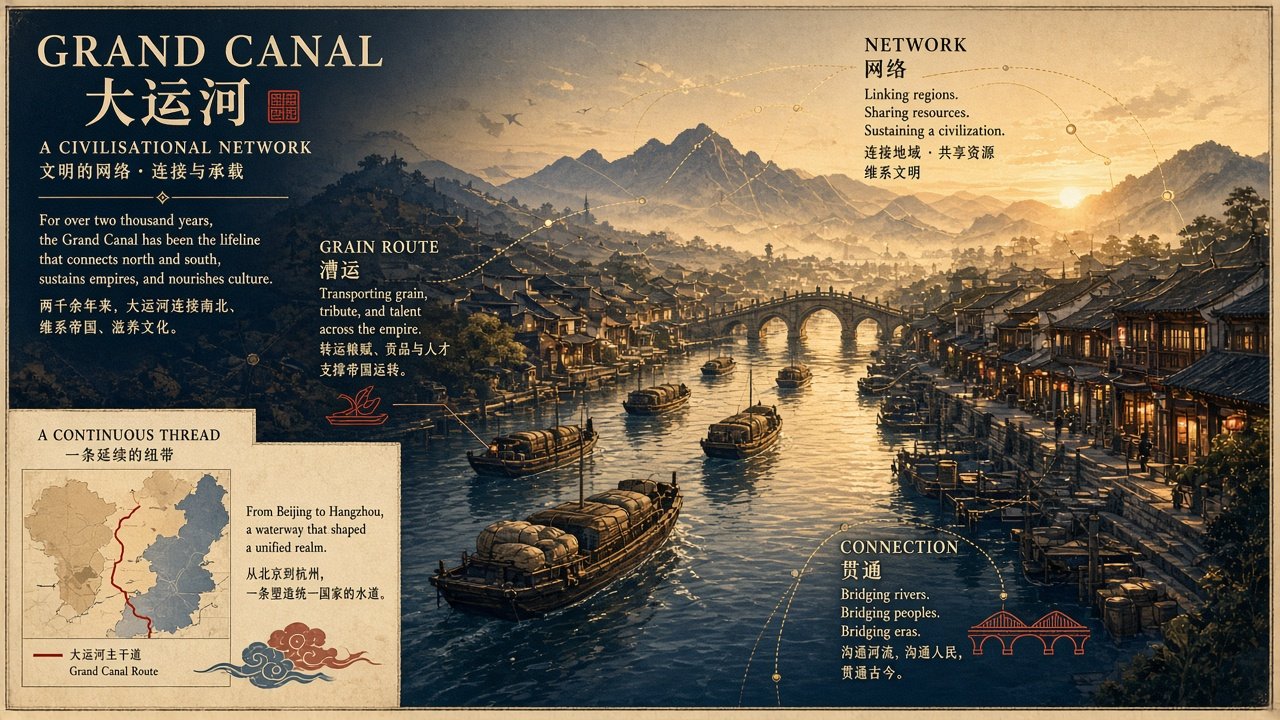
Western accounts of Chinese power still reach first for walls, emperors, and armies. Those things mattered. They also miss something quieter and more durable. For more than a thousand years, China kept binding a continental civilisation together with water. The Grand Canal was not a scenic ditch. It was a working network: grain, salt, officials, soldiers, ideas, and credit moving on a schedule the state could partially control. If you want to understand how China thinks about infrastructure today, the canal is a better starting point than another lecture about Confucius or another snapshot of a Shenzhen skyline.
The lazy story says China was landlocked in spirit until the twentieth century forced it open. That story collapses the moment you look at the canal. From the Sui dynasty onward, and especially under later dynasties that expanded and repaired it, the waterway linked the productive south to the political north. Rice from the Yangtze basin fed capitals that could not feed themselves. Tax grain became political stability. Political stability became the precondition for markets, armies, and administration on a scale few other premodern states could sustain. The canal did not merely transport calories. It transported the possibility of a unified state across a geography that otherwise pulls apart.
That matters because infrastructure is never only engineering. It is a theory of society made concrete. A wall says: keep threats out. A canal says: keep the centre supplied, keep the provinces connected, keep distance from becoming disintegration. Chinese statecraft has returned to that second idea again and again, sometimes brilliantly, sometimes wastefully, sometimes both at once. High speed rail, expressways, ports, power lines, digital payment rails, and logistics parks all sit in a family resemblance with the canal. They are bets that connectivity compounds, that scale rewards whoever reduces friction first, and that a civilisation of this size cannot be governed as a collection of disconnected localities.
The engineering itself was extraordinary by any historical standard. Sections had to cross watersheds, manage floods, deal with silting, and survive wars and neglect. Locks, reservoirs, embankments, and feeder rivers turned a chain of local water problems into one national system. Maintaining that system required not only labour but institutions: grain transport offices, local magistrates under pressure, contractors, boatmen, and the constant politics of who paid for repairs. When the system worked, it looked almost invisible, the way good infrastructure always does. When it failed, capitals starved, rebellions found oxygen, and historians later wrote as if destiny rather than dredging had decided the outcome.
Foreign observers often noticed the spectacle and missed the logic. Early modern European travellers marvelled at boat traffic and crowd density, then returned home with exotic sketches. What they were seeing was an industrial metabolism before the word industry meant factories. Specialised boat communities, riverside markets, and warehouse towns formed a commercial ecology along the route. Merchants did not need to invent modern capitalism to understand inventory, timing, credit, and route risk. They lived those problems every day. The canal made China look, to careful eyes, less like a sealed empire and more like a continental marketplace with a state perched on top of it.
None of this should be romanticised. Canal labour could be brutal. Corvée obligations crushed households. Flood control failures killed people in numbers that still chill the reader. Dynasties extracted grain with a ruthlessness that looks, in retrospect, like a standing tax on the south for the comfort of the north. The network that held China together also organised inequality. That double character is important. Chinese infrastructure success is often narrated abroad as proof of benevolent planning or as proof of authoritarian excess. Usually it has been both: capacity and coercion braided together. The honest analysis holds both threads without collapsing into either cartoon.
The decline of the canal’s old role is also instructive. Railways, coastal steamships, and later trucks and aircraft rearranged China’s circulatory system. The political centre no longer depended on the same grain fleets in the same way. Sections silted. Towns that had lived on transit traffic lost their purpose. Heritage tourism later rediscovered the romance while the economic centre of gravity moved to coastal manufacturing and global shipping. Yet the underlying instinct did not vanish. If anything, modern China has become more canal minded than ever, only now the canals are steel, fibre, voltage, and containers.
Consider high speed rail. Critics abroad often ask whether every line pays for itself in narrow accounting terms. That is a fair question for any project. It is also an incomplete one if the historical analogy is the Grand Canal. The canal was never only a profit centre. It was a platform for state capacity and market integration. High speed rail likewise compresses time between cities, thickens labour markets, makes weekend industrial ecosystems possible, and teaches contractors and ministries how to deliver complex projects repeatedly. Learning by doing at national scale is itself an asset. China has been unusually willing to pay for that asset up front and argue about the balance sheet later. Whether every bet was wise is debatable. That the bet belongs to a deep tradition is not.
The same pattern appears in electricity. Ultra high voltage transmission lines moving power from west to east are, in spirit, another canal: move surplus from where it is produced to where it is consumed, keep the system whole, refuse to let geography dictate fragmentation. Ports and logistics hubs do the same for goods. Digital platforms do it for payments and information, with all the political hazards that implies. Once you see the canal as a template, a surprising amount of contemporary Chinese development stops looking like a sudden invention of the reform era and starts looking like a technological update of an old civilisational habit.
There is a strategic lesson here for outsiders who still treat Chinese infrastructure as either miracle or mirage. Miracles ignore the corpses under the embankments and the wasted projects. Mirages ignore the compounding knowledge that comes from building, failing, repairing, and building again for centuries. The Grand Canal survives in the modern imagination less as a single waterway than as a proof of concept: China can organise matter across immense distances when political will, engineering skill, and economic necessity align. That proof of concept now expresses itself in batteries, ships, factories, and data centres. The medium changes. The appetite for connection does not.
It also changes how we should read Chinese rhetoric about connectivity. Belt and Road speeches, Eurasian rail ambitions, port investments abroad, and domestic integration campaigns are not merely propaganda themes invented last Tuesday. They resonate because they sound familiar inside China’s own historical memory. A state that once fed Beijing with southern rice through inland waterways is not starting from zero when it talks about corridors and hubs. Scepticism toward any particular project remains healthy. Amnesia about the longer pattern does not.
What, then, should a careful reader take from the canal today?
First, judge Chinese systems by trajectories and networks, not by isolated monuments. A single bridge can be a vanity object. A network that moves food, power, people, and goods at continental scale is a different kind of fact.
Second, expect tradeoffs. Connection creates wealth and vulnerability together. It concentrates power. It disciplines localities. It can rescue a capital and exhaust a province in the same century.
Third, stop treating China’s modern infrastructure boom as historically orphaned. The reform era mattered enormously. Foreign capital, export markets, and late twentieth century technology mattered enormously. So did an older readiness to treat earth, water, and distance as problems the state must solve rather than conditions it must accept.
Walk a surviving stretch of the Grand Canal now and you may see tourists, parks, and cleaned up waterfronts. That surface can fool you into thinking the story is finished, filed under heritage. Look longer and the water starts to rhyme with rail viaducts, container cranes, converter stations, and the relentless Chinese preference for stitching places together until the map behaves. Empires fall. Dynasties rename themselves. The question underneath keeps returning: how do you keep a vast country from coming apart in space and time?
China’s answer, again and again, has been to build the network first and argue about the metaphysics later. The Grand Canal was an early, muddy, magnificent version of that answer. The twenty first century versions are cleaner, faster, and more contested. They are not, in the deepest sense, new.