
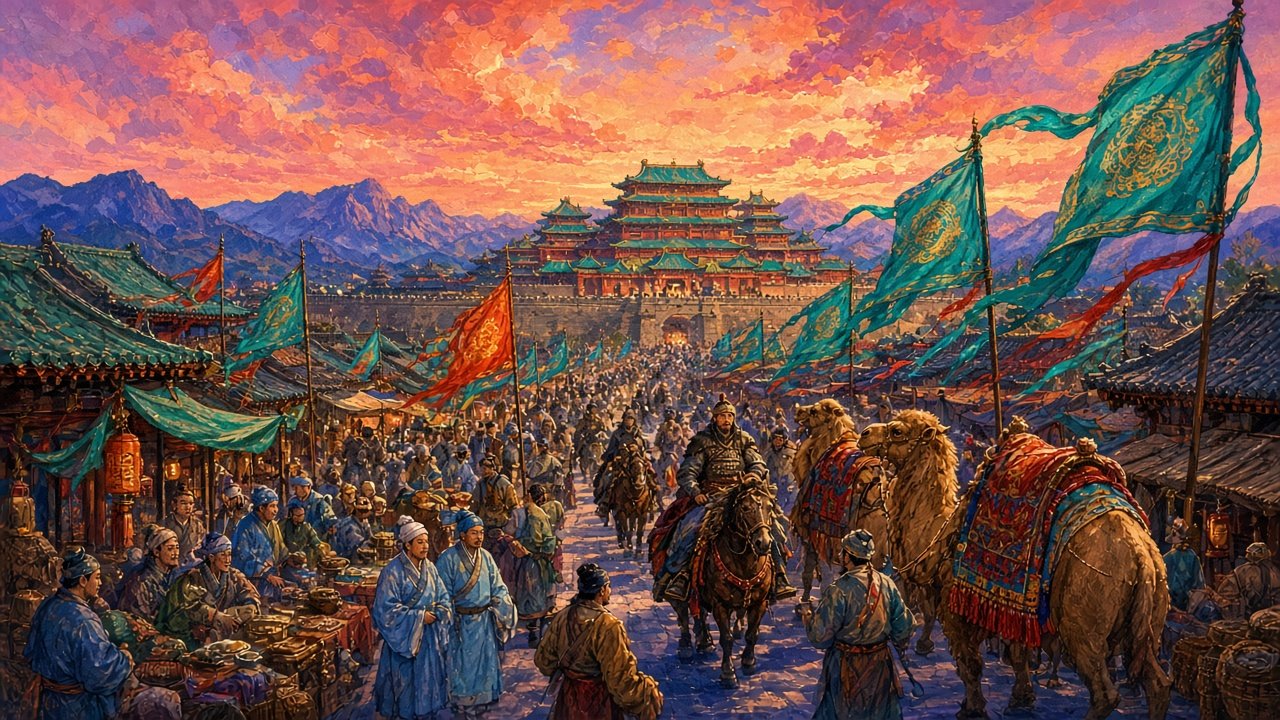
Western textbooks still treat the Yuan as a foreign interruption: Mongols rode in, Chinese civilisation paused, Ming restored the script. That story flatters a tidy national timeline and misses what actually happened. From 1271 to 1368, China was not sealed off from the world. It sat at the eastern hinge of a Eurasian political system that moved people, goods, techniques, and ideas on a scale few earlier empires could match. The Yuan’s legacy is not a footnote to Song glory or a prelude to Ming revival. It is one of the hinges on which early global history turns.
The lazy version of Chinese history likes clean dynastic beads on a string. Qin, Han, Tang, Song, then a blank labelled “Mongols,” then Ming and Qing. The blank is doing ideological work. It protects a fantasy of uninterrupted Chineseness and turns a century of Eurasian entanglement into an embarrassing parenthesis. Serious history cannot afford that comfort. The Yuan was a Chinese dynasty that also belonged to a Mongol imperial family of states. Hold both facts at once and the period stops looking like an accident. It starts looking like a structural transformation.
Call it the Pax Mongolica if you like, but keep both edges of the phrase. Conquest was real, and so was coercion. Populations were displaced; cities were broken; the human cost of Mongol expansion across Eurasia was enormous. At the same time, the Mongol imperial order lowered certain frictions across a continental corridor linking China to Central Asia, Persia, and, for a while, the edges of Europe. Merchants, doctors, astronomers, craftsmen, and envoys moved along routes that earlier politics had made intermittent. Silk, porcelain, and paper technologies travelled west. Medical knowledge, astronomical methods, and administrative practices travelled east. The Yuan court in Dadu was not a museum of steppe nostalgia. It was an experiment in ruling a dense agrarian civilisation while remaining plugged into a wider Mongol world.
That double identity matters because later politics keeps misreading it. Nationalist narratives want the Yuan to be alien occupation. World-history narratives sometimes want it to be a frictionless Silk Road utopia. Neither cartoon survives contact with the sources. Chinese institutions, languages, and fiscal systems did not vanish under Kublai Khan. Mongol political habits, multi-ethnic staffing, and continental horizons did not vanish when Chinese officials wrote memorials. The productive tension between those modes shaped court culture, military organisation, and the geography of power. Beijing’s later career as a capital sits inside that story. So does the habit, still visible in Chinese statecraft, of thinking about connectivity as a strategic asset rather than a scenic extra.
Kublai’s decision to rule from the North China plain was not a mere logistical convenience. It re-centred the political map. Dadu, the city that would become Beijing, was designed as an imperial machine: walls, avenues, markets, granaries, and ceremonial space arranged to make a multiethnic empire look governable. Capitals are arguments in stone. Dadu argued that the Mongol ruling house could inhabit Chinese state forms without surrendering the claim to a wider Eurasian kingship. That argument did not persuade everyone. It did not need to. It only needed to organise enough grain, soldiers, clerks, and rituals to keep the machine running.
Grain and water tell the institutional story more honestly than court portraits. Feeding a northern capital from southern surplus demanded transport systems that earlier dynasties had already begun and that the Yuan had to keep alive under new pressures. Canal repair, river control, and coastal shipping were not romantic heritage projects. They were regime survival. When the circulatory system clogged, politics panicked. When it flowed, the court could afford cosmopolitan display. Infrastructure was the quiet constitution of Yuan power, just as it would later be for regimes that pretended the Mongol century had never happened.
Commerce under the Yuan was not a romantic caravan postcard. It was logistics under imperfect security. Paper money experiments, postal relay stations, and maritime trade through ports such as Quanzhou expanded the circulatory system of the empire. The ortoq partnerships that linked merchants to Mongol patrons were messy, privileged, and often resented. They also reveal a governing instinct: treat long-distance trade as a revenue and intelligence resource, not as a private hobby of coastal families. Foreign observers noticed densities of traffic that looked, to them, extraordinary. What they were seeing was an early form of continental market integration: specialised traders, credit across distance, and a state interested in the revenues that movement produced.
Maritime China deserves equal billing with the overland romance. Quanzhou and other ports tied Fujian and the southeast coast into Indian Ocean and Southeast Asian circuits that long outlived the dynasty. Ceramics, textiles, and shipborne credit did not wait for modern steam to invent Chinese overseas commerce. The Yuan period thickened those connections under a polity that, for all its violence inland, could also recognise the fiscal value of the sea. Later Ming maritime bans and reopenings make more sense when you remember that the coastal world had already learned how profitable outward facing trade could be. The overseas Chinese story does not begin in the nineteenth century treaty ports. Its deeper grammar includes these earlier circuits of movement, risk, and remittance.
Culture followed the roads without becoming a simple import catalogue. Persian and Central Asian specialists worked in Yuan scientific and administrative settings. Chinese painting, drama, and ceramics absorbed new patrons, new audiences, and new motifs without dissolving into foreign copies. Yuan drama in particular shows a society processing status anxiety, legal violence, and social mobility through popular forms that later Chinese literary history could not ignore. Islam, Buddhism, Christianity, and local cults all found niches in a polity that, for reasons of governance as much as theology, often preferred management to monopoly. The result was not multicultural harmony in the modern sense. It was a hard-edged pluralism organised by hierarchy, law, and force.
Hierarchy is the part polite Silk Road stories prefer to skip. Yuan legal and status classifications ranked populations in ways that privileged Mongols and certain allies while constraining others. Chinese elites remembered the humiliation for centuries. That memory was politically useful to the Ming and emotionally durable in literati culture. It is also incomplete if it becomes the whole story. Empires classify people because classification is a tool of rule. The Yuan used that tool bluntly. Later Chinese empires used other tools, sometimes softer in language and just as hard in practice. The point is not moral equivalence. The point is to stop treating Mongol hierarchy as the only moment Chinese history ever organised inequality by ethnicity and conquest.
Science and technique are where Eurasian entanglement becomes concrete. Astronomical collaboration, medical exchange, cartographic ambition, and military technology all moved through Mongol-era networks. Gunpowder knowledge did not travel because poets wished it so. It travelled because wars, artisans, and courts created pathways. The same is true for textile designs, foodways, and administrative paperwork. Globalisation before the word existed was not gentle. It was a by-product of imperial logistics. That is precisely why it matters for understanding later centuries: modern globalisation still rides on power, routes, and standards, even when the branding insists otherwise.
The Ming overthrow in 1368 did not erase the Mongol century. Early Ming rulers inherited problems, maps, and ambitions shaped by Yuan precedents. Recent scholarship has been blunt about this. Ming imperial vision did not spring fully formed from a sealed Chinese essence. It renegotiated Mongol scale, military institutions, and claims over continental East Asia, sometimes loudly rejecting the Yuan while quietly learning from it. Dynastic propaganda needed a rupture. Institutional reality preferred a complicated succession. The early Ming court hunted legitimacy in Confucian restoration language and still operated in a world the Mongols had enlarged.
That enlargement shows up in frontier policy, capital geography, and the stubborn Chinese habit of treating logistics as high politics. If you want to understand why later Chinese states keep returning to big-infrastructure thinking and multi-frontier security, the Yuan-Ming hinge is more useful than another sermon about timeless continuity. Continuity exists. So does rupture. The honest account is braided. The Yuan forced Chinese political society to administer a larger, more plural, more connective field than Song elites had preferred. The Ming reasserted cultural confidence without fully shrinking that field back to a nostalgic dream of closed agrarian virtue.
There is a darker Eurasian legacy too. The same corridors that carried silk and ideas also carried pathogens. Long-distance mobility helped disease travel with brutal efficiency. Celebration of connectivity without that ledger is incomplete. The Yuan world shows what every later globalisation episode repeats: speed compounds wealth and risk together. China’s contemporary debates about openness, supply chains, and strategic autonomy rhyme with that older pattern more than national mythmakers usually admit. Routes that enrich can also transmit shock. Courts that prize circulation must also manage contagion, panic, and blame.
Environmental pressure sharpened the late Yuan crisis. Floods, droughts, epidemic disease, fiscal strain, and local rebellion braided into a legitimacy collapse. Mongol rule did not fall only because Chinese nationalism magically awakened. It fell because the logistical and political machine that had made Dadu possible began to fail under cumulative stress. Rebels and rival strongmen offered alternative protection rackets. The Red Turbans and the eventual Ming founder operated inside that wreckage. Moral narratives of national liberation came later, polished by victors. The structural story is colder and more useful: when the grain does not move and the waters do not obey, empires look temporary.
Historiography itself is part of the Yuan legacy. The Ming compiled the Yuan dynastic history and, in doing so, helped convert a Eurasian imperial experience into a Chinese dynastic chapter. That editorial act was not neutral. It domesticated the Mongol century for a Sinocentric archive. Modern Chinese nationalism and modern Western world history have both fought over what to do with the leftovers. One side underplays Eurasian entanglement. The other sometimes overplays Mongol cosmopolitanism until conquest becomes a lifestyle brand. The better path is harder. Read the Yuan as Chinese history and as world history at the same time, without letting either frame cancel the other.
Comparative empire thinking helps. The Yuan belongs beside other conquest regimes that governed dense agrarian societies with Inner Asian military cores. It also belongs beside maritime commercial moments that tied China to Southeast Asia and the Indian Ocean. Those comparisons do not flatten difference. They stop Chinese history from being narrated as a unique sealed essence interrupted only by foreigners. China has been porous, predatory, inventive, defensive, open, and closed in different combinations across time. The Yuan is one of the clearest demonstrations that porosity and power can coexist.
For readers watching contemporary China, the usable past is not a set of costume dramas. It is a set of problems. How does a large state manage plurality without losing coherence? How does it extract revenue from trade without being captured by merchant coalitions? How does it secure frontiers that are simultaneously land corridors and maritime horizons? How does it tell a national story that can survive contact with archives showing deep foreign entanglement? The Yuan did not solve those problems for all time. It staged them early, under extreme conditions, and left later governments to pretend the staging had been a temporary nightmare.
So what should a reader take from the Yuan today? First, stop treating Mongol rule in China as a blank between two “real” dynasties. Second, notice how Chinese history has always been entangled with Central and West Asia when politics allowed the roads to work. Third, see infrastructure and circulation as political theory made concrete, not as technocratic afterthoughts. Fourth, keep the moral ledger honest: connectivity produced brilliance and catastrophe in the same century. The Yuan did not invent Chinese civilisation. It did something rarer. It forced that civilisation to operate, for a century, as a node in a genuinely Eurasian system.
The overseas Chinese story begins, in part, in these older circuits of movement. Merchants and migrants who later stitched Southeast Asian ports to Fujian and Guangdong were not inventing mobility from nothing. They were working inside a longer memory of Chinese participation in wide maritime and overland networks. Remittance cultures, dialect associations, temple networks, and trading diasporas all have ancestors older than the steamship. The Yuan did not create the diaspora. It did help normalise the idea that China’s economic life could face outward without ceasing to be Chinese. That idea never really left. It still structures family strategies from Penang to Vancouver, even when the people living those strategies have never heard the word Dadu.
If huaxia.click has a beat, it is this refusal of the sealed-China illusion. The Yuan is foundational to that refusal. A civilisation that once administered Eurasian scale under Mongol emperors, then reworked that inheritance under Ming and Qing rule, then again under modern revolution and reform, is not a civilisation whose only plot is isolation interrupted by the Opium War. The nineteenth century matters. So does the thirteenth. Readers who start the clock too late will keep being surprised by Chinese capacity, Chinese trauma, and Chinese ambition. The Yuan is where some of that surprise should have been retired centuries ago.