
Western memory of the Opium Wars often stops at Canton factories, opium chests, and a few coastal bombardments. Chinese memory does not. For China, the decisive humiliation of the mid nineteenth century is not only the first war of the 1840s. It is the second: the Anglo French expedition that forced its way to Peking in 1860, burned the Old Summer Palace, and made the Qing court ratify unequal treaties under the shadow of foreign guns outside the capital. The siege language that later generations used for that campaign is less a technical description of trenches and more a political fact. The empire’s centre had become reachable. That is the wound that still shapes Chinese readings of Western power.
The Second Opium War, fought mainly between 1856 and 1860, grew out of unfinished business from the Treaty of Nanking and the new appetites of British and French commerce and diplomacy. Britain wanted fuller access, legalised opium trade on terms favourable to its merchants, a resident minister in Peking, and the end of the old Canton system’s remaining humiliations. France joined with its own grievances and Catholic missionary interests. The Arrow incident of 1856, a legal and flag dispute that imperial historians later inflated into a casus belli, was less a sudden spark than a convenient match. What followed was a war of coastal forts, treaty drafts, broken ratifications, and finally a northern campaign aimed at the political heart of the Qing state.
The 1858 Treaties of Tientsin already pointed toward a new order: more treaty ports, inland travel for foreigners, missionary protections, indemnities, and diplomatic residence in the capital. The Xianfeng Emperor’s court resisted the meaning of those clauses even when paper had been signed. In 1859, when British and French envoys tried to proceed to Peking for ratification by the route they preferred, Qing forces at the Taku Forts bloodied the allied attempt. That reverse mattered. It convinced London and Paris that coastal pressure alone might not discipline a dynasty that could still fight at the Hai River mouth. The next expedition would be heavier, better supplied, and aimed past the forts toward Peking itself.
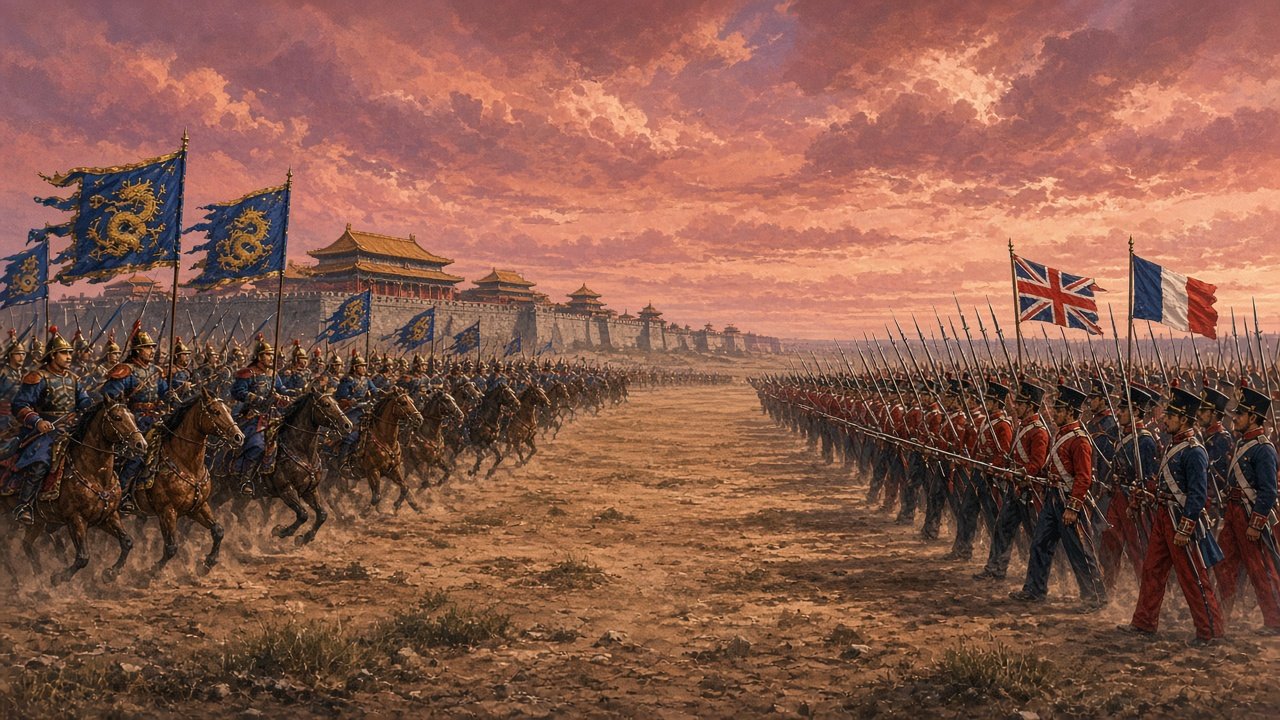
In 1860 the allied army came north in force. After taking the Taku Forts and occupying Tientsin, the campaign turned into a contest with Sengge Rinchen’s Mongol and Qing cavalry screen on the approaches to the capital. Western accounts like to dwell on rifle and artillery superiority. That superiority was real. So was Qing tactical courage and the political panic inside the Forbidden City as foreign columns closed the distance. At Zhangjiawan and then at Baliqiao on 21 September 1860, Sengge Rinchen’s forces were broken. Baliqiao, the Eight Mile Bridge, became one of those hinge battles that later Chinese textbooks treat as a national trauma and that Victorian journalists treated as a demonstration of civilisation’s hardware.
With the field army shattered, the Xianfeng Emperor fled toward Rehe. He left his brother, Prince Gong, to face the invaders and negotiate survival. That division of labour is itself a portrait of late Qing crisis: the sovereign retreats into the ritual safety of the hunting grounds while a younger prince manages catastrophe with foreigners who already hold the military initiative. Anglo French troops pushed to the outskirts of Peking. The capital was not reduced by a year long classical siege of the medieval European type. It was coerced by battlefield defeat, hostage crisis, the threat of bombardment, and the occupation of imperial pleasure grounds that symbolised the dynasty’s cosmic self image. For Chinese political psychology, that was siege enough.
Then came the event that turned a military campaign into a civilisational indictment: the capture, torture, and death of members of an allied negotiating party, including the British envoy Harry Parkes’s group and others travelling under understandings of truce. Lord Elgin, the British high commissioner, chose a reprisal designed to punish the court rather than merely to defeat another army. He ordered the destruction of the Old Summer Palace, the Yuanmingyuan, a vast complex of gardens, halls, libraries, and collections northwest of Peking. French forces had already joined in the looting. On 18 October 1860 British troops began the systematic burning. Accounts speak of days of fire. What burned was not only timber and lacquer. It was an archive of imperial taste, technical craft, and the Qing claim to stand at the centre of a tribute world.
Looting preceded and accompanied the flames. Officers and men walked through halls stuffed with porcelain, clocks, silks, jades, and European gifts accumulated over generations of Jesuit and commercial contact. Prize money was calculated. Private souvenirs were pocketed. Museums and country houses in Britain and France still hold fragments of that harvest, often with bland labels that say more about Victorian collecting than about October 1860. Chinese nationalism later turned Yuanmingyuan into a sacred ruin, a pedagogy of humiliation taught to schoolchildren and tourists alike. Both responses are historically true in different registers. The palace was a treasury of empire. Its destruction was also an act of organised imperial revenge dressed as moral punishment.
Into this scene stepped a young Royal Engineers officer who would later be mythologised as Chinese Gordon. Charles George Gordon arrived in China during the 1860 campaign as a captain hungry for active service after the Crimea and the boredom of home garrison duty. He was present at the climax around Peking and at the destruction of the Summer Palace. Royal Engineers work is easy to omit from heroic oil paintings, which prefer cavalry charges and flag plantings. In 1860 that omission is a mistake. Engineers mapped approaches, threw up batteries, and made the threat against the city technically credible when Qing authorities delayed the surrender of gates and positions the allies demanded.
Gordon’s own letters refuse the simple roles later politics assigned him. He agreed that the murder of prisoners under flag related circumstances required a sharp reply. He also called the burning of the palace vandal like and wrote that it made his heart sore to destroy places of such beauty and scale. In the same breath of the campaign’s material culture, he noted prize money with the frankness of a professional soldier who had done well out of the proceeds. That combination is the real Victorian officer voice: aesthetic regret, moral rationalisation, and cash accounting sharing a page. Chinese Gordon was not yet a nickname with global currency. He was a technically skilled subordinate inside a punitive expedition that had reached the Qing capital.
The military pressure worked. On 24 October 1860 Prince Gong signed the Convention of Peking, ratifying and extending the earlier Tientsin settlement. The terms mattered for decades: indemnities, more open trade and residence, the cession of Kowloon to Britain, and a deeper foreign diplomatic presence that ended the old fiction that Westerners could be managed at the maritime fringe. Russia, hovering on the northern frontier, extracted its own territorial gains in the same season of Qing weakness. The Second Opium War was therefore never only an Anglo French story. It was a moment when multiple empires read Chinese vulnerability at once and moved.
If the essay stopped at the Convention, Gordon would remain a footnote with a conscience and a share of prize money. History did not stop there. The Taiping Rebellion still tore through the Yangzi valley. Foreign settlements in Shanghai feared rebel success and Qing collapse in equal measure. Out of that panic grew the Ever Victorious Army, a Qing authorised, Western officered force that began under the American adventurer Frederick Townsend Ward. After Ward’s death in 1862, command eventually passed to Gordon. Under him the corps became famous for drill, steamers, artillery, and a tempo of campaigning that Qing regulars and Taiping armies both had to respect.
This is where the name Chinese Gordon was earned in British public culture. The 1860 engineer at Yuanmingyuan mattered for his later China legend, but the nickname stuck because Gordon helped the Qing destroy the Taiping Heavenly Kingdom’s remaining power in Jiangnan. Li Hongzhang praised him with the theatrical warmth of a Chinese official who needed foreign military skill without surrendering political ownership of the victory. Gordon became a hybrid figure: servant of British arms in an opium war, then hired sword and organiser for a Chinese dynasty against a Chinese millenarian revolt. That hybridity is precisely why later storytellers cannot agree whether to cast him as imperial villain, Christian eccentric, or modernising soldier of fortune.
Holding the two Gordons together is the point. The man who regretted burning a palace in 1860 later perfected a style of warfare that used Western organisation to preserve Qing sovereignty of a kind. He did not arrive in China as a Sinophile mystic. He arrived as part of a coercive apparatus that had just taught Peking it could be reached. His subsequent service to the dynasty does not cancel that. It complicates it. Chinese statecraft in the Tongzhi years learned a brutal lesson from both chapters: foreign violence could break the capital’s aura, and foreign methods could also be borrowed to crush domestic rebellion. Self Strengthening did not begin as philosophy seminar. It began as emergency procurement of techniques that had just been used against China.
British liberal opinion often preferred a cleaner script. Free trade, ambassadorial dignity, and punishment for Oriental cruelty were the official music. Opium profits, indemnity extraction, and the tourist thrill of looting an emperor’s pleasure ground were the bass line. French Catholic politics added another melody. Qing politics had its own failures: faction, underestimation of industrial war, and a court culture that still wanted the rituals of supremacy after the material basis for supremacy had shifted. A serious history of 1860 needs all of these actors without letting any one of them monopolise innocence.
The topography of the campaign still rewards attention. Taku, Tientsin, Tongzhou, Baliqiao, the approaches to the city walls, Yuanmingyuan to the northwest: these are not interchangeable place names. They mark a logistics corridor from sea to capital. Whoever controlled that corridor in 1860 controlled the dynasty’s ability to pretend that foreign affairs were a southern problem. Modern Chinese strategic thought about coastal defence, capital security, and the danger of rapid enemy advances from the Bohai rim still quietly remembers that geography, even when the public rhetoric speaks only of century of humiliation slogans.
For Peking’s residents and for the banner elites who watched smoke rise from the northwest, the burning of Yuanmingyuan was a sensory education in modern empire. Fire does political work. It teaches spectators that sacred compounds can be turned into ash by men who do not share the cosmological story those compounds were built to express. Elgin understood spectacle. Chinese memory understood it even better and kept the lesson hotter for longer. Today’s ruins at Yuanmingyuan are curated trauma. Victorian engravings of the same event were curated triumph. Between those two archives sits the actual campaign diary of men like Gordon, half appalled and half enriched.
Gordon’s later death at Khartoum in 1885 sealed a different British myth, the Christian hero in a far province. That myth often swallows the China years into a single exotic adjective. It should not. The Second Opium War chapter shows him inside the machinery of European coercion at the Qing capital. The Ever Victorious Army chapter shows him inside the machinery of Qing restoration against the Taiping. Together they explain why Chinese Gordon remains a useful irritant for both British imperial nostalgia and Chinese nationalist simplification. He does not fit either costume cleanly.
What, then, should a reader take from the British advance on Peking in 1860? First, the Second Opium War was a capital directed war, not merely another Canton quarrel. Second, the destruction of Yuanmingyuan was policy, not accident, chosen as reprisal and as theatre. Third, Charles Gordon’s presence ties the opium war coercion of the Qing state to the later foreign assisted counterinsurgency that helped that same state survive the Taiping. Fourth, the Convention of Peking locked in a treaty order that trained generations of Chinese reformers and revolutionaries to treat Western legality as a weapon system. The siege of Peking, whether or not every military pedant accepts the word, was the moment the Qing learned that the centre itself could be placed under foreign time pressure.
Huaxia readers do not need another morality play in which China is only victim and Britain only demon, or the reverse Victorian pageant in which free trade liberates a stagnant empire. They need the harder picture: industrial military advantage, commercial appetite, Qing political failure, cultural plunder, and the strange afterlife of a British engineer who burned with regret at a palace fire and then made his name fighting for the dynasty that palace had once glorified. The Second Opium War ends on paper in October 1860. In Chinese historical feeling it does not end. Every debate about sovereignty, museums, and the price of access still walks, one way or another, past the ashes of Yuanmingyuan and the batteries Gordon’s peers raised against Peking.