In July 1940 a young woman calling herself Princess Sumaire stepped off a boat from India and took a suite at the Cathay Hotel on the Bund. She said she belonged to the ruling family of Patiala, and nobody could quite prove that she did not. Within weeks she had gathered a circle that Bernard Wasserstein, writing in History Today in 1998, listed with evident relish. It included Italian officers from the local garrison, English and American society girls, a pair of professional dancers called Don and Dolly, an Austrian abortionist and extortionist, a narcotics dealer who called himself a monkey expert, and a Franco-American journalist and aviator who was also a pimp. Some of them were, or would become, agents of one secret service or another.
That scene is a fair sample of Secret War in Shanghai, Wasserstein’s archive-based history of the spies, renegades and collaborators who worked in the city’s foreign settlements from the Japanese attack of 1937 to the end of foreign Shanghai in 1945. It is a crowded, dry and deeply researched book. A quarter of a century on, it is still the fullest account in English of the foreign side of Shanghai’s intelligence war. This review looks at what it covers, where its evidence comes from, its strengths and weaknesses, the critics’ verdicts, and how it compares with related books by Wakeman, Sergeant and Paul French.
The book and its author
Profile Books first published the book in London in 1998, subtitled Treachery, Subversion and Collaboration in the Second World War. Houghton Mifflin brought it out in the United States in September 1999 with a louder subtitle, An Untold Story of Espionage, Intrigue, and Treason in World War II. Library catalogues describe the American edition as xiv + 354 pages, with illustrations and maps. Profile’s 1999 paperback ran to 368 pages. I.B. Tauris reissued the book in 2017 with a new preface. A Chinese translation by Zhou Shuyao, 上海秘密战, was published by the Shanghai Academy of Social Sciences Press in 2015, and according to the author biography listed for that edition, Wasserstein took the Chinese name Hua Baina (华百纳) to mark the occasion.
Wasserstein was an unusual author for a book on China. He was born in London in 1948 and educated at Balliol and Nuffield Colleges, Oxford. He made his name as a historian of modern Jewish history and of British rule in Palestine. He taught at Sheffield and then at Brandeis, where he was dean of the graduate school, and was president of the Oxford Centre for Hebrew and Jewish Studies when the Shanghai book appeared. His route to Shanghai was his 1988 biography The Secret Lives of Trebitsch Lincoln, which won the Crime Writers’ Association Golden Dagger for non-fiction. Trebitsch Lincoln was a Hungarian-born con man who became a British MP, a German agent and finally a Buddhist abbot, and he died in Shanghai in 1943. Researching his life took Wasserstein into the files of the Shanghai Municipal Police, and those files became the backbone of the later book.
Readers who expect Trebitsch Lincoln to reappear will be disappointed. He barely surfaces, mainly in a note that points back to the biography. Sir Victor Sassoon, owner of the Cathay Hotel, gets little more space: he appears as one of the princess’s acquaintances, and as the author of anti-Japanese remarks that alarmed the Japanese. The real cast of the book comes from further down the social scale.
After an introduction and a “Who Was Who” of the main characters, the book has twelve chapters: “Solitary Island”, “Bad Hats”, “Phony War in the International Settlement”, “Waiting for the Barbarians”, “Dark World”, “Oriental Mission”, “Eagles Mew’d”, “Collaborators”, “Shanghailanders in Exile”, “Wars Within Wars”, “Endgames” and “Twilight of Old Shanghai”. A short conclusion follows. The order is roughly chronological, from the Japanese conquest of Chinese Shanghai in 1937 to the post-war trials.
A city with too many masters
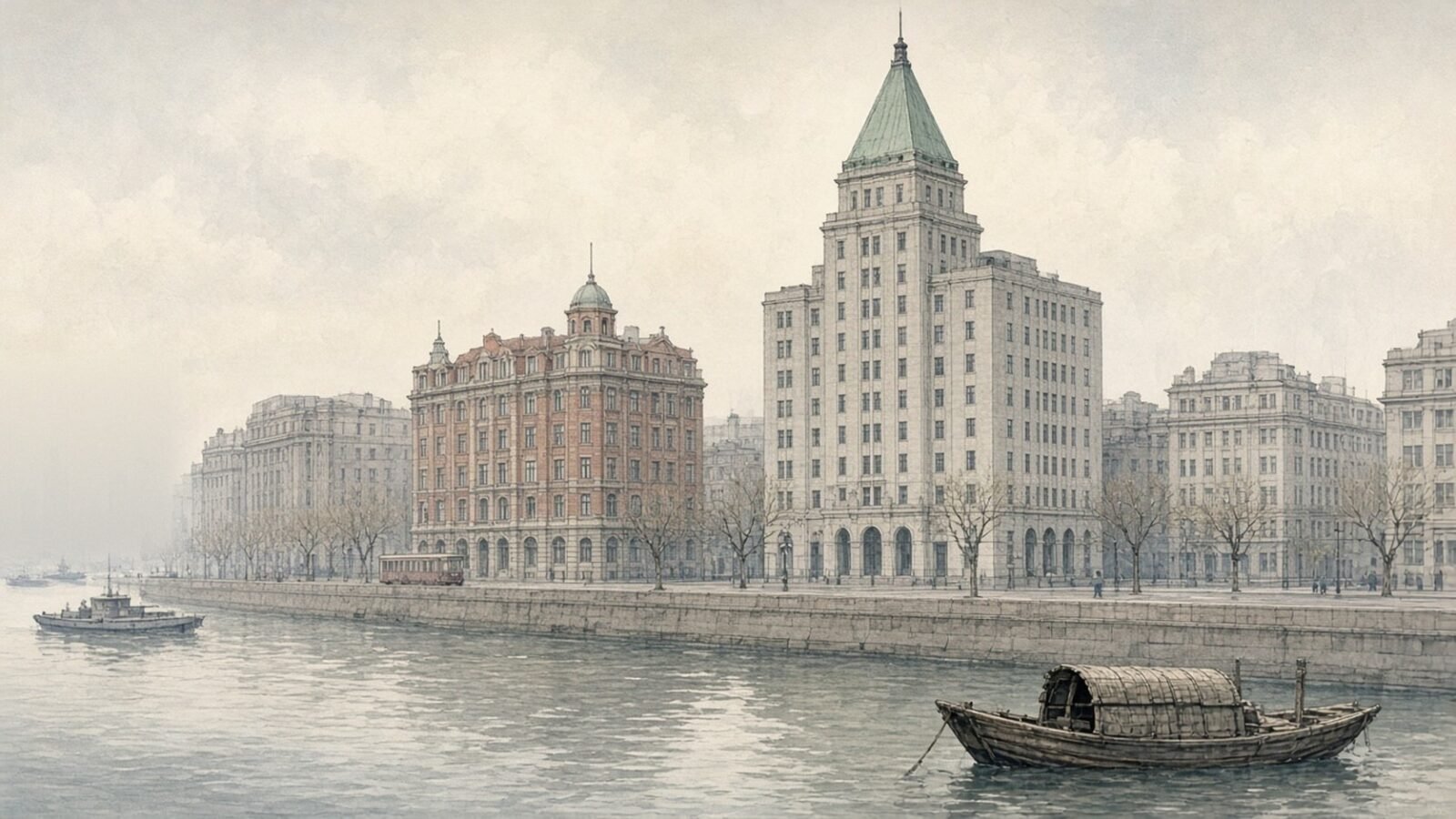
Wasserstein opens with the odd constitution of pre-war Shanghai, because the secret war grew out of it. Since the Treaty of Nanking in 1842 the city had been divided into separate jurisdictions. The International Settlement was run by a Municipal Council elected by a small body of foreign ratepayers, most of them representing British firms and banks. The French Concession answered to the French consul-general. Around both lay the Chinese municipality. In Hongkew, north of Soochow Creek, the Japanese, by then the largest foreign community, had a naval garrison and effective control of the streets. (Our piece on Old Shanghai and the International Settlement explains the system in more detail.) Foreigners with extraterritorial rights answered only to their own consular courts; White Russians and Central European Jews had no such protection.
The book’s working argument is that this patchwork made Shanghai an ideal home for people Wasserstein calls, using a period expression, “bad hats”. A 1937 exposé he quotes had called the city a “paradise of adventurers”. Wasserstein describes the result as “the twilight zone between politics and criminality”. Gun-runners, nightclub owners and confidence men moved easily into intelligence work, and the intelligence services, short of trained agents, were glad to hire them.
The war reached Shanghai in August 1937, when Chinese and Japanese armies fought for three months in and around the city and stray bombs fell on Nanking Road and the Bund (the waterfront’s wider story is told in our piece on the Bund). When the Chinese armies withdrew, the Settlement south of the creek and the French Concession were left as the “solitary island” (gudao) of the first chapter’s title: neutral foreign territory surrounded by Japanese-occupied China. For four years every government with a stake in the war kept agents there.
Bad hats and the princess
The early chapters are the most entertaining, and they show Wasserstein’s method at its best. He picks out people whose police files are thick enough to reconstruct their lives and follows them through the war, so that each career leads into a wider network. The princess is one such thread. Her circle leads to Dr Albert von Miorini, an Austrian abortionist, brothel-keeper and sexual extortionist. It leads to Hermann Erben, an Austrian-American who had wandered the Pacific with the young Errol Flynn, joined the Nazi Party in 1938 and later worked for German military intelligence, the Abwehr, until it dismissed him. And it leads to Hilaire du Berrier, the Franco-American aviator and journalist whom one report judged “a mercenary adventurer”. Du Berrier’s own papers even record his attentions to Rosalynd Kadoorie, of the wealthy Baghdadi Jewish family.
Above them all stands “Captain” Eugene Pick, an actor, impresario and gang boss who also went by the names Hovans and “Doctor” Clige. While on holiday in Japan in August 1940 he met Commander Otani Inaho of Japanese naval intelligence. He went on to become the navy’s leading local adviser in Shanghai, and used his employers’ protection to settle old scores. Otani is quoted as finding Pick “unstable and childlike”. Behind these figures stand the survivors of an older generation of China adventurers, such as the British gun-runner General “One-Arm” Sutton and the American “Peg-Leg” Kearney, most of whom had faded from the scene by the late 1930s. Then there is Lawrence Kentwell, a disbarred British-Chinese lawyer with a long record of quarrels with British officialdom, who attached himself to the Japanese-sponsored regime of Wang Ching-wei (Wang Jingwei in modern spelling).
Alan Judd, reviewing the book in the Daily Telegraph, summed up this side of it: “Wasserstein knows a bad hat when he sees one.” The portraits are deadpan, and most of the comedy comes from the files themselves: informers’ reports, intercepted letters and solemn official memoranda.
The intelligence services
Beneath the characters lies a careful account of the services that employed them. The Shanghai Municipal Police, and especially its Special Branch, is both a subject of the book and its main source. It was a British-dominated force that had spent the 1930s watching Communists and that, after 1937, tried to keep order without provoking the Japanese. On the Chinese side, Wasserstein describes the underground network of Tai Li (Dai Li), head of the Nationalists’ Military Bureau of Investigation and Statistics, the service usually called the Juntong. Its mix of moralising puritanism and ruthlessness earned Tai Li the nickname “the Himmler of China”. He also covers its working alliance with the Green Gang of Tu Yueh-sheng (Du Yuesheng). Opposing them was the puppet secret police headquarters set up in July 1939 at 76 Jessfield Road, in the Western Roads area just beyond the Settlement’s boundary, which served Wang Ching-wei’s movement. Wang established his “Reorganized Government” at Nanking in March 1940.
The Axis services get more space than a reader might expect, and this is some of the book’s freshest material. The Nazi Party organisation, the consulate-general and the Abwehr station all ran informers. The Gestapo office’s officers included Gerhard Kahner, whom Wasserstein calls “a malevolent ruffian”, and Franz Huber. Above them, from 1941, stood Colonel Josef Meisinger. He was the former Gestapo chief in occupied Warsaw, and he was sent to the German embassy in Tokyo as the SS and Gestapo representative for the Far East. Meisinger connects the book to Richard Sorge, the Soviet spy who had worked in Shanghai in the early 1930s. By 1941 Sorge was a trusted adviser to the German ambassador in Tokyo and on friendly terms with Meisinger himself. Wasserstein records that Sorge visited Shanghai in May 1941, a few months before his arrest. He also covers the German radio station XGRS, whose star English-language broadcaster was Herbert Moy, a Chinese-American former Columbia student.
Lucian Pye, reviewing the book in Foreign Affairs, picked out the detail that best captures this world: the Allies alone had fifteen intelligence agencies operating in the city. Germans and Japanese distrusted each other, Russians were split between Soviet loyalists and White émigrés, and Chinese agents served the Nationalists, the Communists or the puppets, sometimes in turn.
Pearl Harbor and the eagles mew’d
The middle chapters grow darker. On 8 December 1941 Japanese forces moved into the International Settlement. On the Whangpoo, the American gunboat USS Wake was captured almost without a fight. The British gunboat HMS Peterel refused to surrender. Her commander, Lieutenant Stephen Polkinghorn, told the Japanese boarding party “Get off my bloody ship!”, and she was shelled and sunk. It is one of the book’s few heroic episodes.
The “Oriental Mission” chapter deals with the Far East section of the Special Operations Executive (SOE), Britain’s sabotage service, and it is a story of earnest amateurism. SOE’s man in Shanghai was W. J. Gande, a 55-year-old wholesale liquor merchant with the code-name “0.5000”, whose instructions included destroying or damaging a ship. In the weeks after Pearl Harbor the Japanese gendarmerie rounded up his group and took its members to the Bridge House, the interrogation centre that became notorious among Shanghai’s foreigners. The prisoners’ own accounts of their treatment there are among the most harrowing pages in the book.
“Eagles Mew’d” takes its title from Richard III, where it is called a pity that eagles should be caged while kites and buzzards prey at liberty. The chapter traces the confinement of Allied civilians, from the repatriation exchanges of 1942 to the camps of 1943 at Lunghwa, Yu Yuen Road and Yangtsepoo and in an old tobacco warehouse across the river in Pootung, today’s Pudong. Suspected agents went to a separate camp for political prisoners on Haiphong Road. Wasserstein’s verdict on the ordinary camps is measured: conditions were “spartan but not utterly inhuman”. That restraint matters, because the book’s moral argument depends on it.
The collaborators
The chapter that made headlines in Britain was “Collaborators”. The Daily Express said the book revealed that British police and businessmen had collaborated extensively with the enemy. Wasserstein shows the Municipal Police continuing to work under Japanese direction after Pearl Harbor. The commissioner, Kenneth Bourne, had left on furlough for Canada, and in February 1942 he was formally replaced by a Japanese officer, Watari Sakon. Deputy Commissioner H. M. Smyth and one other senior officer were kept on as “advisers”. Some people went much further. Herbert Moy and the American journalist Don Chisholm broadcast for the Axis, and the book names British, American and Australian citizens who worked for the Japanese or the Germans.
The chapter is not aimed only at the British. Wasserstein treats the French Concession just as coolly, with its Vichy-appointed consul-general Roland de Margerie, whose true loyalties puzzled the British, and a small Gaullist group led by a wine merchant, Roderick Egal. He is equally unsentimental about the Italians, whose sailors scuttled the liner Conte Verde in the river after Italy’s armistice in September 1943 rather than let the Japanese take her. Steven Schwankert, reviewing the American edition for Virtual China in 1999, admired this even-handedness: “Wasserstein is utterly balanced in his reporting.” The book’s conclusion gives the overall judgement in one sentence:
“Collaboration was surprisingly prevalent but the traitors were a minority.”
Bernard Wasserstein, Secret War in Shanghai, Conclusion
That balance is the book’s most distinctive contribution. The Shanghailanders, as the settlement’s foreign and mostly British residents called themselves, tended to remember the occupation as a story of stoic suffering under Japanese brutality. Wasserstein does not deny the brutality, but he shows how much everyday accommodation lay beneath it. Schwankert pointed out that because Britain wanted to avoid dragging Japan into the wider war, its instructions to Britons in Shanghai never said exactly which acts counted as collaboration. In Wasserstein’s telling, collaboration was usually a gradual drift, beginning with keeping a business open and ending somewhere nobody had planned.
Refugees, Nazis and the designated area
Given Wasserstein’s background, the book has surprisingly few pages on Shanghai’s Jews, but they are precise. The Baghdadi Jewish elite appears through Ellis Hayim, former president of the Shanghai stock exchange. Captain Inuzaka Koreshige, the Japanese navy’s specialist on Jewish affairs, warned Hayim about Sir Victor Sassoon’s anti-Japanese statements, and Hayim was later arrested. The roughly 18,000 to 20,000 Central European refugees appear through the work of Laura Margolis, representative of the American Jewish Joint Distribution Committee, as relief funds ran out after Pearl Harbor. How the refugees got to Shanghai is told in our pieces on the port of last resort, on the Chinese consul in Vienna who issued their visas, and on Jewish Shanghai of refugees and tycoons.
In February 1943 the Japanese ordered “stateless refugees” who had arrived since 1937 to move into a “designated area” in Hongkew. Wasserstein judges that, whatever its official name, it amounted to “something very similar to a ghetto”. He describes the Japanese officials who ran it: T. Kubota, who denied any antisemitic intent, and Ghoya, who issued the passes and whom Wasserstein calls “a crude and tyrannical figure”. What he does not do is also worth noting. Popular accounts have often blamed the ghetto on Meisinger and on an alleged Nazi plan to kill Shanghai’s Jews, a story that rests mainly on one post-war testimony and that recent scholarship treats with deep scepticism. Wasserstein’s Meisinger is chiefly the bullying policeman of the German community and Sorge’s drinking companion. His account of the designated area centres on the Japanese officials who ran it, and on this point the book has aged better than much that came after it.
Wars within wars and endgames
The last third of the book widens its scope and loses some focus as a result. “Shanghailanders in Exile” follows those who carried on the fight from outside the city, above all the Keswick brothers of Jardine Matheson. Tony Keswick, chairman of the Municipal Council, survived being shot at a stormy ratepayers’ meeting in January 1941 by Hayashi Yukichi, a leader of the Japanese ratepayers. His brother John ran SOE in China from 1942. “Wars Within Wars” describes the feuds between allies that often absorbed more energy than the war with Japan. SOE fought the American Office of Strategic Services (OSS), and the OSS fought Commander Milton Miles of the US Navy, who allied himself so closely with Tai Li that he refused to obey orders from William Donovan, the head of the OSS. The Axis partnership decayed in the same way.
The endgame is the strangest part of the story. After Germany surrendered in May 1945, the Abwehr’s Shanghai station, known as the Ehrhardt Bureau from the cover name of its chief, Lothar Eisentraeger, went on working with the Japanese. In August 1946 Eisentraeger and his colleagues were tried in Shanghai by an American military tribunal for continuing hostilities after Germany’s capitulation. The case went on to the US Supreme Court as Johnson v. Eisentrager (1950), which held that enemy aliens tried and imprisoned abroad could not seek habeas corpus in American courts, a ruling argued over again in the Guantánamo cases half a century later. Meisinger surrendered to American correspondents in Japan in September 1945, was handed over to Poland and was hanged in Warsaw in 1947. The final chapter follows the bad hats, Kentwell among them, into the post-war years, as foreign Shanghai faded away.
Sources and method
The book’s authority rests on its archives, and its bibliography is a research guide in itself. At its core are the Shanghai Municipal Police files, which passed to American intelligence after 1949 and are now in the US National Archives at College Park, Maryland. Wasserstein added British records at the Public Record Office in Kew, including Foreign Office, Admiralty and SOE files, some released only with deletions. He also used India Office records, US State Department and OSS papers, and intelligence documents released by the CIA and the US Army under the Freedom of Information Act. Further sources were the Eisentraeger trial records, German Foreign Ministry archives in Bonn, the Bundesarchiv at Potsdam, French diplomatic archives at Nantes, the Central Archives for the History of the Jewish People in Jerusalem, captured Japanese Foreign Ministry records on microfilm, and private papers at the Hoover Institution and the Imperial War Museum. Kirkus, otherwise lukewarm, conceded that he “seems to have covered every source”.
The weakness of this evidence is its slant. The richest files belong to Western police and intelligence services and carry their preoccupations: informers’ gossip, sexual scandal and the routine paperwork of surveillance. Schwankert noted that the police “documented every scrap of information ever gathered on their subjects”, down to their sexual habits. Wasserstein flags doubtful reports carefully, but the shape of the evidence still limits what the book can see. Its Shanghai is overwhelmingly the Shanghai of foreigners. Several million Chinese residents appear mostly as background or as victims, or through a handful of leading figures such as Tai Li, Tu Yueh-sheng and the Wang regime. The book also keeps the Wade-Giles spellings of its sources (Tai Li, Wang Ching-wei, Hongkew, Pootung, Whangpoo), which readers used to pinyin will have to convert as they go.
What the critics said
British reviewers in 1998 were warm. As quoted by the publisher, Martin Booth in the Sunday Times praised the author’s “consummate skill of the storyteller”. Frances Wood in the Times Literary Supplement wrote that the book “reads very well and draws on a marvellous variety of sources”. Phillip Knightley in the Mail on Sunday called it “a scholarly reconstruction of seedy times in an exciting city”. The Literary Review said that much of it “reads like some improbable thriller”. On the American jacket, Jonathan Spence called it “a richly documented and fascinating exploration of hundreds of the foreigners and secret agents who schemed and scrabbled in the turbulent city”. Peter Lowe also gave it a shorter notice in the English Historical Review in 1999.
American reviewers were more divided, and their disagreements are revealing. Publishers Weekly made the sharpest observation:
“There are no persons or events of high importance, no battles of consequence, no intelligence breakthroughs. Paradoxically, it is exactly this absence of momentous historical drama that gives the book its charm.”
Publishers Weekly, 1999
The same review warned that “the canvas is a bit too crowded”. Kirkus Reviews was harsher. It called the book “well-written, well-researched, but ultimately flat”, complained that “the portraits are drawn too briefly”, and summed up: “Colorful material richly researched, but weak in narrative flow.” Pye, by contrast, wrote that Wasserstein “has brilliantly captured both the ambiance of the time and the personalities of its many shady actors”. He also drew the deflating conclusion that the book invites: Shanghai’s closed social world kept the agencies so busy “that it did not seem to matter that their activities had almost no effect on the war itself”. HistoryNet’s reviewer called it “an extraordinary reconstruction of conditions in Shanghai under Japanese occupation”. Among historians of the city, Nicholas Clifford, reviewing Marcia Ristaino’s study of Shanghai’s refugee communities for H-Asia in 2003, referred in passing to “the rogue’s gallery recently portrayed by Bernard Wasserstein”.
Strengths and weaknesses
The strengths are real. No other book brings together so many of the services and agents, and none is so thoroughly documented. Wasserstein punctures two myths at once: the romantic picture of Shanghai as a glamorous den of master spies, and the patriotic picture of a foreign community that stood firm. In his account most of the spying was petty, mercenary and ineffective, and most of the collaboration was undramatic. The “Who Was Who” and the clear chronology make it easy to consult, and on contested questions such as the origins of the Hongkew ghetto his caution has held up well.
The weaknesses come from the same choices. A book with hundreds of characters has little room for any one life, and the Kirkus complaint about brief portraits is fair: Sumaire, Pick and du Berrier come alive, but most others pass in a paragraph. The structure keeps doubling back, and the last chapters drift from Shanghai towards Chungking and the wider China theatre. Because the stakes are small, by the author’s own argument, the book can feel more like a superbly catalogued set of footnotes to the war than a history of it. And its focus on foreigners, natural for a historian of Europeans abroad, leaves the Chinese experience of occupation, which was far harsher, to other books.
Alongside Wakeman, Sergeant and French
The obvious companion is Frederic Wakeman’s The Shanghai Badlands: Wartime Terrorism and Urban Crime, 1937–1941 (Cambridge University Press, 1996), which Wasserstein cites. Wakeman worked from the same police files but looked at the Chinese side of the solitary island: the assassination war between Tai Li’s agents and the puppet police of 76 Jessfield Road, and the gambling and opium dens of the Western Roads. Wakeman’s later Spymaster: Dai Li and the Chinese Secret Service (2003) gives a full portrait of the man Wasserstein glimpses as “the Himmler of China”.
Harriet Sergeant’s Shanghai (1991) is a different kind of book: a social history of the 1920s and 1930s, arranged by community (Chinese, British, White Russian) and built on interviews with former residents. It ends more or less where Wasserstein begins, and its warmth balances his coolness. Paul French, discussed in our survey of British writers who explain China, writes the kind of narrative Kirkus wished Wasserstein had written. His City of Devils (2018), about the gambling boss Jack Riley and the dance-hall impresario Joe Farren, takes the same Badlands world and gives it a plot. Taras Grescoe’s Shanghai Grand (2016) returns to the Cathay Hotel and makes room for Sumaire again. For the refugee communities, Ristaino’s Port of Last Resort (2001) is the scholarly complement. For a single British policeman’s career, Robert Bickers’s Empire Made Me (2003) draws on the papers of Maurice Tinkler, which Wasserstein also used. For the wider war, start with Rana Mitter, profiled in Rana Mitter and China’s forgotten war, and our overview of the war that remade China.
Verdict
Secret War in Shanghai is less a thriller than an exceptionally well-stocked case file. Readers who want to know who was really spying on whom in the city between 1937 and 1945, how little it achieved, and how ordinary the slide into collaboration could be, will find nothing better in English. Its conclusions are modest and well supported. The secret services in Shanghai were numerous and busy, their effect on the war was slight, and many foreign residents accommodated the occupier without ever becoming traitors. These findings are less dramatic than the American subtitle promised, but they are better evidenced, and nothing published since has overturned them.
Sources
- Bernard Wasserstein, Secret War in Shanghai (London: Profile Books, 1998; Boston: Houghton Mifflin, 1999; London: I.B. Tauris, 2017): WorldCat record; contents of the 2017 edition; Internet Archive catalogue entry.
- Bernard Wasserstein, “Collaborators and Renegades in Occupied Shanghai”, History Today 48:9, September 1998.
- 上海秘密战, Chinese edition, Shanghai Academy of Social Sciences Press, 2015 (Douban).
- Lucian W. Pye, review, Foreign Affairs, March/April 2000.
- Kirkus Reviews, 1999.
- Publishers Weekly, 1999.
- Steven Schwankert, “A Dark Shanghai Story of Spy vs. Spy”, Virtual China, December 1999.
- HistoryNet review.
- Press quotations: Profile Books paperback, 1999; Houghton Mifflin edition.
- Peter Lowe, shorter notice, English Historical Review 114:458, 1999.
- Nicholas Clifford, review of Marcia Ristaino, Port of Last Resort, H-Asia, July 2003.
- Bernard Wasserstein (Grokipedia); University of Chicago, Department of History.
- Grokipedia: Josef Meisinger; Johnson v. Eisentrager; Tony Keswick.
- Bernard Wasserstein, “Collaborators and Renegades in Occupied Shanghai”, History Today 48:9, September 1998 (Princess Sumaire).
- Frederic Wakeman Jr, The Shanghai Badlands, Cambridge University Press, 1996.
- Harriet Sergeant, Shanghai, Jonathan Cape, 1991.
- Paul French, City of Devils, 2018.
- Christopher Rea, “Shanghailanders” (review of Taras Grescoe, Shanghai Grand), Literary Review of Canada, July–August 2016.