The Kangxi Dictionary, known in Chinese as the Kangxi Zidian, was completed in 1716 under the patronage of the Kangxi emperor of the Qing dynasty. It contained more than forty-seven thousand characters, arranged under a system of 214 radicals, and for two centuries it was regarded as the most authoritative dictionary of the Chinese written language. Its arrangement has had an influence far beyond its own pages. The 214 radicals it standardised are still used to organise characters in many dictionaries, they form a block of the Unicode standard used by computers around the world, and its page references serve as an identifier for characters in international encoding work. This article describes the origins of the dictionary, the scholars who compiled it, the system on which it was built, its strengths and its errors, and the place it has held in the study of the Chinese language.
Writing and the Problem of Order
Chinese is written with characters, each of which generally represents a syllable and a unit of meaning. Unlike an alphabetic script, in which a small number of letters can be arranged in a fixed order, the Chinese writing system contains many thousands of distinct characters. Literate people in pre-modern China typically knew several thousand, and the total number of characters attested in texts over the centuries runs to tens of thousands, many of them rare, obsolete or variant forms of more common characters. The general history of the script is described in the Grokipedia article on Chinese characters, and the modern division between traditional and simplified forms is discussed in Why Chinese Has Two Official Scripts.
Any dictionary of characters must solve the problem of how to arrange them so that a reader can find a particular character. Over the centuries Chinese lexicographers developed several approaches. Some dictionaries grouped characters by meaning, placing words for plants, animals, tools or kinship together. Others arranged them by pronunciation, grouping characters by their rhyme and tone, a method suited to poets who needed to find rhyming words. A third approach, which eventually became dominant, grouped characters according to a shared graphic component known as a radical. Many characters are composed of two or more parts, one of which often indicates the general category of meaning and another the approximate pronunciation. Characters relating to water, for example, frequently contain a component derived from the character for water, while those relating to trees and wood frequently contain the component for tree.
The Shuowen Jiezi
The radical system originated with the Shuowen Jiezi, compiled by the scholar Xu Shen and presented to the Han court in the early second century CE. Xu Shen analysed 9,353 characters, together with more than a thousand variant forms, and arranged them under 540 section headers. His purpose was not merely to provide a finding list but to explain the structure and original meaning of each character, which he did by analysing it into its components and classifying it according to the principles by which characters had been formed. The Shuowen Jiezi became the foundation of Chinese philology and has been studied and commented upon ever since. Its 540 headers, however, were numerous and in some cases obscure, and they were organised according to a philosophical scheme rather than by any principle that would make searching easy.
Ming Reforms of the Radical System
Over the following centuries other dictionaries modified the system, and the decisive simplification came in the late Ming. In 1615 the scholar Mei Yingzuo published a dictionary called the Zihui, in which he reduced the number of radicals to 214. He also arranged the radicals in order of the number of strokes needed to write them, from one stroke to seventeen, and within each radical he arranged characters by the number of additional strokes. This made it possible for a reader to find a character mechanically, by identifying its radical, counting the remaining strokes, and turning to the relevant section. Mei Yingzuo’s arrangement was practical rather than philological, and some of his assignments of characters to radicals were based on visual convenience rather than on the historical structure of the character.
A few decades later another Ming scholar, Zhang Zilie, produced the Zhengzitong, a dictionary that followed the same arrangement of 214 radicals while providing more extensive discussion of the forms and meanings of characters. Both the Zihui and the Zhengzitong were widely used in the seventeenth century, and both served as important bases for the Kangxi Dictionary. Scholars of the early Qing considered them useful but felt that they contained many errors and omissions.
The Emperor and His Projects
The Kangxi emperor, whose personal name was Xuanye, reigned from 1661 to 1722, a period of sixty-one years that makes him one of the longest reigning monarchs in Chinese history. He came to the throne as a child, took personal control of government as a teenager, and went on to suppress the Revolt of the Three Feudatories, incorporate Taiwan into the Qing empire and campaign against the Dzungar Mongols. His reign is outlined in the Grokipedia article on the Kangxi Emperor, and the Qing conquest of Taiwan is described in Koxinga Takes Taiwan from the Dutch.
The Kangxi emperor was also a ruler of considerable intellectual curiosity. He studied the Confucian classics with tutors, practised calligraphy, and took a serious interest in mathematics, astronomy and other sciences, learning geometry and other subjects from Jesuit missionaries at his court. That aspect of his reign is discussed in The Jesuits at the Chinese Court. As a Manchu ruler governing a predominantly Han Chinese population, he was concerned to present himself as a patron of Chinese learning and culture, and he sponsored a series of major scholarly compilations. These included a comprehensive anthology of Tang poetry, a large dictionary of literary phrases arranged by rhyme, a great encyclopedia that was completed under his successor as the Gujin Tushu Jicheng, and the character dictionary that bears his name. Such projects continued a tradition of imperial sponsorship that had produced earlier compilations such as The Yongle Encyclopedia of 1408, and they anticipated the even larger enterprise of his grandson, the Qianlong emperor, described in The Siku Quanshu.
The Compilation
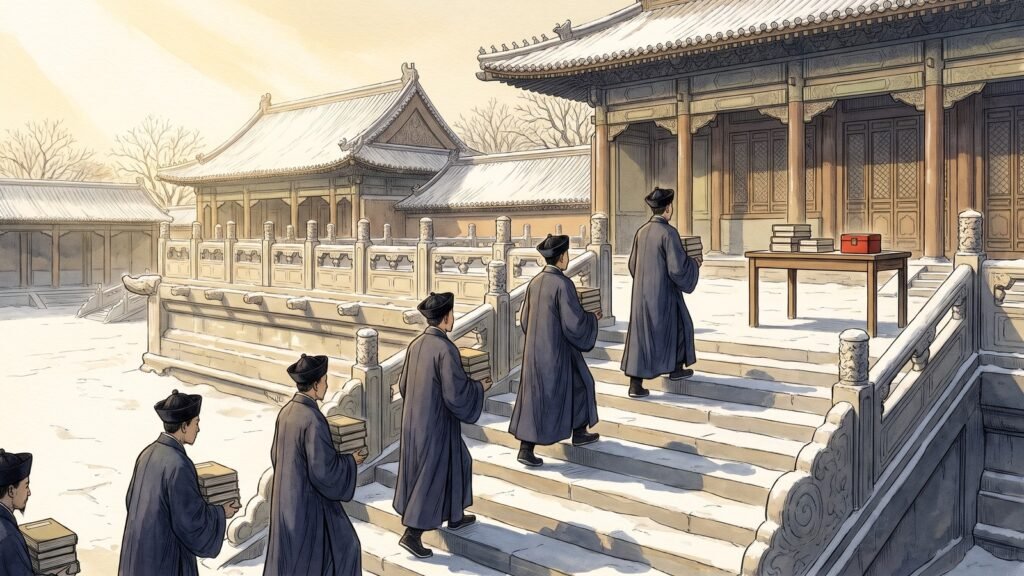
The emperor ordered the compilation of the dictionary in 1710. The project was placed under the direction of two senior scholar-officials, Zhang Yushu and Chen Tingjing, both of whom held high office as Grand Secretaries and had experience of directing earlier imperial compilations. Working under them was a group of about thirty scholars drawn from the Hanlin Academy and other institutions. The work was completed in 1716, the fifty-fifth year of the Kangxi reign, and was printed in the palace printing office located in the Wuying Hall of the Forbidden City. Chen Tingjing and Zhang Yushu both died before the printed work was published, Chen in 1712 and Zhang in 1711, and the project was carried to completion by their colleagues.
The emperor wrote a preface in which he explained the purpose of the work. He noted that previous dictionaries had each had their merits but also their deficiencies, that some had been too brief and others too complicated, and that errors and inconsistencies had accumulated. He expressed the hope that the new dictionary would establish a standard reference that combined the best of earlier works and corrected their faults, so that it could be used for generations. The compilers drew upon a wide range of earlier works, including the Shuowen Jiezi, the Yupian of the sixth century, the great rhyme dictionaries of the Tang and Song such as the Guangyun and the Jiyun, the Ming Hongwu Zhengyun, and the Zihui and Zhengzitong.
The speed of the compilation, which took only about six years, was remarkable given the size of the work. It was made possible partly by the use of existing dictionaries as a basis, and partly by the resources that imperial sponsorship provided. The speed has also been cited as one reason for the errors that later scholars found in the text.
Structure and Arrangement
The Kangxi Dictionary adopted the arrangement of 214 radicals used by the Zihui and the Zhengzitong. The radicals were arranged in order of their stroke count, from the single horizontal stroke to the seventeen-stroke radical for flute. Within each radical, characters were arranged by the number of strokes in addition to the radical. The work was divided into twelve main sections, each named after one of the twelve earthly branches, a traditional series of signs used in Chinese calendrical reckoning. Each section was further subdivided into upper, middle and lower parts.
The dictionary contained 47,035 characters according to the count most commonly cited, together with a large number of variant forms. This total far exceeded the number of characters in ordinary use. The compilers included not only common characters but also rare characters attested in ancient texts, variant forms found in earlier dictionaries, and in some cases characters that appeared only once in earlier lexicographical works and whose meaning and use were uncertain. The aim was comprehensiveness. Rare characters and variants were often grouped in supplementary sections, and the dictionary included an appendix of characters for which the compilers could find no reliable information.
Each entry generally began with the character, followed by its pronunciation according to earlier rhyme dictionaries, given by the traditional method known as fanqie. In this method the pronunciation of a character was indicated by two other characters, the first sharing its initial consonant and the second its final and tone. The compilers often listed fanqie readings from several earlier sources, which preserved information about how pronunciations had been recorded at different periods. After the pronunciation came definitions, usually supported by quotations from the classics, histories, philosophers and literary works, indicating where and how the character had been used. Where a character had more than one pronunciation with different meanings, these were set out separately.
The dictionary also provided guidance to the reader. Introductory sections explained how to find characters, offered tables of characters whose radical was difficult to identify, and listed characters that were easily confused because of their similar appearance. These aids reflected the practical purpose of the work as a reference that could be used by a wide range of readers.
Authority and Use
Because it was sponsored by the emperor and compiled by senior scholars, the Kangxi Dictionary acquired great authority. It came to be regarded as the standard for the correct forms of characters, and examination candidates and officials consulted it to determine proper usage. Its arrangement became the dominant system for Chinese dictionaries, and later dictionaries throughout the Qing and well into the twentieth century followed its radical system and often its order of characters.
The dictionary was reprinted many times, and it circulated widely outside China. In Japan, Korea and Vietnam, where Chinese characters were used in writing, it became an important reference, and Japanese editions were produced. In Europe, missionaries and scholars studying Chinese used it as a basis for their own dictionaries. The early nineteenth-century dictionary compiled by the Protestant missionary Robert Morrison drew heavily on the Kangxi Dictionary for its arrangement and content, and many subsequent European dictionaries of Chinese adopted its radical system.
Influence Across East Asia
The influence of the Kangxi Dictionary in neighbouring countries deserves fuller description, since it was in many respects as important there as in China. In Korea, where literary Chinese remained the language of government and scholarship until the late nineteenth century, character dictionaries were widely used by scholars and students. The Korean word for a character dictionary, okpyeon, derives from the name of the sixth-century Chinese dictionary Yupian, a reminder of the long history of Chinese lexicography on the peninsula. Korean dictionaries of the later Joseon period, which gave the Korean readings and meanings of characters, adopted the radical arrangement that the Kangxi Dictionary had made standard.
In Japan the dictionary was imported and reprinted during the Edo period and was consulted by scholars of Chinese learning. Japanese character dictionaries, known as kanwa jiten, generally arranged characters under the Kangxi radicals and often gave the number of the radical as a means of reference. Students of Japanese who use such dictionaries today still look up characters by these radicals, even though the forms of many characters in modern Japanese differ from those in the Kangxi text as a result of the script reforms carried out after the Second World War. In Vietnam, where Chinese characters were used for official writing until the early twentieth century and where a native script based on Chinese characters was also developed, scholars likewise used Chinese dictionaries arranged by radical.
This wide adoption meant that the Kangxi radicals became a shared framework for organising characters across the region. A scholar in Seoul, Kyoto or Hue who knew how to find a character under its radical could use dictionaries produced in any of these places, and the standard sequence of radicals was a common reference point in the study of characters throughout the Chinese-reading world.
The Dictionary and Western Learning of Chinese
European scholars of Chinese in the eighteenth and nineteenth centuries relied heavily on the Kangxi Dictionary. Catholic missionaries in China had compiled manuscript dictionaries of Chinese since the late sixteenth century, and in the nineteenth century Protestant missionaries produced printed dictionaries for a wider readership. Robert Morrison’s Dictionary of the Chinese Language, published in several parts between 1815 and 1823, was the first large printed Chinese-English dictionary, and its first part followed the arrangement of the Kangxi Dictionary by radical. Later dictionaries compiled by Western scholars, such as the Chinese-English dictionary of Herbert Giles first published in 1892, adopted other arrangements based on the romanised pronunciation of characters, but they continued to give radical numbers and to rely on the Kangxi Dictionary for information about rare characters and meanings.
The adoption of the Kangxi radicals by Western scholars contributed to the spread of the system in modern scholarship. Library catalogues and bibliographies of Chinese works in Europe and North America sometimes used the radicals as a means of arranging titles and names, and the numbering of the radicals became a familiar tool for anyone who studied Chinese at an advanced level. Even after alphabetical arrangements became common, the radical index remained an essential complement, since a reader who encountered an unfamiliar character could not know its pronunciation and therefore could not look it up alphabetically.
Errors and Corrections
Despite its authority, the Kangxi Dictionary was not free from error. Scholars of the Qing period, particularly those associated with the movement of evidential research that flourished in the eighteenth century, subjected classical texts and earlier scholarship to rigorous critical examination, and they found many mistakes in the dictionary. Quotations were sometimes inaccurate or attributed to the wrong source, definitions were sometimes mistaken, and some characters were assigned to inappropriate radicals.
In the reign of the Daoguang emperor the scholar Wang Yinzhi, a leading figure in evidential philology, was commissioned to produce a systematic correction of the dictionary. His work, published in 1831 under the title Zidian Kaozheng, identified and corrected 2,588 errors, most of them in quotations. It was afterwards printed together with the dictionary in some editions. Later scholars continued to find further errors, and the problems of the Kangxi Dictionary became a subject of study in their own right.
The dictionary has also been criticised for the inclusion of large numbers of characters of doubtful status. Many of the rare characters it contains are variant forms of other characters, mistaken forms that arose through copying errors in earlier works, or characters attested only in earlier dictionaries without any evidence of use in actual texts. The inclusion of such characters was a consequence of the compilers’ aim of comprehensiveness, but it means that the dictionary’s total of more than forty-seven thousand characters greatly overstates the number of characters in real use.
Modern scholarship has examined the nature of these errors more closely. In a study of the dictionary’s editorial practices, published in the journal Historiographia Linguistica in 2013 under the title Misquoting the ancients, the historian Imre Galambos argued that many of the faulty quotations arose because the compilers frequently took their examples from earlier dictionaries and reference works rather than checking them against the original texts, so that mistakes in those intermediaries were carried into the new work. He also pointed out that such practices were common in Chinese lexicography and that the errors should be understood in the light of the size of the undertaking and the speed with which it was completed. His study has been widely cited as a corrective both to uncritical reliance on the dictionary and to the dismissive view that its errors deprive it of value.
Later Dictionaries
In the twentieth century new dictionaries were compiled that sought to replace the Kangxi Dictionary as the standard reference. The Zhonghua Da Zidian, published in 1915, contained more than forty-eight thousand characters and corrected many of the errors of its predecessor. Later dictionaries in the People’s Republic of China, in Taiwan and in Japan expanded the record further. The Hanyu Da Zidian, published in the People’s Republic between 1986 and 1990, contained about fifty-five thousand characters in its first edition and more than sixty thousand in its second, and the great Japanese dictionary compiled by Morohashi Tetsuji contained around fifty thousand. In Taiwan, the Ministry of Education’s dictionary of variant characters records over a hundred thousand forms. For the general history of the genre, see the Grokipedia article on the Chinese dictionary.
Many of these modern dictionaries continued to use the 214 radicals of the Kangxi system, sometimes with modifications. In the People’s Republic, the simplification of characters in the 1950s and 1960s altered the forms of many radicals and made some of the traditional assignments unworkable, and dictionaries using simplified characters adopted revised radical systems with different numbers of radicals. In 2009 a national standard established a set of 201 radicals for simplified Chinese. In Taiwan, Hong Kong and in dictionaries of traditional characters, the 214 Kangxi radicals remain the usual system.
The Digital Age
The Kangxi Dictionary has an important place in the digital representation of Chinese characters. When the Unicode standard was developed to encode the characters of the world’s writing systems, a block was set aside for the 214 Kangxi radicals, located between the code points U+2F00 and U+2FDF. The radicals are also used in the indexing of the large Unicode repertoire of Chinese, Japanese and Korean characters, where characters are ordered by radical and additional stroke count. The Unicode database records for many characters a reference to the page and position at which the character appears in a standard edition of the Kangxi Dictionary, a reference that is used to help identify characters and to distinguish between similar forms.
In this way a work compiled under the patronage of an emperor in the early eighteenth century continues to provide part of the infrastructure through which Chinese characters are encoded, displayed and searched on computers and phones today. The modern user who looks up a character by its radical in an electronic dictionary is, in effect, using the method that Mei Yingzuo devised and that the Kangxi compilers made standard.
The Dictionary as a Historical Source
Beyond its practical use, the Kangxi Dictionary is a valuable historical document. It provides a record of the state of Chinese lexicography at the beginning of the eighteenth century and preserves information drawn from earlier works, some of which survive only in part. Its many quotations offer a guide to the texts that scholars of the time considered authoritative. Its treatment of variant characters reveals the complexity of the written tradition and the efforts of scholars to impose order on it.
The dictionary is also an expression of the cultural policy of the early Qing. By sponsoring a work that sought to fix the standard forms of characters, the Kangxi emperor asserted the role of the Manchu court as guardian of Chinese civilisation. The project formed part of a wider effort to win the support of Han Chinese scholars and to demonstrate that the new dynasty was the legitimate heir to the tradition of Chinese imperial rule. This purpose did not diminish the scholarly value of the work, but it helps explain why the court invested so heavily in it.
A Court of Many Languages
The Kangxi Dictionary was not the only lexicographical project of the reign. The Qing was a multilingual empire, and its rulers used Manchu, Chinese and Mongolian in government, with Tibetan and other languages employed in particular regions. In 1708, two years before the Chinese character dictionary was commissioned, the court completed a large monolingual dictionary of the Manchu language, often known in English as the Mirror of the Manchu Language. It arranged Manchu vocabulary by subject and defined Manchu words in Manchu, with the aim of standardising the language of the ruling group at a time when many Manchus living in Chinese cities were adopting Chinese speech. Later in the eighteenth century the court sponsored expanded versions with Chinese, Mongolian, Tibetan and other equivalents, culminating in multilingual dictionaries in five languages.
These works show that the Kangxi Dictionary formed part of a broader effort by the court to define and regulate the languages of the empire. The Chinese dictionary addressed the written language of the great majority of the empire’s subjects and of its scholarly and administrative elite, while the Manchu dictionaries addressed the language of the dynasty itself. Both reflected the conviction of the Kangxi emperor that language was a matter of state concern, and that an authoritative reference produced under imperial auspices would serve the unity and order of the realm.
An Example of an Entry
The character for water illustrates how the dictionary worked. It is itself one of the 214 radicals, the eighty-fifth in the standard sequence, and it heads a large section containing all the characters classified under it. In combination with other components the water radical usually takes a compressed form of three short strokes on the left side of a character, so that a reader had to recognise this form as a variant of the full character. Under the radical the reader would find characters for rivers, lakes and seas, for actions such as washing, flowing and soaking, and for qualities such as clear and deep, arranged by the number of additional strokes.
For the radical character itself, the entry gives its readings from earlier rhyme dictionaries, cites the Shuowen Jiezi on its form and meaning, and then quotes passages from the classics and other early literature in which the word appears, including texts associating water with one of the five phases of Chinese cosmology. It notes extended meanings and uses as a proper name. Entries for rare characters are much shorter, sometimes consisting only of a reading and a brief definition taken from an earlier dictionary, and occasionally only a statement that the meaning is unknown. The contrast between these long and short entries shows the double aim of the work, which sought both to explain the common vocabulary of the literary language in depth and to record every character that earlier scholarship had noted.
The Number of Characters in Use
The large total of characters in the Kangxi Dictionary is sometimes taken as a measure of the size of the Chinese writing system, but this can be misleading. Studies of character frequency in modern Chinese have shown that a relatively small number of characters accounts for the overwhelming majority of written text. A list of about 3,500 common characters, published in the People’s Republic in 1988 for educational purposes, was designed to cover the great bulk of characters met in ordinary modern writing. The Table of General Standard Chinese Characters issued in 2013, which defines the characters for general use in the People’s Republic, contains 8,105 characters. Educated readers of classical literature in the Qing would have known a larger number, including many characters that are now rare, but still far fewer than the total in the dictionary.
The remaining tens of thousands of characters are of several kinds. Some are genuine words that fell out of use, preserved in early texts and of interest to scholars of the classics. Some are characters used for personal and place names. Many are variant forms, different ways of writing the same word that arose in different periods and regions, and some are errors that entered the lexicographical tradition through miscopying and were then repeated from one dictionary to the next. Disentangling these categories has been one of the main tasks of modern scholarship on the history of Chinese characters, and the Kangxi Dictionary is both an object of that work and one of its principal sources.
The Dictionary in the Imperial Library
When the Qianlong emperor commissioned the great imperial library later in the eighteenth century, the Kangxi Dictionary was included among the works copied into it, classified among the philological works of the classics section, the division that contained dictionaries and studies of characters and pronunciation. The editors of the library also wrote an annotated catalogue in which each included work was described and evaluated. Their inclusion of the dictionary reflected its standing as an imperial work and its acknowledged importance, and its presence in the library ensured that it formed part of the officially recognised body of learning that the Qing court sought to preserve.
The Printing of the Dictionary
The production of the dictionary in physical form was itself a considerable undertaking. The text was cut onto woodblocks, the standard method of printing in China for most of the imperial era. In woodblock printing each page of text was first written out by a calligrapher in a clear and regular hand, the written sheet was pasted face down on a smoothed block of wood, usually pear or jujube, and skilled carvers then cut away the wood around the strokes so that the characters stood in relief. The block was inked, a sheet of paper laid upon it and rubbed with a brush, and the impression lifted. For a work as large as the Kangxi Dictionary, many thousands of blocks had to be prepared, and the work demanded both calligraphers whose characters would serve as a model of correct form and carvers who could reproduce those forms exactly.
The palace printing office in the Wuying Hall was responsible for a large number of imperial publications in the Kangxi and later reigns, and editions printed there were known for the quality of their calligraphy, paper and binding. The dictionary was bound in many volumes in the traditional thread-bound format, with soft paper covers, and was distributed to officials, academies and libraries. Because the forms of the characters in the printed dictionary were taken as a standard, the style of writing used in the palace edition itself had an influence on the shapes that later printers and calligraphers regarded as correct. The typefaces used in many modern publications of traditional characters, and the forms adopted in some national standards, still show the influence of the shapes established in printed works of the Qing court.
Using the Dictionary
For a reader of the eighteenth or nineteenth century, using the Kangxi Dictionary required a certain skill. The first step was to identify the radical under which a character was classified. In many cases this was straightforward, since the radical was a clearly visible component that indicated the meaning of the character. In other cases it was difficult, because the radical might be disguised by a change of form when combined with other elements, or because the character contained more than one component that could plausibly be considered its radical. The compilers’ tables of difficult characters were intended to assist with these problems.
Once the radical was identified, the reader counted the strokes in the remainder of the character and turned to the corresponding section. This required knowledge of the conventional way of writing each component and of counting its strokes, since some components that look similar are written with different numbers of strokes. Readers who learned to use the dictionary acquired a practised familiarity with the structure of characters, and the habit of analysing characters by radical and stroke count became part of the education of literate people throughout the Chinese-reading world.
Conclusion
The Kangxi Dictionary brought together the work of more than fifteen centuries of Chinese lexicography, from Xu Shen’s analysis of the structure of characters in the Han dynasty to the practical reforms of Mei Yingzuo in the late Ming. Compiled in a short time by a team of court scholars, it contained errors that later philologists laboured to correct, and it included many characters of doubtful status. Yet its arrangement of 214 radicals proved remarkably durable, shaping the organisation of dictionaries across East Asia for two centuries and continuing to serve as a reference point in the digital encoding of Chinese characters. Its history shows how a scholarly project initiated for reasons of cultural policy could become a lasting part of the way in which a writing system is organised and used.
Sources and Further Reading
- Grokipedia, Kangxi Dictionary
- Grokipedia, Shuowen Jiezi
- Grokipedia, Kangxi Emperor
- Grokipedia, Chinese dictionary
- Grokipedia, Chinese characters
- Jerry Norman, Chinese, Cambridge University Press, 1988
- Endymion Wilkinson, Chinese History. A New Manual, Harvard University Asia Center, latest edition