
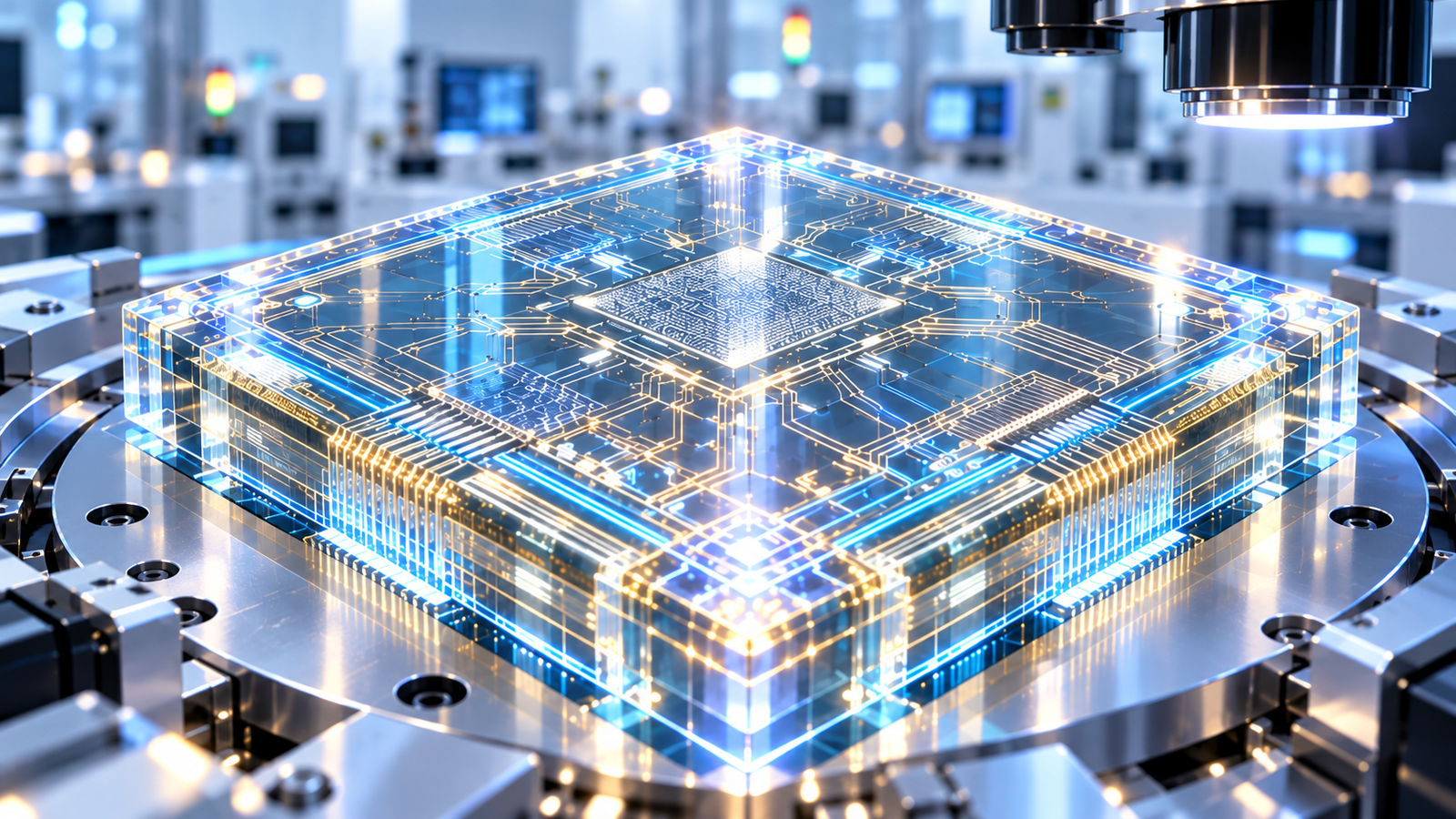
Glass seems an unlikely material for a computer chip. It is best known for windows, bottles and screens, and ordinary glass barely conducts electricity. Yet a recent Chinese chip-packaging demonstration puts it at the centre of an intriguing development in AI hardware.
At the World Artificial Intelligence Conference in July 2026, chip designer Enflame and Shanghai Xianfeng Technology unveiled what they described as China’s first glass-based CoPoS advanced-packaging sample for AI computing. The development introduces glass into the structure supporting and connecting the computing components. DigiTimes’ report
Calling it a “chip made of glass” needs some unpacking. Ordinary glass is an electrical insulator: electrons cannot move through it easily. Silicon is a semiconductor, whose electrical behaviour can be controlled to create transistors—the tiny switches that perform computation. Replacing silicon transistors with ordinary glass would therefore seem a peculiar way to build a processor.
In this design, however, glass has a different job. It forms part of the chip’s package, while semiconductor components handle the calculations. Its insulating nature helps keep conductive pathways electrically separated. Its physical properties provide a stable foundation for the fine connections linking components together. Intel describes this substrate as the body that connects and protects the silicon inside. Intel’s explanation of glass packaging
Think of a modern processor package as a miniature city. The computing components are its buildings, and the connections between them are its roads. Adding more buildings helps only if the roads can carry the traffic. Advanced packaging lets manufacturers combine multiple chips, placing them alongside one another or stacking them vertically so they can work together within a single product. Intel’s overview of advanced packaging
Glass offers a promising foundation for that city. Its flatness and dimensional stability can help engineers align extremely fine connections across large packages. Intel, which announced its own glass-substrate work in 2023, says these properties can support denser interconnects and larger assemblies of chiplets—the smaller chips brought together inside a package. These are potential advantages of glass substrates generally, rather than demonstrated performance gains for the Chinese sample. Intel’s glass-substrate announcement
The Enflame and Xianfeng demonstration uses an approach called CoPoS, short for Chip-on-Panel-on-Substrate. It brings an AI computing chip together with glass-based, panel-level advanced packaging. The milestone is the integration of these technologies into a sample, opening another route for assembling complex AI hardware. DigiTimes
This matters because progress in computing increasingly depends on how components work together. As traditional transistor scaling becomes harder, manufacturers are also improving the connections and arrangement of separate chips. Packaging gives designers another way to put more capability into a product. Intel
There is still a considerable distance between an exhibition sample and a commercially successful product. The demonstration alone does not establish economical mass production or superior AI performance. The next evidence to watch for is manufacturing yield, long-term reliability, production cost and results in actual computing systems.
Changing the substrate also requires changes to manufacturing. Intel’s account of its own glass programme describes extensive work to adapt processes and the surrounding supply chain. A material with attractive properties still has to survive production, assembly and everyday operation reliably. Intel’s account of the engineering challenge
For China, the demonstration suggests growing capability in an important part of AI hardware development. Its commercial significance will depend on turning the sample into a dependable product manufactured at scale.
That prospect is compelling on its own. A material familiar for keeping electricity from flowing could help engineers organise the connections that make powerful processors possible. Glass may earn its place in the AI race through the foundation it provides beneath the computing machinery.