When Matteo Ricci 利瑪竇 (1552–1610) arrived in China in 1583, he did not come as a conqueror or a trader. He came as a mathematician. The Italian Jesuit was one of the most learned men of late Renaissance Europe, trained in astronomy, geometry and classical languages, and he had spent the previous decade learning the customs and the language of the Portuguese trading stations of South Asia. He had also been sent by his superiors to do something more difficult than trade: to convert the emperor of China, or at least some of his subjects, to the Catholic faith.
The mission was, by any measure, a long-term project. China was already a civilised state with its own Confucian elite, its own imperial institution, its own literary tradition and its own philosophical self-understanding. To convert China would require something more than translation; it would require the demonstration that Christianity completed rather than contradicted Chinese civilisation. Ricci understood this from the beginning, and he spent the rest of his life working out the strategy that would make it possible.
He arrived first in Zhaoqing 肇慶, a small city in the southern province of Guangdong, where he was allowed to live in exchange for his knowledge of clocks and cartography. He then moved north through the Jiangnan cities, eventually settling in Nanjing 南京 in 1599 and Beijing 北京 in 1601, where he lived until his death in 1610. In each city he learned the language more thoroughly, dressed as a Chinese literatus, mastered the Confucian classics, and produced a stream of works in Chinese that argued the case for Christianity in terms his hosts could understand.
The most famous of these was Tianzhu Shiyi 天主實義, “The True Meaning of the Lord of Heaven”, written in 1595 and revised several times afterwards. In it Ricci argued that the Christianity he preached was compatible with the most ancient stratum of Chinese tradition. The Chinese Heaven (天 tian) and the Chinese Supreme Emperor (上帝 Shangdi), mentioned in the earliest Confucian classics, could be understood as the Christian God. The rites honouring Confucius and the ancestors, performed by Confucian scholars and by families, were civil rites expressing respect and gratitude, not acts of religious worship. The Buddhism and Daoism of the late Ming were superstitious accretions that Ricci, like many of his Chinese interlocutors, regarded with distaste. A sincere Confucian could, with these distinctions, become a sincere Catholic.
The strategy worked, in a modest way. By the time of Ricci’s death there were perhaps two thousand Chinese Catholics, clustered around three converts of unusual prominence: the Shanghai scholar-official Xu Guangqi 徐光啟 (1562–1633), the Hangzhou scholar Li Zhizao 李之藻 (1565–1630), and the Yangzhou official Yang Tingyun 楊廷筠 (1557–1627). These three men, sometimes called the “Three Pillairs” of the early Chinese Catholic Church, were all scholar-officials of the highest rank, and their conversions gave Christianity an unexpected respectability in late Ming China.
II. The Accommodation Strategy
Ricci’s strategy of accommodation rested on a careful hermeneutic move. He distinguished between what he called the “primitive” Confucianism of the pre-Buddhist classics and the “neo-” Confucianism of the Song and Ming. The original Confucianism, as preserved in the Shujing 書經, the Shijing 詩經 and the earliest strata of the Liji 禮記, was, he argued, essentially a system of moral and political philosophy compatible with Christian monotheism. The later accretions of Buddhist and Daoist metaphysics, with their doctrines of reincarnation and emptiness, were superstitious additions that true Confucians already rejected. A sincere Confucian scholar who also happened to be a sincere Catholic could, in Ricci’s view, simply ignore the Buddhist and Daoist elements of popular Chinese religion and continue to honour his ancestors and his patron saints with the rites that his classical tradition prescribed.
The argument was, in many ways, an extremely sharp piece of intellectual work. It allowed Ricci to claim that Christianity was not a foreign import but the recovery of something already present in the Chinese tradition. It allowed Chinese converts to retain their social position, their civil duties and their family obligations. It allowed the Catholic mission to operate inside the Confucian literati class, the only class in late imperial China that could meaningfully be addressed at all.
But the argument also contained the seeds of the controversy that would eventually destroy it. By treating ancestor rites as civil rather than religious, Ricci opened the question of what, exactly, religious and civil rites were. Was the burning of incense before an ancestral tablet a civil gesture of respect, or was it a religious act of veneration? Was the seasonal offering at the Confucian temple a political ceremony of civic loyalty, or was it a form of idolatry? These were not abstract questions in early modern China. They were questions that could be answered by a magistrate, by a literatus, or by the emperor himself, and the answers would have consequences for whether a Chinese Christian could continue to participate in the life of his family and his state.
The Dominicans and Franciscans who arrived in China in the 1630s did not share Ricci’s distinctions. The Dominican Juan Bautista Morales and others argued that ancestor rites were religious acts incompatible with the First Commandment. The Franciscans, arriving somewhat later, took a similar view. The result was a long-running jurisdictional dispute between the religious orders in China, conducted by appeals to Manila, to Rome, and eventually to the Pope himself.
III. The Scientific Exchange
While the Jesuits argued among themselves and with Rome, they continued to do what they had come to China to do in the first place: serve the Chinese court as experts in astronomy, mathematics, cartography, painting and other technical fields. The exchange that resulted was one of the most remarkable cross-cultural scientific collaborations of the early modern world.
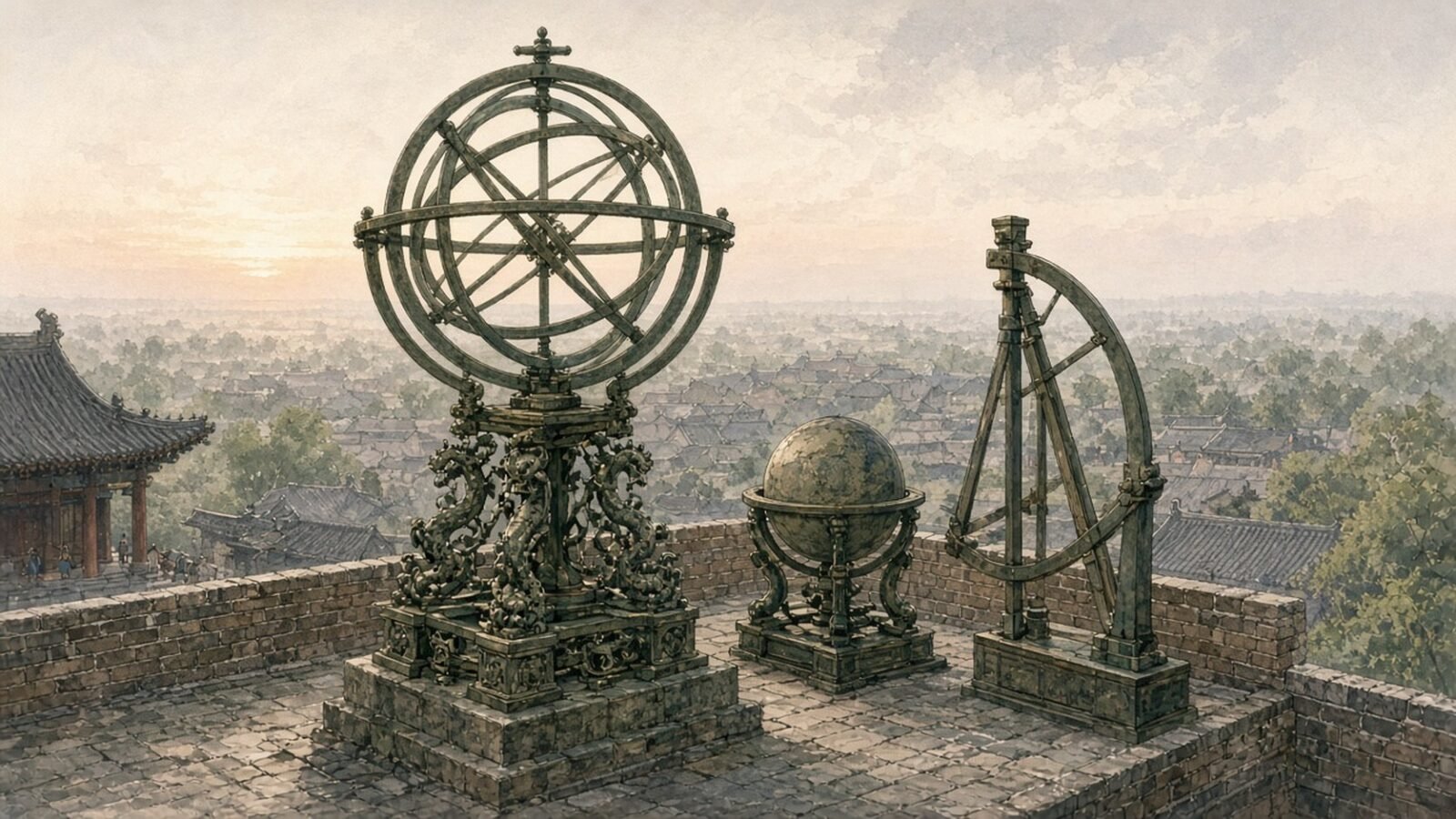
The most consequential Jesuit contribution was to Chinese astronomy. The Chinese calendar, which governed the timing of state rituals, agricultural work and imperial audiences, had been drifting from astronomical reality for centuries. The Jesuits, equipped with the European mathematical tradition and the recent improvements to the Alfonsine and Tychonic tables, were able to compute a more accurate calendar. Johann Adam Schall von Bell 湯若望 (1592–1666), who succeeded Ricci as head of the mission, presided over the reform of the calendar under the Qing in 1645. Ferdinand Verbiest 南懷仁 (1623–1688) continued the work, designed new astronomical instruments that still stand on the Beijing Ancient Observatory 北京古觀象台, and composed a comprehensive treatise on European astronomy for the Kangxi emperor.
The Jesuits also taught European painting at the Qing court. Giuseppe Castiglione 郎世寧 (1688–1766), an Italian Jesuit who arrived in Beijing in 1715, became one of the most accomplished court painters of the eighteenth century. His work combined the techniques of European oil painting with the materials and conventions of Chinese painting; his horse paintings, his flower paintings and his images of the Qianlong emperor remain among the most striking visual records of the Qing court. The Jesuits also introduced Western engraving, perspective drawing and anatomy into Chinese visual culture.
The exchange worked in both directions. The Jesuits learned Chinese. Joachim Bouvet 白晉 (1656–1730) wrote a treatise on the I Ching 易經, the Book of Changes, in which he argued that the hexagrams of the I Ching contained traces of ancient Mosaic monotheism and of Pythagorean mathematical philosophy. Dominique Parennin 巴多明 (1665–1741) translated Chinese medical texts into French and sent them back to Paris, where they influenced the development of European pharmacology. The European intellectual world of the late seventeenth and early eighteenth centuries was, for the first time, beginning to learn systematically about China, and the Jesuits were its principal informants.
IV. The Rites Controversy Erupts
The Rites Controversy, as it came to be called, was one of the longest-running theological disputes in the history of the Catholic Church. It began in the 1630s with the disputes between Jesuits and Dominicans in the Chinese mission, and it lasted in one form or another for more than a century. It involved the Pope, the Propaganda Fide (the Vatican congregation responsible for missionary affairs), the Inquisition, the religious orders, the Kangxi emperor, and ultimately the political survival of the Catholic Church in China.
The first formal papal intervention came in 1645, when the Sacred Congregation of the Holy Office of the Inquisition, under Pope Innocent X, condemned the rites at the urging of the Dominican faction. The Jesuits appealed, and in 1656 Pope Alexander VII reversed the condemnation, allowing Chinese Catholics to participate in the rites provided they were understood as civil acts. In 1669 Pope Clement IX confirmed Alexander’s position, and for a generation the matter seemed settled.
It was not settled. The dispute reopened in the 1690s when Charles Maigrot, the vicar apostolic of Fujian, issued a more rigorous condemnation of the rites and ordered his missionaries to refuse communion to any Chinese Catholic who continued to participate. Maigrot’s condemnation was endorsed by the Sorbonne and by the Propaganda Fide, and in 1704 Pope Clement XI issued a new decree, Cum Deus optimus, condemning the rites. In 1715 Clement XI went further with the bull Ex illa die, which declared that the rites could never be tolerated under any interpretation. The bull also required all missionaries in China to swear an oath that they would never permit the rites among their converts.
The decree put the Jesuits in an impossible position. To comply with the Pope was to break with the Qing emperor and to risk the entire Jesuit presence in China. To defy the Pope was to risk excommunication. The Jesuits argued, with some force, that the Pope had been misled by the Dominicans and by the Roman authorities who had never visited China and could not understand the actual practice of the rites. The argument was not heard. In 1742 Pope Benedict XIV issued the bull Ex quo singulari, definitively condemning the rites and ending the long debate.
V. Kangxi and the Limits of Accommodation
The Qing emperor Kangxi 康熙 (r. 1661–1722) was initially one of the most enthusiastic supporters of the Jesuit mission. He employed Jesuits as astronomers, mathematicians, painters, architects and diplomats. In 1692 he issued an Edict of Tolerance 容教令 that permitted Catholic worship throughout the empire. He made the Jesuit Joachim Bouvet his tutor in geometry and philosophy. He studied Latin, memorised Catholic prayers and, by some accounts, came close to baptism himself. He was, in short, the closest the Catholic mission ever came to a Chinese imperial convert.
The Rites Controversy ruined the relationship. As the papal position hardened through the early eighteenth century, Kangxi became increasingly frustrated. The Emperor’s frustration was not theological. He had no interest in the subtleties of the Dominican arguments about the nature of the rites. He had, rather, an imperial frustration. The Pope was a foreign ruler claiming authority over the rites by which Chinese subjects expressed their duties to family, teachers and the state. The Pope was claiming, in effect, to be able to dictate to the Son of Heaven what his subjects could and could not do. This was unacceptable.
In 1706 Kangxi issued an order that missionaries could remain in China only if they accepted the principle that the rites were civil acts. Those who refused were expelled. In 1720, when the papal legate Carlo Ambrogio Mezzabarba arrived in Beijing with a copy of Clement XI’s Ex illa die, the Emperor received him coolly and asked, in some form, why the Pope insisted on interfering in matters that were none of his concern. The legate offered eight “permissions” (ex quibus) that allowed Chinese Catholics to continue certain practices under restricted interpretations; the Jesuits accepted these as a partial accommodation, but the more rigorous missionaries refused. The result was that the Catholic mission in China split into two camps: those who obeyed the Pope and could not continue to evangelise, and those who obeyed the Emperor and were technically excommunicated.
The Kangxi emperor died in 1722. His son Yongzheng 雍正 (r. 1722–1735) was openly hostile to Christianity. In 1724 he issued a formal prohibition of Catholic missions, expelled most of the missionaries, and restricted those who remained to technical work at the court. The Qianlong emperor 乾隆 (r. 1735–1796) continued his father’s policy. The Catholic Church in China, which had perhaps two hundred thousand members at its eighteenth-century peak, declined rapidly; the official mission was reduced to a handful of artists, astronomers and translators serving the court.
VI. The Long Afterlife
The Chinese Catholic Church did not disappear. Despite the official prohibition, perhaps a hundred thousand Chinese Catholics continued to worship in clandestine communities, served by a small number of foreign missionaries who had remained under cover. Some members of the imperial family, including a Yongzheng prince who was secretly Catholic, kept the faith. The Beijing diocese persisted into the nineteenth century, when the arrival of French and Portuguese missionaries in the treaty-port era brought a new wave of Catholic expansion.
The Rites Controversy itself had consequences that extended well beyond the eighteenth century. The Chinese Catholic Church developed a distinctive character, deeply rooted in family practice and Confucian ethics, that distinguished it from Catholic communities elsewhere. The legacy of accommodation is still visible in the practice of Chinese Catholics today, who venerate their ancestors and honour Confucius in ways that would have surprised the Roman authorities of the eighteenth century.
The story also raises questions that go well beyond the history of Catholic missions. The encounter between Ricci and the late Ming literati was the first sustained attempt at intellectual translation between early modern Europe and Confucian East Asia, and it was in many ways a remarkable success. The Jesuits learned Chinese; the Chinese learned Latin and Euclidean geometry. The Jesuits produced a Chinese theological literature of high quality; the Chinese produced works of European learning that entered the curriculum of the Qing court. For two centuries the two traditions lived together in the same buildings, read each other’s books and argued with each other across a language barrier.
That argument failed in the eighteenth century, and it failed not because of cultural incompatibility but because of an unresolved question about authority. Who had the right to define the meaning of a Chinese ritual act: the Pope in Rome, the Emperor in Beijing, or the local Chinese Christian? Each of the three answered in his own person, and the answers were incompatible. The Pope insisted that religious authority resided in Rome. The Emperor insisted that sovereign authority resided in Beijing. The local Chinese Christian, who wanted to honour both his ancestors and his God, was left with the impossible task of being loyal to two masters at once.
Conclusion – The Translation That Failed
The story of the Jesuits at the Qing court is one of the great near-misses of cross-cultural history. For two centuries, from Ricci’s arrival in 1583 to the Yongzheng prohibition of 1724, the Catholic mission and the Confucian state coexisted in a working, if always fragile, accommodation. The Jesuits became Chinese in dress, language and many habits of thought. The Qing court became, in certain limited ways, European in astronomy, mathematics and painting. The translation between the two civilisations was, in some respects, extraordinarily successful.
It failed because of a question that neither the Pope nor the Emperor could resolve. Could a Chinese Catholic honour his ancestors? Could a Confucian official serve an emperor who claimed the Mandate of Heaven and a Pope who claimed authority over the souls of men? Could a civilisation whose moral order rested on the rites of family and state submit to a religion whose moral order rested on the commands of a universal Church?
The Rites Controversy was, in the end, less a theological dispute than a political one. It was a dispute about who had the authority to define the meaning of a ritual act. The Pope answered that he did. The Emperor answered that he did. Neither was willing to share the answer, and neither could impose it on the other. The result was that a working accommodation was destroyed by an argument that neither side could win.
The history of the Jesuits at the Qing court reminds us that cultural translation is always a political act. The meaning of a word, a rite, or a symbol is not a private matter; it is a public one, and the public authorities who define it shape what it is possible for human beings to be. The Jesuits tried to define the meaning of Confucian rites in a way that made Christianity possible. The Dominicans tried to define them in a way that did not. The Pope tried to define them in a way that suited Roman authority. The Emperor tried to define them in a way that suited Chinese sovereignty. None of them succeeded. The Chinese Catholics, caught in the middle, survived as best they could, and the tradition they preserved survives still.