
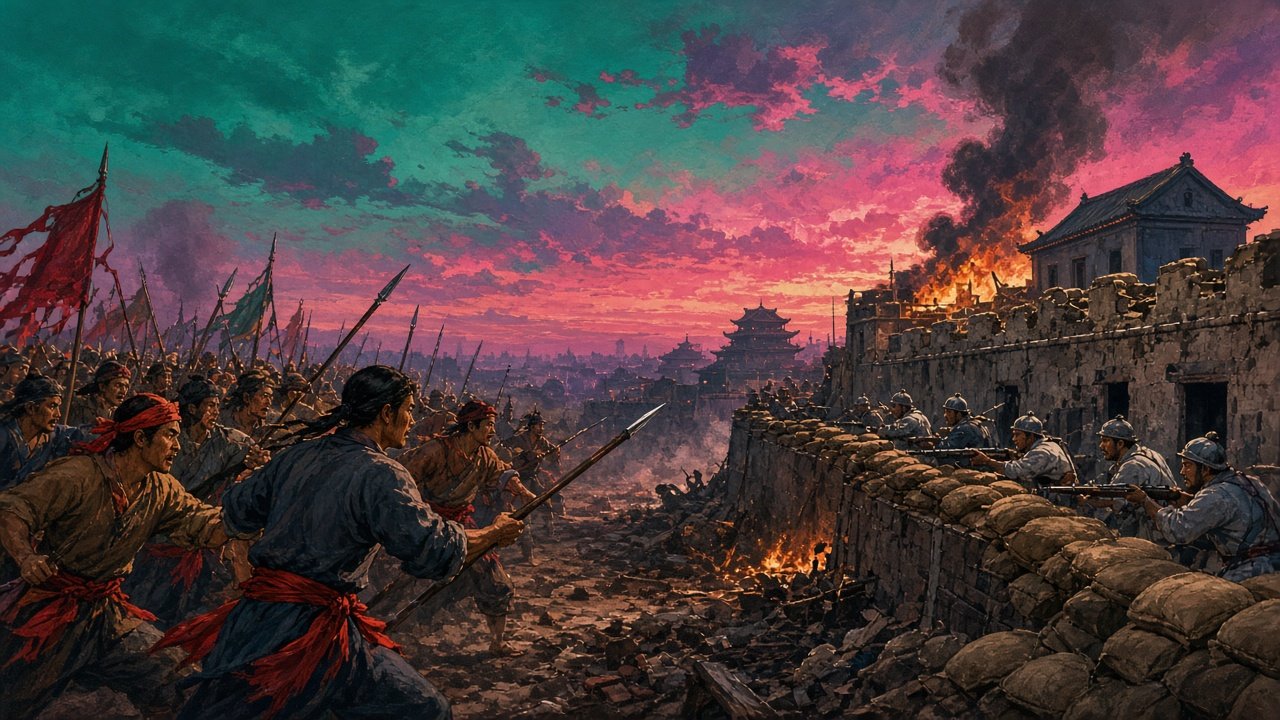
The Boxer Rebellion is too often told as a single picture: fists raised against churches, diplomats trapped behind Legation walls, and a multinational rescue column marching on Peking. That picture is not false. It is incomplete. The crisis of 1899–1901 was at once a popular anti-imperial uprising, a violent xenophobic and anti-Christian campaign, a Qing court gamble under Empress Dowager Cixi, and a culminating demonstration of the treaty world’s capacity to punish. To hold only the “patriotic resistance” frame is to erase murdered Chinese converts and the theatre of superstition that accompanied the movement. To hold only the “fanatic mob” frame is to erase drought, mission privilege, German aggression in Shandong, and the deeper structure of unequal treaties that made foreign persons and faiths unusually combustible symbols. An adult history needs the dual character intact.
The Boxers, more precisely the Yihequan, the Righteous and Harmonious Fists, emerged from the social ecology of the north China plain. Shandong and Zhili in the late 1890s were stressed by Yellow River flooding, drought, demographic pressure, and the dislocations of a commercialising countryside. Spirit possession, martial arts societies, and village self-defence traditions supplied organisational forms. Christianity, protected by treaty rights and consular power after the mid-century settlements, had become entangled with local lawsuits, property disputes, and the humiliation of seeing converts escape ordinary communal discipline under missionary shelter. Joseph Esherick’s classic social history remains essential here: the Boxers were not a centralised conspiracy exported from the palace. They were a decentralised popular movement that radicalised as local conflicts scaled upward.
Mission Christianity in late Qing China cannot be reduced to chapels and charity. Under the treaties, missionaries gained inland travel and residence rights that earlier Canton-system China had refused. French protectorate claims over Catholic missions, and later German ambitions after the Juye incident of 1897, tied evangelism to great-power politics. When a Chinese convert won a lawsuit with missionary backing, neighbours did not experience abstract religious liberty. They experienced a breach in the moral economy of the village. Boxer violence against churches and converts was therefore both prejudice and political vernacular: an attack on a visible node of foreign power inside Chinese society. That does not make massacre righteous. It makes it historically intelligible.
Through 1899 the Qing state’s response was divided. Some officials, notably Yuan Shikai in Shandong after his appointment, suppressed Boxers ruthlessly and preferred order to adventurism. Others, especially among conservatives at court and in parts of Zhili, saw in the Boxers a popular force that might be steered against foreigners without the cost of building a modern army. Cixi’s own position shifted with factional weather. She had crushed the Hundred Days’ Reform in 1898, feared foreign sympathy for the imprisoned Guangxu Emperor, and faced a court in which princes such as Duan argued for using the Boxers. The movement’s claim that spirit boxing made fighters invulnerable to bullets was militarily absurd. Politically it was intoxicating to men who wanted a cheap miracle against ironclads.
By spring 1900 Boxer bands were destroying churches and killing converts across the north. Foreign consuls demanded suppression. Railway and telegraph lines, the infrastructure of both commerce and foreign control, were cut. In June the crisis accelerated. The killing of the Japanese diplomat Sugiyama and the German minister Clemens von Ketteler, the concentration of foreigners and Chinese Christians in the Legation Quarter and Beitang Cathedral, and the arrival of Boxers in Peking’s streets forced the court’s hand into the open. On 21 June 1900 the Qing issued a decree that amounted to war against the foreign powers. Careful diplomatic historians stress how contingent this decision was: not an ancient civilisational destiny, but a fatal misreading of the balance of force in a fortnight of panic.
The Siege of the International Legations lasted fifty-five days. Inside the compound were diplomats, soldiers, civilians, and Chinese Christians whose presence alone complicates any simple “East versus West” morality play. Defenders improvised barricades from furniture and sandbags; food dwindled; sorties and sniping marked the days. At Beitang, Bishop Favier’s cathedral held under equally grim conditions. Qing regulars and Boxers were never a perfectly unified army. Some imperial troops fought hard; others hedged; southern governors quietly refused to turn the whole empire into a battlefield and pursued the “mutual protection” of the southeast. China in 1900 was already multiple polities under one dynasty’s thinning canopy.
The Eight-Nation Alliance of Austria-Hungary, Britain, France, Germany, Italy, Japan, Russia, and the United States assembled a relief force whose composition itself maps the late imperial world. Japan supplied the largest contingent of the march on Peking; Russia used the chaos to tighten its grip in Manchuria; Germany, after von Ketteler’s death, arrived with Kaiser Wilhelm’s notorious “Hun speech” rhetoric hanging over its troops’ conduct. The first Seymour expedition failed. Tianjin fell after bitter fighting. On 14 August 1900 the allies entered Peking, lifted the siege, and then visited upon the capital and its hinterland a revenge that included looting, rape, and indiscriminate killing of suspected Boxers. Narrative reconstructions and later scholarship on atrocity make clear that “civilised” rescue and colonial punishment were not opposites. They were sequential moods of the same campaign.
Cixi fled toward Xi’an with the court. The dynasty survived by accepting that it would negotiate under occupation. Li Hongzhang and other experienced managers of Qing weakness returned to the familiar craft of limiting damage through diplomacy after military disaster. The Boxer Protocol, signed on 7 September 1901, was a victor’s catalogue: punishment and execution of officials deemed responsible, a ban on civil service examinations in cities where foreigners had been killed, permanent foreign garrisons and the razing of the Dagu forts, a two-year prohibition on arms imports, and an indemnity of 450 million taels, more than the government’s annual revenue, to be paid over thirty-nine years with interest. Foreign troops on the Peking–Tianjin corridor institutionalised the lesson that the capital itself could be held hostage.
The indemnity’s afterlife is one of the episode’s bitter ironies. Portions were later remitted or redirected by some powers into educational programmes, notably the American Boxer Indemnity Scholarship that famously funded Chinese students, converting part of a punitive transfer into human capital pipelines. That conversion does not wash the Protocol clean. It shows how imperial domination could wear philanthropic clothing once military hierarchy was secure. Chinese nationalists remembered the debt; American liberals remembered the scholarships; both memories are incomplete alone.
What, then, of the Boxers’ dual character? As anti-imperial uprising, the movement struck at missionary empire, railway imperialism, and the psychic order of the treaty world. It expressed a rural northern China’s refusal to accept that sacred space and communal justice had been outsourced to consuls. As xenophobic violence, it murdered Chinese Christians whose Christianity was often as much a local social strategy as a theological conviction, and it clothed revenge in magical claims that guaranteed military catastrophe against modern rifles. Paul Cohen’s work on the Boxers as event, experience, and myth shows how later Chinese politics repeatedly rewrote the rising: condemned as superstition in May Fourth modernism, partially rehabilitated as anti-imperial struggle under the People’s Republic, and still unstable in popular culture. Myth is not a reason to avoid the archive. It is a reason to read the archive against the myths.
Cixi’s gamble looks, in retrospect, like the last great political fantasy of the high Qing court: that popular fury plus ritual monarchy could cancel industrial war. Yet Cixi was not a cartoon villainess invented by backhouse gossip alone. She had kept a dynasty afloat through earlier storms; she would later countenance New Policies reforms after 1901: education, military, administrative changes that amounted to a delayed modernisation drive. The Boxer year sits between her suppression of 1898 reformers and her post-Protocol reformism. That sequence suggests less a simple “anti-modern” essence than a ruler oscillating among survival strategies under impossible constraints. Gendered Orientalist portraits of a uniquely demonic empress have done as much harm to understanding as nationalist hagiographies of the Boxers as pure patriots.
Consequences for Qing reform were paradoxical. The Protocol’s humiliation discredited the old conservatives who had ridden the Boxer tiger. The New Policies followed: abolishing the examination system in 1905, attempting constitutional preparation, reorganising armies. These reforms were sincere in parts and insufficient in sum. They created new provincial elites and new expectations they could not satisfy, helping to set the board for 1911. In that sense the Boxers did not merely fail. Their failure reordered the dynasty’s last decade. Foreign privilege, meanwhile, was entrenched even as Chinese nationalism crystallised against it. The siege of the Legations entered Western memory as proof of Chinese fanaticism; it entered Chinese memory as proof that foreign guns could again dictate terms in Peking. Both memories trained the next generation’s politics.
Compare the Boxers briefly with the Taiping Heavenly Kingdom half a century earlier. The Taiping were a Christian-inflected millenarian rebellion against the Qing; the Boxers were an anti-Christian rising that the Qing briefly tried to ride. One tore the empire from within under a rival sacred kingship; the other invited the concert of powers to discipline the empire from without. Together they bookend a lesson about late Qing state capacity: the court could neither fully suppress nor safely instrumentalise mass religious politics once the international system had a veto over China’s internal order. That structural point matters more than moral scorekeeping about which rising was more “authentic.”
Western historiography has its own distortions. Victorian and Edwardian accounts revelled in the siege romance, the “defence of the Legations” as a colonial Thermopylae. Interwar and Cold War writings sometimes folded the Boxers into generic Yellow Peril. Late twentieth-century scholarship recovered social history, women’s experiences, convert communities, and the economics of mission. Chinese scholarship after 1949 emphasised anti-imperialism while often soft-pedalling the slaughter of converts; more recent mainland and overseas Chinese work has grown more willing to face the movement’s internal violence. Readers should beware any version that needs only heroes and demons. The Boxers were peasants and townsmen under ecological and political stress. The Alliance soldiers were professionals and conscripts of empires that looted as they “civilised.” Chinese Christians were neither traitors by essence nor protected innocents in the eyes of neighbours who had lost lawsuits to them.
For China’s longer arc of modern crisis, 1900 is a hinge between the Sino-Japanese defeat of 1895 and the republican revolution of 1911. Shimonoseki taught elites that Japan had stolen the Meiji march. The Boxer Protocol taught them that the dynasty could still stake the empire’s survival on magical popular mobilisation and lose the capital. Reformers concluded that institutional transformation could not wait. Revolutionaries concluded that the dynasty itself was the obstacle. Foreign powers concluded that China could be punished collectively without any one power yet able to swallow it whole, the classic condition of informal empire. The scramble for concessions intensified even as the Open Door notes tried to stabilise equal access among predators.
Contemporary Chinese politics still touches the Boxers lightly but persistently: as a cautionary tale about superstition, as a badge of resistance, as a museum episode inside the broader century of humiliation. Contemporary Western politics rarely remembers them at all, except as colour in a thriller. That asymmetry is itself revealing. For China, 1900 is part of the syllabus of why sovereignty is treated as existential. For much of the Atlantic world, it is a closed colonial adventure story. Closing the gap in knowledge does not require adopting Beijing’s catechism. It requires admitting that the siege and the Protocol were formative institutional events, not exotic anecdotes.
A further analytical caution. To call the Boxers anti-imperial is accurate; to call them a proto-national liberation army is anachronistic. Their horizon was local and cosmological before it was national in the modern sense. To call the Alliance a humanitarian police force is propaganda; to call every Allied soldier a cartoon imperialist erases the trapped civilians whose relief was also a fact. Dual character means refusing purification. The Boxer Rebellion was a popular explosion against a semi-colonial order and a spasm of communal murder; a court disaster and a stimulus to late Qing reform; a Western triumph that exposed Western brutality; a Chinese trauma that later politics would keep rewriting. History’s job is not to pick a mascot. It is to keep the whole mechanism visible (drought and doctrine, rifle and ritual, indemnity and aftermath) until the pretty pictures crack.
Operational military detail sharpens the political story. At Tianjin and along the Beihe, modern artillery and disciplined infantry beat Boxer mass tactics and Qing units unevenly equipped and commanded. Invulnerability charms failed in the only court that mattered: the open field. Yet guerrilla-style destruction of rail and wire had already shown how popular forces could hinder foreign logistics before decisive battle. The allies’ later punitive expeditions into the Zhili countryside were intended to re-teach fear. They also deepened Chinese hatreds that nationalist organisers would harvest. Military history and memory politics are not separate drawers.
Religion remains the most uncomfortable seam. Protestant and Catholic missions included doctors, translators, and educators who left complicated local legacies; they also included political entrepreneurs of the cross. Chinese Christianity included sincere belief, opportunistic conversion, and families trapped between community and chapel. Boxer killers did not conduct theological seminars before they burned. Allied troops did not conduct ethical seminars before they looted. A serious account names missionary imperialism without turning every Chinese Christian into a legitimate target, and names Boxer brutality without treating churches as islands of innocence floating above treaty power.
Russia’s Manchurian seizure during the Boxer year deserves underline because it links 1900 to 1904–05 and to later Chinese trauma in the northeast. While the world watched Peking, Russian troops entrenched in Manchuria, setting conditions for the Russo-Japanese War on Chinese soil, another reminder that “Allied” coordination never dissolved separate imperial appetites. The Boxer crisis was a multiplex of interventions, not a single crusade.
Women’s history, long sidelined in siege adventure tales, has begun to return through memoirs and mission archives: foreign women in the Legations, Chinese Christian women hunted as polluted by association, village women swept into spirit possession practices or widowed by reprisals. Gender does not decorate the story. It redistributes who counted as a political subject when banners and protocols were written by men.
Finance and logistics deserve one more pass because Protocol politics were not only ceremonial. Indemnity bonds tied Qing revenue streams to foreign creditors for decades. Railway guards and legation escorts normalised foreign military presence along the approaches to the capital. Arms embargo clauses attempted to freeze Qing rearmament while the same powers sold influence elsewhere. The architecture of constraint was bureaucratic as well as bayonet-sharp. Chinese state-builders after 1901 had to modernise under a ceiling designed by their punishers, a condition that radicalised some toward revolution rather than toward patient reform within dynastic forms.
Primary voices still startle. Missionary letters that mix genuine terror with racial contempt; Boxer placards that promise rain and the expulsion of foreign gods; Cixi’s edicts that swing from suppression to enlistment; Allied officers’ diaries that boast of loot. These are not illustrations for a predetermined moral. They are the friction that any honest synthesis must feel. Secondary literature that smooths them into a single national allegory is doing the reader a disservice.
Teaching the Boxers well means teaching sequence. Esherick’s social origins; the court’s June gamble; the fifty-five days; the August sack; the September Protocol; the New Policies; the road to 1911. Skip a step and the dual character collapses into slogan. Keep the steps and students can see how anti-imperial anger, anti-Christian violence, dynastic miscalculation, and imperial punishment locked together. That is the opposite of mood. It is mechanism.
The southeast mutual-protection arrangements of 1900 also deserve weight in any thesis about dual character. While Peking burned its bridges with the powers, viceroys such as Zhang Zhidong and Liu Kunyi effectively quarantined the lower Yangzi from Boxer war, negotiating local peace with foreign consuls. That split shows the Qing empire as a layered system in which provincial survival logics could diverge from court adventurism. It also shows why foreign powers could punish the north without facing a fully mobilised national war, and why later revolutionaries concluded that dynastic centre and provincial China no longer shared a single political nervous system.
Cartography of memory still matters. Yuanmingyuan ruins teach mid-century vengeance; the Legation Quarter’s former footprint teaches 1900; Lugou Bridge and Nanjing teach the 1930s. The Boxers occupy a peculiar place in that landscape: less museified than the Opium Wars in some tourist circuits, more awkward than the Anti-Japanese War because the victims include Chinese Christians and the perpetrators include Chinese villagers. Awkwardness is pedagogically useful. It resists the flattening of modern Chinese history into a single emotion.
If one must leave with a single thesis, let it be this: the Boxer Rebellion is the moment when China’s unequal-treaty system stopped being only a coastal and commercial grievance and became, once more, a war for the capital under the eyes of eight empires. Cixi’s court tried to surf a popular anti-foreign wave and was broken by it. The Protocol then hard-wired foreign military privilege into northern China while pushing the dynasty into reforms that undermined its remaining foundations. The Boxers’ fists were real. So were the converts’ graves. So were the Alliance’s bayonets and the indemnity bonds. Any story that drops one of those realities is not simplifying for clarity. It is lying for comfort.
In the end, the Boxer Rising is best taught as a systems event. Ecology plus mission privilege plus court faction plus international hierarchy produced an outcome none of the actors fully controlled. Cixi did not get a cleansed China. The Boxers did not get a land purged of foreigners. The allies did not get a permanently docile Qing. What all got was a harder, clearer map of power: who could occupy Peking, who would pay, and who would rewrite the story afterward. That map is why 1900 still belongs in any adult syllabus of modern China, not as folklore but as structure revealed by disaster. Huaxia readers can hold the dual character without apology: anti-imperial and xenophobic, popular and catastrophic, a Qing gamble and an Allied crime scene, a hinge between Shimonoseki and the Xinhai Revolution. Chronology, again, beats mood.