
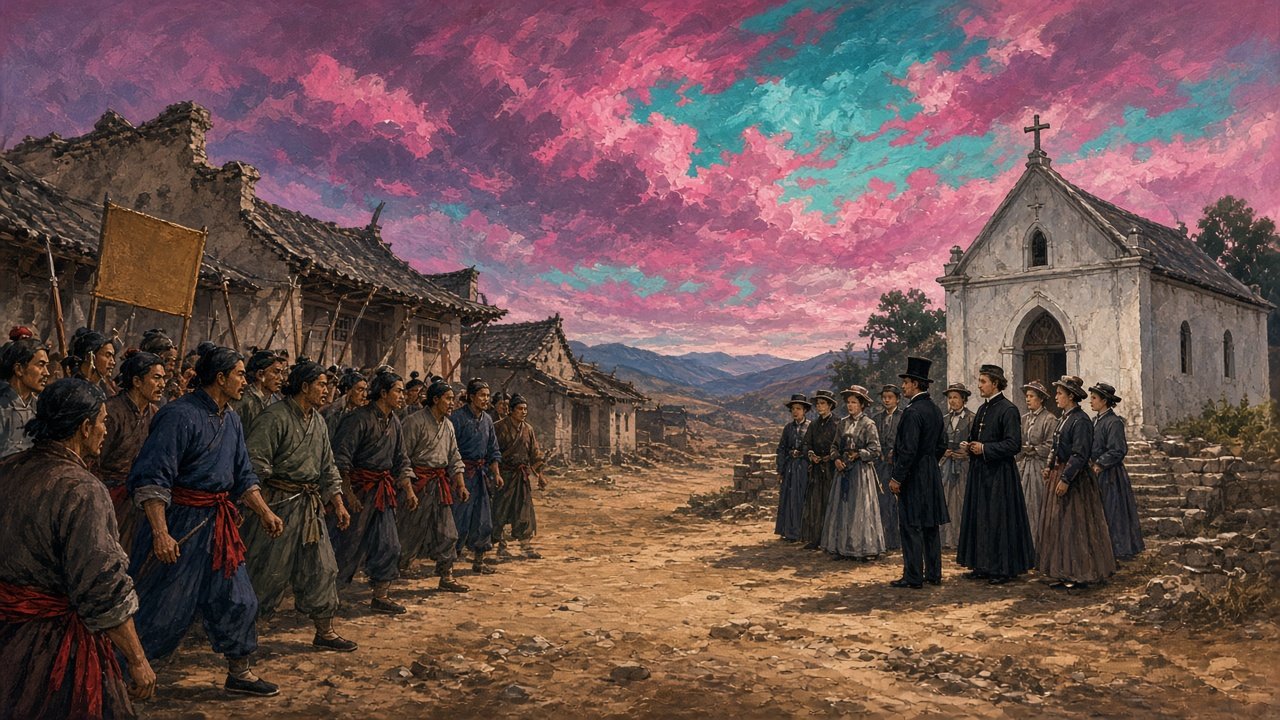
Western Yellow Peril stories cast China as an organised threat to white civilisation. Chinese “foreign devil” language ran the insult the other way. Words such as yangguizi, guizi, and related labels turned Westerners into demonic outsiders: polluting, greedy, and cosmically dangerous. The two vocabularies were not mirror images in every detail, but they were countervailing. Each side could narrate the other as less than fully human while insisting its own fear was realism. A factual account has to hold that symmetry without pretending the power balance was equal, and without turning either vocabulary into a sermon.
Yang means oceanic or foreign in the modern sense of people and goods from across the seas. Guizi means devil or ghost, a term of abuse with deep roots in Chinese popular speech. Put together, yangguizi and shorter forms like guizi marked Westerners as alien beings who did not belong inside the moral community. Related insults included hongmaozi, “red haired ones,” and for Chinese Christians erguizi or ermaozi, “secondary devils” or “secondary hairy ones.” The lexicon was insult first, theology second. It could be casual street scorn, pamphlet rage, or Boxer wartime dehumanisation.
The habit predates the Opium Wars in older patterns of naming outsiders, but it thickened after the mid nineteenth century settlements. Missionaries gained inland access, land rights, and the ability to shelter converts under treaty protection. Local lawsuits, festival refusals, orphanage rumours, and gentry tracts followed. Anti Christian literature revived older demonising images of foreign religion as heterodox and sexually polluted. Villagers who watched converts escape communal dues or win disputes with consular backing did not need a seminar in international law. They needed a word. Devil was ready to hand.
Missionaries and diplomats recorded the insult because it stung and because it explained hostility. Chinese officials sometimes discouraged the roughest street language while still resenting extraterritoriality. Treaty port Chinese merchants who traded with foreigners might use softer terms in business and harder ones in private. Language tracked interest. That variety matters. Foreign devil talk was not a single state ideology broadcast from Beijing. It was a popular and polemical toolkit used unevenly across class, region, and moment.
The Boxer rising of 1899 to 1901 pushed the vocabulary to its most organised extreme. Placards and rhymes blamed foreigners and churches for drought and disorder. The slogan fu Qing mie yang, support the Qing and destroy the foreign, made cleansing the land of yang a political programme. Boxers tabooed foreign goods and even the character yang itself at the height of the frenzy. Killing could be spoken of as butchering. Westerners were guizi; Chinese Christians were secondary demons. Paul Cohen, Joseph Esherick, and others who have worked the sources carefully show a social movement with local roots, ritual practices, and escalating targets. Demon speech was part of how the movement made killing thinkable.
From the Chinese popular religious angle, this was not random swearing. Calamity needed a cause. Foreign religion and foreign objects could be cast as blockers of rain, offenders of gods, and breakers of ancestor duty. Boxer texts accused foreigners of sexual chaos and physical otherness, including the nursery rhyme claim that devil children came from unnatural unions and that blue eyes proved the point. Modern readers can call this superstition. Historical readers should also call it a causal theory under stress. Drought plus mission privilege plus national humiliation made a demonic explanation socially available.
From the Qing court angle, the story is colder. Cixi’s faction moved from suppressing Boxers to using them, then faced catastrophe when the alliance armies took Peking. Official China had long oscillated between managing foreigners as useful barbarians and fearing them as wreckers of order. Foreign devil talk from below could be useful when the court wanted popular heat, and dangerous when it escaped control. The New Policies after 1901 show a dynasty trying to modernise instruments of power after a gamble that popular demonology could substitute for military reform. It could not.
Western observers often cited guizi language as proof of Chinese xenophobia and cruelty. They were not inventing the words. They were selective about context. They underplayed how gunboats, indemnities, and missionary legal shields taught many Chinese to experience the foreigner as an untouchable predator. A farmer who loses a lawsuit to a convert protected by a consul may reach for devil faster than for a treatise on sovereignty. Yellow Peril fiction and foreign devil speech fed each other internationally: each side could point to the other’s insults as justification.
Power asymmetry still matters. Britain, France, Russia, Germany, Japan, and the United States could occupy, fine, and rewrite Chinese law in ways Chinese crowds could not reverse in London or Washington. Foreign devil rhetoric could kill missionaries and Chinese Christians. It could not, by itself, impose a Boxer Protocol on Europe. Yellow Peril rhetoric helped sell exclusion laws and pulp novels in the West, and sat beside real imperial capacity. Countervailing does not mean identical. It means reciprocal dehumanisation under unequal force.
Twentieth century Chinese nationalism remade the older insult into a more modern story of humiliation and resistance. Schoolbooks and patriotic media retained the memory of foreign predation while often dropping the crudest ghost language for the language of imperialism and sovereignty. Yet guizi never fully vanished from street anger, wartime slogans, or online abuse in later eras. Japanese invaders were called guizi in the war of resistance. The term’s flexibility is part of its life. It can mean Westerner, Japanese, or outsider enemy depending on the fight.
Reformers and Westernising Chinese complicated the picture again. Students who studied abroad, treaty port journalists, and Self Strengthening officials needed foreign knowledge and often despised popular demonology as backward. They could still resent missionary arrogance and racial contempt from white society. A Chinese liberal in Shanghai might reject Boxer magic and still flinch at Fu Manchu posters. Countervailing narratives do not require every Chinese person to chant the same curse. They require a recognisable tradition of casting the foreigner as moral pollutant and political danger.
Compare the narrative machinery. Fu Manchu offers a Chinese genius threatening white order through conspiracy and science. Foreign devil talk offers Westerners threatening Chinese order through religion, goods, guns, and cosmic offence. One centres elite thriller fear. The other centres popular and ritual fear, later folded into nationalist pedagogy. Both reduce a complex opposite population to a hostile essence. Both can coexist with curiosity, trade, and selective admiration. Chinese consumers bought Western clocks while calling their sellers names. Western readers hired Chinese laundrymen while devouring Rohmer.
Indifferent audiences exist on the Chinese side too. Many villagers who used guizi were not theorists of world politics. They were naming a local pest: the chapel that split the village, the convert who would not pay festival dues, the rumour about orphans. Indifference here means lack of systematic Sinology about Europe, not lack of feeling. Feeling was intense. Analysis was thin. That is parallel to the Western clerk who feared Chinese genius without reading a Qing memorial. Sticky words do the work of thought.
A factual essay should also register internal Chinese criticism of foreign devil excess. After the Boxer disaster, officials and intellectuals who wanted a stronger state often treated the movement as a cautionary tale: popular fury without modern arms invites harder foreign punishment. Christian Chinese survivors remembered terror from neighbours, not only solidarity against imperialism. Any account that keeps only the anti imperial dignity of guizi language and drops the murdered converts is incomplete. Any account that keeps only fanaticism and drops treaty violence is also incomplete.
Sources help keep the temperature honest. Boxer placards, missionary letters, local gazetteers, and later oral histories do not say the same thing. Missionary archives emphasise martyrdom and Chinese superstition. Chinese nationalist histories emphasise invasion and popular resistance. Social historians emphasise drought, tax, and village structure. Read together, they show foreign devil thinking as a real speech practice with lethal peaks, not as a Western invention projected onto China, and not as the whole of Chinese attitudes toward the outside world.
Linguistically, devil talk sits inside a wider Chinese practice of marking the strange as ghostly or bestial when social boundaries fail. That does not make it uniquely Chinese. Europeans called enemies Huns, vermin, and worse. The comparative point is that modern Sino Western conflict activated old naming tools on both shores. What was distinctive was the treaty structure that made foreigners unusually hard to punish locally while making their protected converts unusually visible. Demonology followed the legal fact.
Treaty port life shows the contradiction daily. In Shanghai or Tianjin one could find Chinese clerks in foreign firms, compradors enriching themselves as intermediaries, and street kids shouting guizi at sailors. Collaboration and contempt shared the same streets. Yellow Peril novels rarely admitted Chinese complexity. Foreign devil rhetoric rarely admitted Western individuality. Mass names are blunt instruments. They survive because blunt instruments work in crowds.
Japanese imperialism scrambled the categories again. For Chinese patriots in the 1930s and 1940s, the primary guizi were often Japanese soldiers, while Western allies could be temporary partners. The word tracked the front line. That mobility warns against treating foreign devil thought as a fixed anti white essence. It was an enemy technology of speech. Enemies changed. The technology remained.
Today’s residual uses, whether in stadium abuse, online flame wars, or tourist anecdotes, are thinner echoes of the late Qing crisis. They still matter for diplomacy and feeling. They should not be anachronistically read back as if 1900 were eternal. Nor should 1900 be sanitised because the vocabulary later softened in official prose. The historical core is the period when yang and guizi helped organise popular violence under a failing dynasty and a predatory treaty world.
What follows for the paired reading with Yellow Peril and Fu Manchu? Late Qing and republican China did not only receive Western racial fantasy. It generated its own demeaning names and stories about Westerners. Those names rose with unequal treaties, mission conflict, and national crisis. They exploded in 1900. They left residues in patriotic education and popular abuse. Western pulp made Chinese intellect look like a conspiracy against white civilisation. Chinese demon speech made Western presence look like a pollution against Chinese order. Between those two factories of fear, indifferent people on both sides learned who to distrust before they learned much else.
Gentry anti Christian tracts of the late Qing deserve separate mention because they were not only peasant rage. Educated local elites feared loss of ritual authority and circulated arguments that mixed doctrinal critique with grotesque rumour. Pig puns on the Lord, tales of organ theft, and sexual slander travelled in print. Missionaries answered with their own print war. The foreign devil image was thus produced in a pamphlet economy as well as in Boxer possession rituals. Literacy and illiteracy shared enemies.
Foreigners inside China heard the words at different volumes. A customs officer in a treaty port, a nun in a village, and a railway engineer under escort did not inhabit the same risk world. Some Westerners collected guizi as a colourful anecdote. Others buried colleagues. That range should warn against treating every utterance as a prelude to massacre. It should also warn against treating massacre as unconnected to the utterance. Speech prepares, excuses, and after the fact narrates violence.
Paired with the Fu Manchu essay, the teaching point for huaxia.click readers is simple. Sino Western mistrust in the modern era was cocreated in popular culture and popular religion, then amplified by unequal treaties and real wars. One side’s pulp genius conspiracy and the other side’s oceanic devil were both crude. Both were historically effective. Understanding China and the West in that period means listening to both factories of contempt without appointing either as the sole original sinner.
The point is not to declare a moral draw and walk away. It is to describe the exchange accurately. Empires that can burn a Summer Palace and impose protocols should not be surprised when crowds answer with devil labels. Crowds that butcher neighbours as secondary demons should not be romanticised as pure resistance. Sax Rohmer sold one fear to Western readers who mostly wanted entertainment. Chinese placards and street speech sold another fear to people who mostly wanted rain, justice, and relief from humiliation. Both fears were historically produced. Both shaped what China and the West thought they were seeing when they looked at each other.