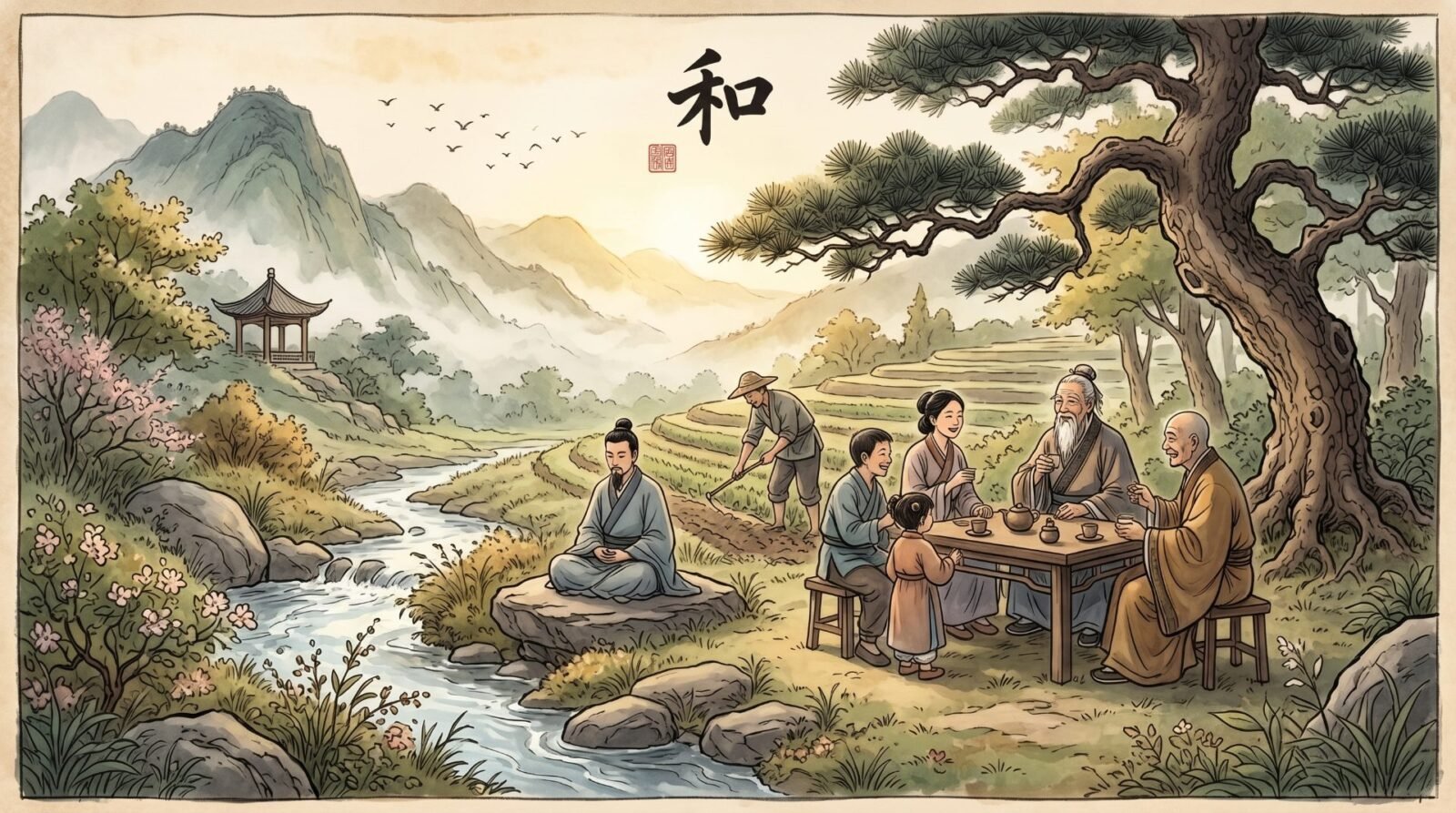
On a cold morning in the ninth century BC, a duke of Qi came back from hunting and found his minister Liangqiu Ju waiting for him at the tower. The duke was delighted. He said that of all the men in Qi, only Ju was truly in harmony with him. His minister, Yan Ying, was not impressed. Ju only agreed with the duke, he said. That is sameness, not harmony. The two are not the same thing at all. When the duke asked him to explain, Yan Ying reached for the nearest image available, which was soup. Harmony, he said, is like making broth: water, fire, vinegar, fermented sauce, salt and plums, used to cook fish and meat. The cook balances them, adds what is missing, takes away what is too strong. Water added to water makes nothing anyone can drink. A zither played on one note is silence. Harmony and sameness are not the same, and the difference is the whole subject.
This dispatch is about that subject. Harmony in China is not a mood or a decoration. It is the organising idea underneath three thousand years of ritual, music, medicine, architecture, food, poetry and statecraft, and it is still doing work in ordinary Chinese speech today. It has a Chinese name, hé (和), and the character is older than Confucius, older than the Zhou, and older than the earliest oracle bones. Its original form was not abstract at all.
The character that was a band of pipes
The character as we know it, 和, is a mouth on one side and a stalk of grain on the other. That is the simplified, familiar shape. The version it replaced was older and considerably more musical. In the oracle bone inscriptions of the Shang, which date from the second millennium BC, harmony is written 龢, a character of some twenty-two strokes. On the left it shows 龠, a row of bamboo pipes, the ancestor of the panpipe and the sheng. On the right it shows 禾, a standing stalk of millet, standing there largely as the sound element that carries the reading hé. The pipes carry the meaning. Harmony began as a picture of a pipe band.
When the character was written down in the second century AD, the Shuowen Jiezi dictionary recorded two entries: 和, glossed as “to correspond”, built from mouth and grain, and 龢, glossed simply as “to tune”, built from the pipes and grain, and read the same way. The older form was not a different word. It was the same word with the instrument still attached. Over the following centuries the strokes were dropped, the pipes went, and the mouth moved to the other side of the grain. What survived was a mouth and a crop.
There is a second line of argument about the etymology, worth stating because it is held by serious scholars and it does not settle the question. A study of the Shang inscriptions published in the Zhongguo Shehui Kexue in 2012 argues that the oracle bone form is a mouth enclosing a stalk of grain, and that the original sense was praying for a harvest: asking, with words, for grain to ripen. The abstract concept of harmony, on this reading, was built later on the concrete noun of the crop. Which story you prefer depends on how literally you trust a shape carved on bone three thousand years ago. Both routes end in the same place: a pipe band and a field, sound and grain, brought together in one graph.
What is not in dispute is the direction of travel. Every derivation of hé in later classical Chinese begins in music and expands outward. The Shangshu, the Book of Documents, has the Yellow Emperor’s successor appoint a music master and describe the point of the appointment: “Poetry expresses the intention, singing prolongs it, the voice follows the prolongation, the pitch pipes tune the tones. The eight kinds of instrument are brought into harmony, none overpowers the others in its turn, and heaven and men are brought into accord.” The eight instruments are named by the material they are made from: metal, stone, clay, hide, silk, wood, gourd and bamboo. Gold, stone and clay do not blend. They are made to be made into one thing, and the pipes are what does it.
The two characters that carry the argument
Almost everything difficult about harmony in Chinese thought comes from a second character: 同 (tóng), sameness, identity, the same. The classical literature does not treat harmony as the opposite of conflict. It treats it as the opposite of sameness. That is a very different move, and it is the single most important thing to understand about the tradition.
The earliest surviving statement of it comes from a conversation recorded in the Guoyu, the Discourses of the States, at the end of the Western Zhou. A Zhou grand astrologer named Shi Bo is asked by the Duke of Zheng whether the Zhou house is going to survive. He says no, and he explains why in a sentence that has been quoted for two thousand years: “Harmony and substance give birth to things; sameness does not carry on.” He expands. To let one thing balance another is called harmony, so that things flourish and gather. To add sameness to sameness exhausts itself. One sound alone is not music. One colour alone is not pattern. One taste alone is not a flavour. One thing alone cannot be measured. And he adds the detail that makes the whole argument concrete: the ancient kings combined earth with metal, wood, water and fire to make the hundred things. Mixing is how you get things. Repetition is not.
The Chinese word for contradiction is 矛盾 (máodùn), which is formed from the two identical-looking halves of a spear and a shield. That is an aside worth leaving alone. The point to take from Shi Bo is narrower and stranger. He is not saying that differences are valuable in the way a modern liberal would say it. He is making a claim about how things come into being at all. Harmony is generative. Sameness is sterile. The test of any proposed harmony is whether it produces something that did not exist before, or merely repeats what was already there.
A modern study of early Chinese generative thought makes the same point from a philosophical direction. It argues that Shi Bo’s formula is one of the earliest answers in China to the question of how things arise, and that the answer is never a creation from nothing. It is always the meeting of unlike materials. Water added to water stays water. That is the state of affairs the formula is written to exclude.
The broth on the table
Return to the soup, because the full passage is better than the summary and it is one of the sharpest pieces of political thinking in the classical corpus. The exchange is dated to the reign of Duke Jing of Qi, who died in 490 BC. Yan Ying’s argument runs like this.
“Harmony is like making soup. Water, fire, vinegar, sauce, salt and plums are used to cook fish and meat, boiled over firewood, and the cook brings them into harmony, matching them by flavour, supplying what falls short and draining away what overflows. A gentleman eats it and his heart is made level. So it is between ruler and minister. What the ruler thinks right has a fault in it, and the minister brings him the fault to complete what is right. What the ruler thinks wrong has a rightness in it, and the minister brings him that rightness so the wrong can be removed. So government is level and does not clash, and the people have no heart to dispute over.”
Then the music, which is the same argument in a different key: “One breath, two bodies, three categories, four objects, five tones, six pitch pipes, seven notes, eight winds, nine songs, completing one another. Clear and muddy, large and small, short and long, quick and slow, sad and happy, hard and soft, late and fast, high and low, coming and going, dense and sparse, assisting one another. A gentleman hears it and his heart is made level. His heart level, his virtue harmonious.” Then the verdict on Liangqiu Ju: “He is not like that. What the ruler thinks right, Ju says is right. What the ruler thinks wrong, Ju says is wrong. To add water to water, who can drink it? A zither and se played on a single note, who can listen to it?”
Two things are worth noticing. The first is that Yan Ying is not asking for a consensus in which everyone ends up saying the same thing. He is describing a working relationship in which the minister’s function is to supply the missing half of the ruler’s judgement. Harmony is what happens when the ruler’s decision and the minister’s objection combine. It is a procedural idea about decision making, dressed as a recipe. The second is that his closing images are a pot of soup and a pair of stringed instruments. Neither can be made out of a single ingredient or a single note. Harmony is not a mood that a group can decide to have. It is an artefact of combination, and it has to be remade every time.
The State Council’s own English account of the story notes the point that the duke was describing a relationship he had mistaken for harmony precisely because it was pleasant. Liangqiu Ju agreed with him in everything. That felt like peace. It was the opposite of it.
What Confucius made of it
Confucius inherited the distinction and gave it its most famous form in a single line of the Analects: “The exemplary person harmonises but does not merely agree; the petty person agrees but does not harmonise.” An earlier dispatch on Confucius covers the life and the reception. What matters here is the shape of the claim. Confucius is not describing a temperament. He is describing a standard of conduct that can be tested, and the test is what happens when someone in authority says something wrong. A harmonising person and an agreeing person behave identically in easy conditions. The difference only appears under pressure, and the difference is everything.
He also put harmony at the centre of ritual, which surprises people who think of him as a moralist. In the first book of the Analects his disciple You Ruzi says: “In the use of ritual, harmony is the most precious, and this was the beauty of the way of the ancient kings.” Confucius does not leave that unqualified. He immediately adds the limit: things that cannot be done, and those who know how to harmonise without the measure of ritual, will not succeed either. Harmony without ritual is not freedom. It is dissolution. This pairing, harmony inside form, is the mechanism of the whole Confucian tradition and it is where it differs most sharply from a purely romantic idea of peace.
The Doctrine of the Mean gives harmony its most systematic statement, and it does something unexpected in the process. It separates two words that are usually run together in translation. When pleasure, anger, sorrow and joy have not yet been stirred, that is called zhong, the centre or equilibrium. When they are stirred and each one arrives at its proper measure, that is called hé, harmony. Equilibrium is the great root of the world; harmony is the universal road. Carry them to their fullest and heaven and earth will be set right and all things will be nurtured. The passage is short and the logic is exact.
The distinction matters because it locates harmony in the middle of a process rather than at its end. Equilibrium is the state before feeling. Harmony is what feeling becomes when it is properly expressed, which means it cannot be reached by suppressing feeling and cannot be reached by letting feeling run. A muted person is not harmonious. A calm person who then acts correctly in an angry situation is. Harmony is a competence, and it has to be practised the way any competence is, in the actual situation, under actual pressure.
Music as the state of the nation
The classical literature is full of sentences that treat music as a diagnostic instrument for public life. The Book of Rites, in the chapter on music, says that music is the harmony of heaven and earth, and ritual is their order: because of harmony all things are transformed, because of order all things are distinguished. It then states the two great cosmologies of culture in two clauses. Music makes for sameness, ritual makes for difference; sameness produces closeness, difference produces respect. Alone the first produces a soft society with no order. Alone the second produces a cold society with no warmth.
The same chapter gives the political reading directly. “The music of a well-ordered age is peaceful and joyful, and its government is harmonious. The music of a disordered age is resentful and angry, and its government is perverse. The music of a dying state is mournful and longing, and its people are in distress. The way of sound is in correspondence with government.” This is not a decorative conceit. It is a diagnostic claim about a whole civilisation, made by people who believed that the sound a society produced would reliably reveal what the society was doing.
It is worth seeing how much work this carried. The Yueji, the chapter on music, available in full at the Chinese Text Project, develops it into a theory of education: music is what cultivates the mind, and a cultivated mind becomes easy, upright, honest and forgiving. Confucius put the same three-stage claim in the Analects: “I stir things with poetry, I establish myself with ritual, I complete myself with music.” Music is the finishing move, and the finishing move is where the harmonising happens.
And then there is the set of bronze bells excavated at Suizhou in 1978, 433 BC, sixty-five bells hanging on a three-tiered lacquered frame. It is the most physically convincing argument for harmony the record contains, because the harmony is built into the material. Different bells carry different tones, the tones depend on the alloy as well as the shape, and the whole set only makes a coherent scale if the alloys were composed with a knowledge that no surviving text describes. An archaeology that plays them has recovered a technical argument for a philosophical claim: that the system works because the parts were made to differ.
The Daoist version is not the same idea
It is easy to assume that hé means roughly the same thing to a Confucian and a Daoist. It does not. The word appears in the Daodejing in a form that sounds like a contradiction until you sit with it. Chapter 4 says the Dao blunts its own sharpness, untangles its own knots, harmonises its own lustre and joins itself to the common dust. Chapter 56 repeats the phrase almost verbatim, in a list of six things done by the one who knows.
Compare the shape of the two traditions. Yan Ying’s cook adds vinegar and drains it off. That is active, skilled, deliberate intervention in a material situation. The Daoist’s harmony is subtraction. Blunt the edge, loosen the knot, soften the glare, sink into the dust. The chapter is short and worth reading whole. Neither version is the other’s opposite, but they are genuinely different proposals about where harmony comes from. One says it comes from attention and adjustment. The other says it comes from not forcing, and warns that the moment you impose a pattern you have lost the thing.
There is also a cosmological use that has no Confucian equivalent. In chapter 42 the Dao gives birth to one, one to two, two to three, three to all things, and “all things hold yin on their backs and embrace yang, and through the blending of the energies they reach harmony”. Harmony there is not a virtue and not a method. It is the name of the process by which opposites are conjoined. The same thought appears in the Zhuangzi: yin at its height is freezing, yang at its height is boiling, the chill comes from heaven and the warmth from the earth, and the interaction of the two establishes harmony, so that things are born.
The standard philosophical account of yin and yang makes the underlying structure explicit. Yin and yang are relational rather than static opposites: darkness is yin in relation to light, cold in relation to heat, stillness in relation to activity. Health is their dynamic balance and disease is the loss of it. The Huangdi Neijing, the foundational medical text, builds the whole physiology on that pair, and the treatment principle follows directly from it: the physician’s job is not to replace a deficient substance but to restore a relation.
The diagram that made the idea visible
For most of its history harmony was written in words, in sentences about soup and pipes and pitch. It became an image in the Song dynasty, and the image has since travelled further than any Chinese philosophical text. The taijitu, the Diagram of the Supreme Ultimate, was set out by Zhou Dunyi between 1061 and 1067 in an essay of about 249 characters. He described a void giving rise to the Supreme Ultimate, the Supreme Ultimate dividing into yin and yang, and yin and yang giving rise to the Five Phases and then to the myriad things.
What the diagram does, visually, is refuse to separate the two halves. The dividing line between dark and light is not a straight edge and not a gap. It is an S, so that each half contains a curve of the other, and the whole figure is a circle, so that neither side has an outside. The two dots inside the halves carry the argument without any commentary: the seed of yang is inside yin and the seed of yin is inside yang. Nothing in the picture is complete on its own account.
Its history is a good corrective to the idea that Chinese philosophy arrived fully formed. The circular form with the swirling halves and the two dots does not appear in any Song text. Zhu Xi, the dominant Neo-Confucian of the twelfth century, argued for decades about whether Zhou Dunyi wrote it himself or received it from a Daoist line, and the dispute between him and Lu Jiuyuan over the words “boundless is the Supreme Ultimate” ended a friendship. By the late Ming the familiar icon was in wide circulation. The textual record of the argument is preserved at the Chinese Text Project. A tradition that can dispute its founding image for two hundred years and still end up with one is a tradition arguing, not a tradition repeating.
Harmony in the body
The most sustained practical application of the idea in Chinese culture is medicine, and it is not a metaphor. When you walk into a traditional Chinese clinic the consultation is diagnostic in a way that feels different from a Western one, because the vocabulary is relational. Yin and yang do not name substances. They name a relationship between substances, and they are always relative: whether something is yin depends on what it is being compared with.
The Neijing separates the organs into pairs, five solid organs classed as yin and six hollow organs classed as yang, and connects each pair by channels so that the circulation of the two is a physical fact in the model. Health is the flow. The text’s own formulation for imbalance is blunt: when blood and qi are not in accord, a hundred illnesses arise. A physician reads the pulse not to find a fault but to find the place where a relationship has slipped.
This produces a distinctive clinical logic. The treatment is rarely to replace what is missing. It is to adjust what is excessive and support what is deficient, which means the therapeutic gesture is always relational. It also makes the boundary between medicine and everyday life thin, since the same text prescribes a seasonal routine: in spring walk about in the courtyard, in autumn rise with the cock, in winter wait for the sunlight. To be healthy is to be in phase, and phase is a relation to the weather and the calendar rather than a property of the body alone.
It is worth saying where this goes wrong, because the honest version of this essay includes the costs. A relational model makes it harder to isolate a single failing cause, and it makes a system that treats the whole harder to test than one that treats a mechanism. The dispatch on Li Shizhen and the Materia Medica shows the same framework at its most systematic, and also shows how far patient observation could go without the instruments that arrived later. What the model gave was coherence, and coherence is not the same as accuracy.
Harmony as a way of running a family and a state
Underneath most of the classical political vocabulary there is one word, li, ritual propriety, and the relation between li and hé is the mechanism of the whole system. The dispatch on the last hereditary Confucian follows what happened when the ritual stopped carrying authority. In the classical account, harmony does not replace distinction, it depends on it. The Book of Rites states the pair outright: music makes for sameness, ritual makes for difference, and a society needs both. Distinction without affinity is a cold society. Affinity without distinction is a society that dissolves.
That is why the harmony being sought is never harmony for everyone. It is harmony for the roles, which is a much more specific and much more demanding claim. The Book of Rites describes the ideal in the passage usually called the Great Unity, and it is worth reading for what it assumes. “When the Great Way prevails, the world is shared by all. The worthy and the capable are chosen, trust is kept and goodwill cultivated. People do not treat only their own parents as parents, nor only their own children as children. The aged are supported to the end, the strong find work, the young are reared, and the widowed, the orphaned, the childless and the disabled are all cared for.” The passage then says conspiracies do not thrive, theft does not occur, and people do not shut their doors when they go out. That is the term this essay is about, datong, the Great Unity, and it is a tong, not a hé. The great community, in other words, is the one place the tradition explicitly asks for sameness, and it is placed in a lost golden age rather than in the future.
Set beside the broth, it is clear the tradition did not confuse harmony with comfort. The two images are opposites in one respect: the soup is the product of continuous adjustment between people who are not alike, and the Great Unity is the condition in which likeness is achieved. The classical view does not think the second can be engineered from the first. It is a memory of a state that has been lost, and it functions as an argument about how far the first has degraded.
The dispatch on the living architecture of Chinese social life covers what happened to the working mechanisms in the twentieth century. In practice the Chinese twentieth century ran the two halves of the relation in the opposite order. Mencius is the source for the sequence that shaped the state’s self-description: the people are most important, the state comes next, the ruler is last. The revolutionary state inverted it and made the party first, and in doing so removed the middle term that made the doctrine a limit on power rather than a description of it.
Harmony between states
The tradition had a word for making peace with another people by marrying into them, and it used the harmony character at the front. Heqin (和親), peaceful kinship, first appears in the Zuo Zhuan in a general sense of peace between neighbours and then becomes, in the early Han, a specific policy. The record is unusually well documented: after the Xiongnu surrounded the founder of the Han house in 200 BC, his minister Liu Jing proposed sending a woman of the imperial family and annual payments, and the resulting treaty set the two states as brotherly, fixed the Wall as the border, and established a market.
The interesting part is that the Han did not think of this as charity. The payments were framed as the ritual dowry owed to an equal, not as tribute owed to a victor, and the whole arrangement was constructed so that the next Xiongnu leader would be a grandson of the Han house and so be bound by the filial obligations of a Confucian family. It failed on its own terms, for the ordinary reason that such plans fail, which is that the other party has no intention of being caught in the trap. Wang Zhaojun, sent to marry the Xiongnu chanyu Huhanye in 33 BC, is the most famous case and the last of its kind under the Han.
What the policy reveals is that harmony between states was understood as a constructed artefact, like the soup, requiring active maintenance and a steady supply of the right ingredients. It also reveals what the tradition knew and the modern international system had no word for at the time: peace between unlike peoples is achievable, but it is achieved by paying for it and by building a framework in which each side can tell a story about the arrangement that its own traditions find meaningful.
Harmony at the table
Every classical idea in this essay eventually turns up somewhere physical, and the easiest place to find the doctrine of harmony being practised is an ordinary Chinese banquet. The room is arranged so that nobody sits at the head. The table is round, or made up of round tables pushed together, and the dishes are set in the middle on a revolving tray so that everything is within reach of everybody. There is no place on that table where the person who matters most is sitting at the end of a line of lesser people facing them.
The seating still has a grammar, and it is a grammar about who is owed attention. In most banquet halls the seat facing the door is the seat of honour, because a guest arriving from the corridor can go straight to it without crossing in front of anyone. The host sits with their back to the door, so that the room is watched from the place where the host can see it. The arrangement is not equality in the Western sense, because rank is fully acknowledged and carefully placed. It is a different proposal about where conflict goes. In a line, the ends fight. In a circle, everyone can see everyone, and the worst of it can be absorbed by the people nearest to it.
What makes this worth calling harmony rather than etiquette is the treatment of the food itself. A dish is never served to one person. It arrives in the middle, set down so that a guest can take a piece without reaching across anybody, and shared from then on. The platters accumulate until the table is crowded, and the crowding is the point, because a banquet is constructed as an accumulation of unlike dishes that have to be eaten together. It is the broth again, at a larger scale, and the same rule governs it. Nothing on the table is complete in itself and nothing is served alone.
The reunion dinner of the New Year is the version with the pressure on. The whole family is expected at it, including the unmarried, the widowed and those who could not afford the journey, and the reason given is that a table with an empty chair at it has failed. The dispatch on the Suzhou gardens describes a culture that thinks hard about how to arrange people and space so that the arrangement keeps producing rather than merely repeating. The banquet is that instinct in domestic form.
The word in ordinary speech
Most people who use hé do so without any sense of doing philosophy, which is one of the better reasons for trusting it. The character turns up constantly in casual compounds, and the compounds all lean the same way. Peace is hépíng, hé plus peace, so the word for the absence of war is built on the word for the right relation between unlike things. Harmony between families is hé mù. Mild, of a manner or a climate, is wēn hé. Amiability is hé qì, and there is a proverb about it that hangs in a great many shop doorways, hé qì shēng cái, harmony brings wealth, usually printed beside a grinning mask.
The word has a second life that has nothing to do with any of that. Chinese uses hé as its ordinary conjunction, the word you reach for in English when you say “and”. I and he went to the market together is written with hé between the two names. It is the joining word of the language, the character that performs the act of putting two things next to each other, which is a neat accident for an essay about the relation between two unlike things.
It is also a surname. The most famous bearer of it is Heshen, the Qianlong minister whose corruption became so notorious that he was executed in 1799, days after the new emperor took the throne. The name means harmony. Historians have had a good deal of fun with that, and there is a real point under the joke. A word that names the highest civic virtue in a political culture will happily go on being a man’s family name, in the same way that a word for peace will happily name the man who sold weapons.
Where the two characters drifted apart
Every culture’s central terms drift. The specific drift in this case is that hé, which began as a band of pipes playing together and became an account of how differences combine into a whole, came to be used, especially in the twentieth and twenty-first centuries, to mean something much thinner: absence of conflict.
The drift is documented. In 2002 the Sixteenth Party Congress adopted building a more harmonious society as a national objective. In October 2005 the phrase became the guiding principle of the Eleventh Five-Year Plan. In October 2006 the Sixth Plenum of the Sixteenth Central Committee passed formal resolutions on building a harmonious socialist society, and the communiqué called social harmony the intrinsic nature of socialism with Chinese characteristics. On the same trip, on 15 September 2005, President Hu took the phrase to New York. The white paper on China’s peaceful development that December devoted its final chapter to building a harmonious world of sustained peace and common prosperity, and the speech at the United Nations used the vocabulary of the broth almost without noticing, arguing that the differences between civilisations are what allow them to learn from one another.
That last part is worth pausing on, because it is the classical doctrine in modern diplomatic dress. What is missing from the domestic usage is the part that makes the doctrine coherent. He is defined against tong. A discourse of harmony that has no accompanying account of legitimate difference has quietly become a discourse of sameness, which is the one thing the tradition named precisely in order to rule it out. A careful study of the soup allegory makes the same point about the original text: Yan Ying describes harmony as a balance of proportions, and he has no concept of the conflict internal to the opposites he is balancing. The recipe is sound. The set of problems the recipe cannot see is exactly where the classical argument is weakest, and that weakness has travelled with it into the present.
The vocabulary has also moved inside ordinary life. Neijuan, involution, entered Chinese from an anthropological study in the 1980s and went viral in 2020 as a name for competition in which everyone works harder and nobody gains. The parallel has been drawn explicitly between the neijuan condition and the classical ideal of harmony without uniformity. A culture whose official term for its own social ideal is hé, and whose most widely understood complaint is about a peace that preserves everyone’s frustration, is describing a contradiction in its own vocabulary. The word for harmony is doing two incompatible jobs at once.
What survives, and what the word costs
Read honestly, the tradition is neither a pacifist doctrine nor a cheerful one. It is an attempt to solve a problem the Western philosophical tradition mostly framed differently, namely how a society holds many unlike things in a workable relation without crushing them. On its strongest side it produced a real vocabulary for the process: mutual adjustment, proportional balance, the generative test of whether a combination produces something new, and the recognition that harmony is a verb rather than a state.
On its weaker side it has consistently underweighted the thing a harmony needs most, which is a legitimate account of the conflict. Yan Ying’s minister supplies the missing half of the ruler’s judgement, but the ruler remains the one who decides, and the classical tradition had very little to say about what happens when both halves of the judgement are right and the ruler insists. That is the gap the modern usage has walked into and cannot get out of. A concept of harmony that cannot name the disagreement inside it will eventually be used to manage appearances instead of relations, and everyone will know it, because the word itself says otherwise.
There is also the question of scale. He works on the soup, on the family, on the state. It is not a theory of justice, and it was never asked to be one. The philosopher Li Zehou put the difference plainly in a phrase that has become the standard contemporary formulation: harmony is higher than justice. The distinction matters because harmony asks how things sit together and justice asks who gets what, and a culture can be excellent at the first while being genuinely unsure about the second.
What is left, then, is the pair the tradition itself chose. He and tong. Harmony and sameness. Not a mood, not a slogan, and not a synonym for quiet. A working relation between unlike things, maintained by attention, tested by whether it produces anything, and only ever as good as the difference it is willing to protect. The duke of Qi was pleased with his minister because the minister agreed with him. Yan Ying told him that this was the one condition under which the soup is undrinkable, and then went home to write down how to cook it.
References
- Language Log, “Peace and Harmony”, University of Pennsylvania: on the oracle bone form 龢, the Shuowen Jiezi entries, and the reduction of the character to mouth and grain.
- Shangshu, the Yun Dian chapter: the appointment of the music master Kui, “eight kinds of instrument are brought into harmony, none overpowers the others in its turn”.
- Liji Yueji, Book of Rites, chapter on music, Chinese Text Project: “music is the harmony of heaven and earth, and ritual is their order”; the three ages of music and their politics.
- “The Soup Allegory of Harmony”, Global China Insights: Yan Ying’s broth and stringed instruments, the five flavours and five tones, and the limits of proportional balance.
- State Council Information Office, “Yan Zi’s Broth Metaphor”: the exchange with Duke Jing of Qi and the Liangqiu Ju episode.
- Doctrine of the Mean, chapter 1: “equilibrium is the great root of the world, and harmony its universal path”, with the James Legge translation.
- Daodejing, chapter 4: “blunt its sharpness, untangle its knots, harmonise its lustre, join its dust”; the repetition at chapter 56.
- Stanford Encyclopedia of Philosophy and International Encyclopedia of Philosophy, “Yinyang”: yin and yang as relational rather than static categories, and harmony as a process of continuous harmonisation.
- Grokipedia, Huangdi Neijing: the yin and yang classification of the organs, the meridian pairs, and the treatment principle of restoring balance.
- Chinese Text Project, Taijitu Shuo: Zhou Dunyi’s essay, the Zhu Xi and Lu Jiuyuan dispute, and the late-Ming circulation of the circular diagram.
- Liji Liyun, Book of Rites, the Great Unity passage, Chinese Text Project: the datong text and the xiaokang that follows it.
- Ulrich Theobald, “heqin, interstate alliance by marriage”, chinaknowledge.de: the 198 BC treaty terms, the recorded instances, and the framing of payments as dowry to an equal.
- White Paper on China’s Peaceful Development, State Council Information Office, 22 December 2005: chapter five on building a harmonious world.
- Hu Jintao, “Build Towards a Harmonious World of Lasting Peace and Common Prosperity”, United Nations sixtieth session, New York, 15 September 2005.
- Notre Dame Philosophical Reviews, “Process and Pluralism: Chinese Thought on the Harmony of Diversity”: he er bu tong in a Whiteheadian reading, and harmony as requiring tension.