According to China’s seventh national census, carried out in 2020, 1,286,311,334 people in mainland China identified as Han, or 91.11% of the population. Add the Han of Taiwan, Hong Kong, Macau and the diaspora, and the Han are by a wide margin the largest ethnic group in the world, roughly one person in six on the planet. A 2009 genetics paper described them as composing about 20% of the global population, though that share has fallen since.
Numbers alone do not explain what makes the Han remarkable. They speak varieties of Chinese that are often mutually unintelligible, live across climates from the Manchurian winter to the tropical south, and descend in part from peoples who were once regarded as outsiders. What holds them together is a long history of a shared script, a shared state tradition, family and ancestral practices, and a name that was, for much of history, less fixed than it now seems. This article traces that history and the debates about it, from how the Huaxia of the Yellow River became the Han to how migration, mixing and foreign rule reshaped them across dialects and dynasties, and why historians see Han identity as both real and historically made. It also looks at the legacy the Han have created.
Before the Han had a name
The people now called Han did not call themselves by that name for most of their early history. The oldest terms of self-description were Xia (夏), Hua (华) and their combination Huaxia (华夏), words that appear in texts of the Zhou period and referred to the people of the central states who shared ritual, political and cultural practices. The term Zhongguo (中国), “central states” or “central land”, is first found on a bronze vessel known as the He zun, excavated in Baoji, Shaanxi, whose inscription records a Western Zhou king’s plan to “dwell in this central land” (宅兹中国). It is traditionally dated to the reign of King Cheng, around 1038 BC, though some scholars date it slightly differently.
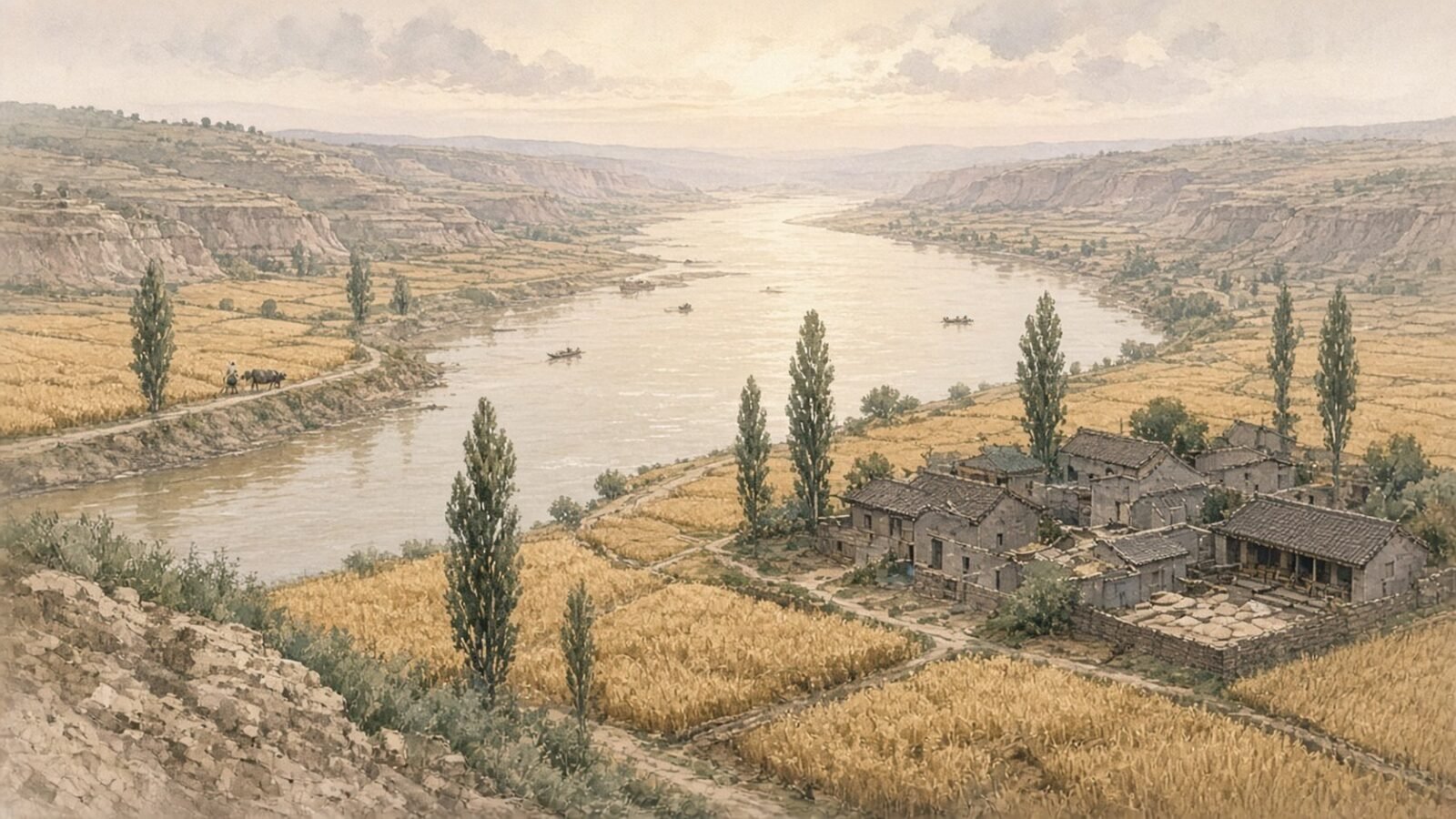
These central peoples emerged from the Neolithic and Bronze Age cultures of the Yellow River basin, where millet farming began, but not from them alone. Archaeology has shown that early China had many regional centres, along the Yangtze and elsewhere, and that the Shang and Zhou states grew through contact, conquest and exchange with neighbours. The Zhou (c. 1046 to 256 BC) articulated much of what later became the core of Chinese political thought: the idea of the Mandate of Heaven, ritual as the basis of social order, and a distinction between the cultivated centre and the peoples around it. That distinction was cultural rather than biological. Classical texts allowed that outsiders could become part of the civilised world by adopting its rites, and that insiders could lose that status. The site’s article on the Yellow Emperor explains how a legendary common ancestor was later placed at the head of this lineage.
How the Han got their name
The name Han comes from the Han river, a tributary of the Yangtze, and from the dynasty founded by Liu Bang, who had been made King of Han before reuniting the Qin empire. The Han dynasty ruled from 206 BC to AD 220, with a brief interruption from AD 9 to 23. It was long, prosperous and expansive, and later generations looked back on it as a classical age.
At first, however, Hanren (汉人) simply meant “people of Han”, the emperor’s subjects, as the historian Mark Elliott of Harvard has argued in an influential essay, “Hushuo: The Northern Other and the Naming of the Han Chinese” (2012). Elliott notes that historians mostly agree that Han began as a political identifier, not an ethnic one. It began to acquire an ethnic meaning in the period of division after the dynasty fell, and particularly under northern regimes founded by steppe peoples such as the Xianbei, who used it to distinguish their Chinese subjects from themselves. Elliott suggests that Han as an ethnic term can be traced to at least the sixth century AD, that its meaning varied greatly for a millennium, and that it stabilised only around the fifteenth century, after the founding of the Ming. In his phrase, “Han was a Hu proposition”, an idea shaped by the northern peoples, the Hu, as much as by the Chinese themselves. Not every historian accepts every part of that argument, and other names, notably Tangren (唐人), “people of Tang”, remained in use, especially in the south and among emigrants. But few scholars now argue that a single, fixed Han identity has existed unchanged since antiquity.
The forces that held them together
If the name was fluid, the forces that created a shared identity were real. The first was the state. The Qin unification of 221 BC standardised the script, weights and measures, axle widths and coinage, and built roads across the empire, a story the site has told in its piece on the First Emperor. The Han dynasty kept most of the Qin system and added an official ideology based on Confucian classics.
The second, and arguably most important, was writing. Chinese characters represent meaning as well as sound, and the classical written language was largely detached from speech. As a result, people whose spoken languages differed as much as, say, Spanish and Romanian could read the same texts, serve in the same bureaucracy and share a literature. Linguists classify the Sinitic languages into several major groups, including Mandarin, Wu, Yue (Cantonese), Min, Hakka, Xiang and Gan, many of which are not mutually intelligible. Whether they should be called dialects or languages is partly a political question. Today, the government reports that 87.72% of the population could speak Putonghua, standard Mandarin, by 2025, up from 80.72% in 2020, but for most of history the unifying medium was written, not spoken. The site’s article on why China keeps two versions of its script looks at the modern forms of that system.
The third was the Confucian state and its examinations. From 605 to 1905, as the site’s article on the imperial examinations describes, officials were selected by tests on the same classical texts across the empire. Local elites everywhere had the same incentive to master the same canon. That produced a remarkably uniform educated class and a shared vocabulary of values, from filial piety to loyalty and ritual propriety.
The fourth was the family. Han society was organised around patrilineal descent groups that kept genealogies, maintained ancestral halls and performed rites to ancestors, practices given systematic form by Neo-Confucian scholars of the Song dynasty and spread widely in the Ming and Qing. Surnames were passed down the male line and linked people to ancestral places. The Ministry of Public Security’s 2020 report found that Wang, Li, Zhang, Liu and Chen were the five most common surnames, together accounting for about 30.8% of registered residents. Lineage culture was stronger in some regions, notably the south-east, than in others, but ancestor rites at Qingming and the New Year were near universal.
Migration south and the absorption of others
The spread of Han identity was, above all, a movement of people from north to south. Historians identify several great waves. The first followed the collapse of northern China into war in the early fourth century, culminating in the fall of Luoyang to the Xiongnu in 311, known as the Yongjia disaster, after which many elite families fled south of the Yangtze. The second came after the An Lushan rebellion of 755 to 763 devastated the north in the Tang dynasty. The third followed the Jurchen conquest of north China in 1127, when the Song court re-established itself at Hangzhou. Population figures from the period show the effect: before the An Lushan rebellion, most registered households were in the north; by the late eleventh century, more than half were in the south, and during the Southern Song perhaps two-thirds. The south, with its rice agriculture and waterways, became China’s economic centre, a shift tied to projects such as the Grand Canal.
The south was not empty. It was home to many peoples, including those the Chinese called the Yue, and ancestors of today’s Zhuang, Miao, Yao, She and others. Over centuries, many of them became Han through intermarriage, adoption of Chinese language and customs, and the incentives of the state, while others retreated to hills and kept distinct identities. The Hakka, a Han subgroup concentrated in the uplands where Guangdong, Fujian and Jiangxi meet, illustrate how identity and history intertwine. The scholar Luo Xianglin, in an influential 1933 study, traced Hakka origins to successive migrations from the Central Plains, partly to defend Hakka against claims that they were not truly Han. More recent scholarship treats that account as important but incomplete, and emphasises the formation of Hakka identity in the south itself through migration combined with extensive contact with local peoples such as the She.
Genetics has added evidence to these historical accounts, and should be read carefully. A 2004 study in Nature by Bo Wen, Li Jin and colleagues analysed Y-chromosome and mitochondrial DNA across Han populations. It found that the southward spread of Han culture involved large movements of people, not merely the spread of ideas, and that it was sex-biased: southern Han paternal lineages were largely of northern Han origin, while maternal lineages showed a much larger contribution from indigenous southern populations. Two genome-wide studies published in the American Journal of Human Genetics in 2009, one by Jieming Chen and colleagues using more than 6,000 samples from ten provinces and one by Shuhua Xu and colleagues using over 1,700 samples from 26 regions, found a gradual north-south gradient in the Han gene pool, consistent with historical migration. Chen and colleagues stressed that this was a continuous gradient rather than distinct northern and southern clusters, and Xu and colleagues measured the differences as very small, although large enough to matter for medical association studies.
These studies do not define who is Han. Han identity has always been cultural and political, and genetic variation within the Han is continuous with that of neighbouring peoples. What the research does show is that the Han are a population formed by mixing, which matches the historical record of migration and absorption.
Under non-Han rule
For long periods, much or all of the Han population was ruled by dynasties from beyond the Great Wall. The Northern Wei (386 to 534), founded by the Tuoba branch of the Xianbei, ruled north China for more than a century. Its Emperor Xiaowen moved the capital to Luoyang in 494 and ordered the court to adopt Chinese dress, language and surnames, changing the imperial clan’s name from Tuoba to Yuan. Many Xianbei families eventually merged into the Han population, and the ruling houses of the Sui and Tang dynasties had mixed Han and Xianbei ancestry.
Later conquerors took a different approach. The Khitan Liao (916 to 1125) and the Jurchen Jin (1115 to 1234) ruled northern China with dual systems of government, one for their own peoples and one for Chinese subjects, and preserved their own scripts. The Mongol Yuan (1271 to 1368) ruled all of China and ranked its subjects in a hierarchy often described as four classes, with Mongols at the top and southern Chinese at the bottom, though historians debate how formal and consistent that system was. The site has covered the period in its article on the Yuan and in the rise of the Ming, whose founders used the language of restoring Chinese rule.
The Manchu Qing (1644 to 1912) was the last and largest of these dynasties. It adopted the Confucian state and examinations, and its emperors patronised Chinese scholarship on a vast scale. Yet it also kept the Manchu banner system, dual appointments in the central government and, from 1645, ordered all Han men to shave the front of the head and wear the Manchu queue on pain of death. Historians of the “New Qing History” school, including Elliott, Evelyn Rawski and Pamela Crossley, have argued that the Qing was a multi-ethnic Inner Asian empire as much as a Chinese dynasty, and that Manchu identity did not simply dissolve into Chinese culture; others, notably Ping-ti Ho, emphasised sinicisation. The debate matters because it shapes how one understands the Han: as a people who absorbed conquerors, or as one of several peoples within larger empires.
Across these periods, Han identity persisted not because it was unchanging but because its institutions, the script, the classics, the family and the bureaucracy, were useful to whoever ruled. Conquerors needed Chinese officials to govern, and those officials needed the texts. Each period of foreign rule also sharpened the sense of who counted as Han.
From race to nation
In the late nineteenth century, defeats by foreign powers and new Western ideas of race and nation transformed the question. Revolutionaries opposed to the Qing used ethnic language. The oath of Sun Yat-sen’s Revolutionary Alliance, founded in 1905, began with a call to “expel the Tartar barbarians and restore China” (驱除鞑虏,恢复中华). The historian Frank Dikötter and others have shown how Western racial theories shaped Chinese thinking in this period. Meanwhile, the reformer Liang Qichao coined the term Zhonghua minzu (中华民族), “the Chinese nation”, in 1902; at first it largely meant the Han, but it came to encompass all peoples within China’s borders.
The revolution of 1911 posed a practical problem. An ethnic Han state would have lost Manchuria, Mongolia, Xinjiang and Tibet. In his inaugural declaration as provisional president in January 1912, Sun proclaimed the union of Han, Manchu, Mongol, Hui and Tibetan lands in one state, a principle known as “five races under one union” (五族共和). In later years he argued for merging all these peoples into a single Chinese nation. The tension between ethnic Han nationalism and a multi-ethnic state has run through Chinese politics ever since. The site’s article on the century of humiliation covers the wider context.
Classifying a nation of 56 peoples
The People’s Republic took a different path from the Republic, following Soviet models of recognising distinct nationalities. When the first census of 1953 to 1954 asked people to name their ethnic group, officials recorded more than 400 answers, over 200 of them in Yunnan alone, as the historian Thomas Mullaney documents in Coming to Terms with the Nation (2011). Ethnologists and linguists were sent to classify them in the Ethnic Classification Project (民族识别) that began in 1954. Groups were merged or recognised through a mix of linguistic research, fieldwork and political judgement. The number of recognised minorities rose over the following decades, with the Jino of Yunnan the last recognised, in 1979, giving the familiar total of 56 groups: the Han and 55 minorities. In 1987, the authorities announced that the classification work was complete.
The Han category itself was never subdivided, despite the linguistic diversity within it. Hakka, Cantonese and Hokkien speakers were all Han. That choice reinforced the idea of the Han as a single people. The sociologist Fei Xiaotong, who had taken part in the classification work, set out in lectures at the Chinese University of Hong Kong in 1988 the idea of the Chinese nation as a “pluralistic unity” (多元一体), with the Han as its cohesive core. That formulation remains central to official thinking.
Relations between the Han majority and minorities are a sensitive subject, and accounts differ widely. The state has a system of regional autonomy, with five autonomous regions and many autonomous prefectures and counties, and minorities long enjoyed preferential policies, including exemption from the strictest birth limits and extra points in university entrance examinations. In recent years, official policy has put more weight on building a common national identity, which the government calls forging a strong sense of community of the Chinese nation, and on the use of standard Mandarin in schools. Critics, including many foreign governments and human rights organisations, say that this has eroded minority languages and cultures. In 2022, the UN human rights office concluded that serious human rights violations had been committed in Xinjiang, which may constitute crimes against humanity; China rejected the assessment as based on disinformation. These disputes are not about Han identity as such, but they are part of what the majority’s dominance means in practice.
A people abroad
Han Chinese have been emigrating for centuries, first to South-East Asia with the maritime trade of Fujian and Guangdong, and in the nineteenth century across the Pacific to the Americas and Australia. Estimates of the ethnic Chinese population outside China, Hong Kong, Macau and Taiwan range from about 50 to 60 million, depending on definitions, with more than half in South-East Asia. Not all of them are Han, but most are of Han descent. In Singapore, ethnic Chinese form about three-quarters of the resident population, and in Taiwan the great majority of people are of Han descent, as the site’s article on Taiwan and its people discusses.
The diaspora has preserved, and adapted, many older regional traditions, including Cantonese, Hokkien, Teochew and Hakka languages, lineage and hometown associations, and temple networks. Its history has also included discrimination, from the United States’ Chinese Exclusion Act of 1882 to violence in South-East Asia, a subject the site examined in its history of “yellow peril” fear.
The legacy
The Han legacy is visible across East Asia and beyond. Chinese characters were adopted for writing in Korea, Japan and Vietnam, and remain part of Japanese today; classical Chinese served as the shared learned language of the region for more than a millennium, and Confucian examinations were held in Korea and Vietnam as well as China. Chinese literature, from the Classic of Poetry and Tang verse to the great Ming and Qing novels, is among the world’s longest continuous literary traditions.
Technologies developed in Han China, including paper, printing, the compass and gunpowder, spread across Eurasia. Statecraft is another legacy: a bureaucracy recruited by examination, detailed record-keeping and a centralised administration that lasted, with interruptions, for two millennia. Festivals such as the Spring Festival, Qingming, the Dragon Boat Festival and the Mid-Autumn Festival are observed wherever Chinese communities live; UNESCO inscribed the Spring Festival on its list of intangible cultural heritage in December 2024. Chinese cuisine, in its many regional forms, is one of the most widely eaten in the world. Many of these practices are shared with other peoples of China, and some came from them, a reminder that Han culture has always borrowed as well as given.
Conclusion
The Han people are, in one sense, the product of an extraordinarily successful idea: that people of very different origins, speaking different languages, could belong to one civilisation through a shared script, shared texts, shared rites and a shared state. That idea drew in Xianbei nobles, southern hill peoples, frontier settlers and conquering dynasties, and it has held together, sometimes by persuasion and sometimes by force, for more than two thousand years.
In another sense, as historians such as Elliott and Mullaney argue, Han identity is historically constructed: the name changed meaning over time, its boundaries shifted, and the modern category was shaped by nationalist politics and state classification. Both statements are true. The coherence of the Han is real, but it is a coherence built by history rather than given by nature, and that is what makes the story remarkable.