In the year 547 a minor official named Yang Xuanzhi rode into Luoyang on government business and barely recognised it. Thirteen years earlier this had been the Northern Wei capital, with, by his own count, 1,367 Buddhist monasteries. Now, as he later described it, the walls had slumped, the temples were ash, wild animals denned on the palace steps and farmers planted millet beside the ruined gate towers. Yang went home and wrote a book about what had been lost. He was not the last to stand among Luoyang’s ruins: the city on the Luo River has been founded, sacked, abandoned and rebuilt more often than almost any other capital on earth, and every time it has come back. A Song-dynasty writer, Li Gefei, summed up the pattern in a line still quoted in China: 洛阳之盛衰,天下治乱之候也, roughly “the rise and fall of Luoyang is the sign of order or disorder in the realm”. This is that city’s story, from Bronze Age palaces to a tractor factory.
huaxia.click has already visited Luoyang’s western twin in The Greatest City on Earth and followed An Lushan’s army through its gates in The Rebellion That Broke Tang. This piece stays in the eastern city and asks what kept drawing dynasties back to one small basin in Henan.
Between the Luo and the Yi
Luoyang sits in a shallow basin on the western edge of the Central Plain, the Zhongyuan, long treated as the cradle of Chinese civilisation. To the north rise the loess hills of Mangshan, with the Yellow River beyond; to the south and west lie the Xiong’er, Funiu and Song mountains. Two rivers run through the bowl. The Luo comes in from the west and gives the city its name, “the sunny (north) side of the Luo”. The Yi flows up from the south through a narrow gap in the hills to join it, and the Luo runs on to the Yellow River near Gongyi.
The basin was fertile, well watered and defensible, ringed by passes such as Hangu to the west. It also sat at a crossroads: west along the Yellow River to the Guanzhong plain and Chang’an, east across the open plain, south through the hills towards the Yangtze. Cosmology added prestige. The idea of the tuzhong, the “centre of the earth” from which the realm could be governed evenly in every direction, attached itself early to this region, known as Heluo after the He (Yellow River) and the Luo. Legend placed the River Chart and the Luo Writing, mystical diagrams said to have risen from the waters, at their confluence. Ancient writers did not see the place as one city among many, but as the middle.
Palaces Before Writing
The oldest evidence of a capital in the basin lies about 20 kilometres east of the modern city, near the village of Erlitou in Yanshi. Excavations since 1959 have uncovered a large settlement usually dated by radiocarbon to roughly 1750–1530 BC, with rammed-earth palace foundations, a grid of roads, bronze workshops that cast some of China’s earliest ritual vessels, and an elite burial holding a dragon made from more than two thousand pieces of turquoise.
Many Chinese archaeologists identify Erlitou with the Xia, the first dynasty of the traditional histories, and the museum that opened beside the site in 2019 is called the Erlitou Site Museum of the Xia Capital. The identification is still debated, especially outside China, because no writing has been found there to say who its rulers were; the wider argument over China’s legendary founders is one this site has explored before. What is not in doubt is that Erlitou was an early, centralised state, and that it chose the Luo basin.
A few kilometres away lies the walled city of Yanshi, discovered in 1983 and dated to the early Shang period, around 1600 BC. Some scholars see it as a Shang capital, others as a fortified secondary centre built to control the conquered Erlitou heartland. Either way, the new dynasty planted itself almost on top of the old one, the first of many conquerors to decide that it needed this ground.
The Centre of the Zhou World
Around the middle of the eleventh century BC the Zhou, from the Wei valley far to the west, overthrew the Shang. To hold the eastern plain they built a second centre in the Luo basin. Tradition credits the Duke of Zhou, regent for the young King Cheng, with laying out the new city of Luoyi, or Chengzhou, after divination confirmed this was the centre of the world.
A bronze vessel found at Baoji in Shaanxi in 1963, the He zun, carries an inscription about King Cheng’s building of this eastern city. It cites his father, King Wu, declaring that he would dwell in “this central state”, zhai zi zhong guo. It is the earliest known appearance of zhongguo, the modern Chinese name for China. In its original sense the phrase pointed to the Luo basin.
When the Western Zhou capital in the west fell in 771 BC, King Ping moved the court east to Luoyi in 770 BC, opening the period known as the Eastern Zhou. For five centuries Luoyang was the seat of kings whose power shrank while their ritual prestige endured. In 2002 builders in the modern city uncovered a burial pit with a chariot drawn by six horses, matching the ritual rule that only the Son of Heaven rode behind six; it is now displayed where it was found.
Sima Qian’s Records of the Grand Historian says that Laozi kept the archives at this court and that the young Confucius came to ask him about ritual. The meeting may be legend, but it reflects a belief that the Zhou capital was where the old rites were kept; Confucius himself has his own huaxia.click profile. Qin deposed the last Zhou king in 256 BC, a generation before the unification told in The First Emperor Gave China Its Operating System.
Scholars and a White Horse
The Western Han ruled from Chang’an, but after Wang Mang’s usurpation Liu Xiu, the Guangwu Emperor, restored the Han in AD 25 and made Luoyang his capital for the next two centuries.
It was the intellectual capital too. The Imperial Academy, the Taixue, trained young men in the Confucian classics for official careers, and the Book of the Later Han says it had more than 30,000 students by the mid-second century. Between 175 and 183 the court had the approved classics carved on stone and set up outside the Academy as a public standard edition; fragments of these Xiping Stone Classics survive. The idea that learning could be measured against a fixed canon, and tested by the state, ran on into the examination system.
Tradition also places the arrival of Buddhism here. Emperor Ming, the story goes, dreamed of a golden figure flying before his palace and sent envoys west, who came back with two Indian monks, Kasyapa Matanga and Dharmaratna, and scriptures carried on white horses. In AD 68, the traditional date, the emperor founded a monastery for them outside the western gate: the White Horse Temple, Baima Si, often called China’s first Buddhist temple.
Historians treat the dream as a pious legend that took shape later. The firmer record begins around 148, when the Parthian monk An Shigao reached Luoyang and began translating Buddhist texts into Chinese, followed by the Kushan monk Lokaksema. Either way, the long work of turning Indian scripture into Chinese began in the Eastern Han capital. The much-rebuilt White Horse Temple is now mostly Ming and Qing.
The Han city ended in fire: in 190 the warlord Dong Zhuo abandoned it for Chang’an, drove its people west and burned it.
The Paper Price of Luoyang
When Cao Pi ended the Han in 220 and founded the Wei, he rebuilt Luoyang as his capital. Soon afterwards his brother Cao Zhi wrote the Rhapsody on the Goddess of the Luo, whose later illustrated scrolls, traditionally linked to the painter Gu Kaizhi, are treasures of Chinese art. In 265 the Sima family’s Western Jin replaced the Wei, reunifying China in 280 from the same capital.
The Jin city gave Chinese one of its best-known idioms. The poet Zuo Si spent years, ten by the traditional account, on his Rhapsody on the Three Capitals. According to the Book of Jin, once critics praised it, Luoyang’s great households competed to copy it and the city’s paper grew expensive: 洛阳纸贵, Luoyang zhi gui. One detail is often missed. The three capitals of the poem were Ye, Chengdu and Jianye, not Luoyang. Luoyang’s part is as the city of readers who turned a book into a sensation, and the phrase is still used of a bestseller.
The Jin’s unity did not last. The War of the Eight Princes, a civil war among imperial relatives, exhausted the state and drew frontier peoples, many already settled inside the empire, into the fighting. In 311, in what Chinese historians call the Yongjia disaster after the reign title of the day, the armies of the Xiongnu-led Han-Zhao state under Liu Yao and Wang Mi stormed Luoyang. Emperor Huai was captured; later histories put the dead at more than 30,000, a figure that cannot be checked. Many elite families fled south of the Yangtze, a migration whose long consequences are traced in The Long Making of the Han People. For most of two centuries Luoyang was a ruin fought over by others.
A Steppe Court on the Central Plain
The next revival came from the steppe. The Northern Wei, founded by the Tuoba clan of the Xianbei, ruled north China from Pingcheng, near modern Datong. Emperor Xiaowen, in power in his own right from 490, wanted to reign as a Chinese sovereign from the traditional centre of the world.
Many nobles had no wish to leave the north. According to the histories, in 493 Xiaowen marched south as if against the southern dynasty; when the army reached Luoyang in heavy autumn rain, his commanders begged him to stop, and he agreed on condition that the court stay. The capital moved in 494, and reforms followed quickly: Chinese dress at court, a ban on the Xianbei language there for younger officials, and in 496 the change of the imperial surname from Tuoba to the Chinese Yuan. To the court this was about legitimacy: an heir to the Han and the Jin had to rule from their capital, in their language and by their rites. Northern garrison troops left behind resented it, and their discontent helped bring the dynasty down a generation later.
The Pagoda of Eternal Peace
Northern Wei Luoyang rose on the Han and Jin ruins as a vast grid of walled wards, and above all as a Buddhist city. In 516 the Empress Dowager Hu began the Yongning Temple, the Temple of Eternal Peace, whose nine-storey timber pagoda became the tallest structure in the Chinese world. Yang Xuanzhi says it could be seen from a hundred li away and that on windy nights its bells could be heard for miles. He also tells of a western monk called Bodhidharma, who claimed to be 150 years old and declared that nothing like it existed in any land; whether he was the later-revered founder of Chan, or Zen, is debated.
The heights given in the texts are probably exaggerated. Its excavated base is a rammed-earth platform about 38 metres square; modern estimates mostly put the tower well above 100 metres, but vary widely. Lightning burned it in 534, the year the Northern Wei split and the eastern court left for Ye.
The Cliffs at Longmen
About 13 kilometres south of the city the Yi passes between two limestone hills, a gap once called Yique, the Yi Gate, and later Longmen, the Dragon Gate. From about the time of the move from Pingcheng, members of the court began paying for Buddhist caves in the western cliff. The early Guyang Cave is crowded with inscriptions naming the nobles who sponsored its niches. The Binyang caves were commissioned by Emperor Xuanwu in memory of his parents, and the Book of Wei records 802,366 days of labour on the project between 500 and 523. Compared with the earlier Northern Wei caves at Yungang, the Longmen figures are slimmer, with long faces and flowing Chinese-style robes, a change art historians often read as a new court identity worked out in stone.
Yang Xuanzhi’s Record
Yang Xuanzhi’s Record of the Buddhist Monasteries of Luoyang, the Luoyang qielan ji, is arranged as a tour, gate by gate and ward by ward, of a city that no longer existed. Alongside the great temples it records markets, mansions, festivals, foreign residents and gossip. As the Princeton Dictionary of Buddhism summarises his figures, Luoyang’s monasteries grew from 42 in the early fourth century to 1,367 under the Northern Wei, then fell to 421 after the court left. It is one of the great works of early Chinese prose: a book written to remember a lost city.
A New City for Emperor Yang
The Sui reunified China in 589, and in 605 the second Sui ruler, Emperor Yang, ordered a new eastern capital a few kilometres west of the old Han and Wei city. His architect, Yuwen Kai, laid it out astride the Luo, with the palace city in the north-west. The Book of Sui says two million men were called up each month for the work. Whatever the true number, the city was largely finished within about a year.
The reason was supply. In the same year Emperor Yang began the Tongji Canal, linking the river system at Luoyang with the Huai and the south, and in 608 the Yongji Canal ran north-east towards the region of modern Beijing. Luoyang became the hinge of a vast Y-shaped network, explored in our earlier piece on the Grand Canal. Southern grain filled huge granaries: the Hanjia Granary inside the walls, excavated from 1969, had hundreds of underground pits, one of which, Pit 160, still held carbonised grain; the Huiluo Granary to the north-east was larger still. Emperor Yang was assassinated amid rebellion in 618 and became the histories’ model of a bad last ruler; his city outlived him by centuries.
The Divine Capital
Under the Tang, Chang’an remained the main capital, but in 657 Emperor Gaozong made Luoyang the Eastern Capital, and the court spent long spells there, partly because it was easier to feed at the canal’s end than upstream of the Sanmenxia gorges. The pilgrim Xuanzang, born near Yanshi in 602 and ordained in the city, made a journey to India that became the Ming novel Journey to the West.
Luoyang’s greatest moment came through Gaozong’s consort, Wu Zhao, better known as Wu Zetian. She governed beside her ailing husband and, after 683, through her sons. In 684 she renamed the city Shendu, the Divine Capital. In 690 she took the throne as emperor of a new Zhou dynasty, the only woman in Chinese history to do so, and ruled from Shendu.
She built to match. In 688 a Mingtang, or Hall of Light, was completed on the palace axis. In the classics the Mingtang was where the Son of Heaven made offerings and ordered the calendar in harmony with the cosmos; scholars had argued for centuries about its form. Wu built hers huge: the Tang histories give 294 chi, perhaps around 86 metres, though the conversion is uncertain. Behind it rose the Tiantang, the Hall of Heaven, which housed a colossal Buddha. In 695 a fire that began in the Tiantang, blamed on her former favourite, the monk Xue Huaiyi, destroyed both, and the Mingtang was rebuilt the following year. Her metal column proclaiming the Zhou, the Tianshu or Axis of Heaven, was melted down in 714. A later version of the same cosmic thinking can be read in the Ming palace at Beijing.
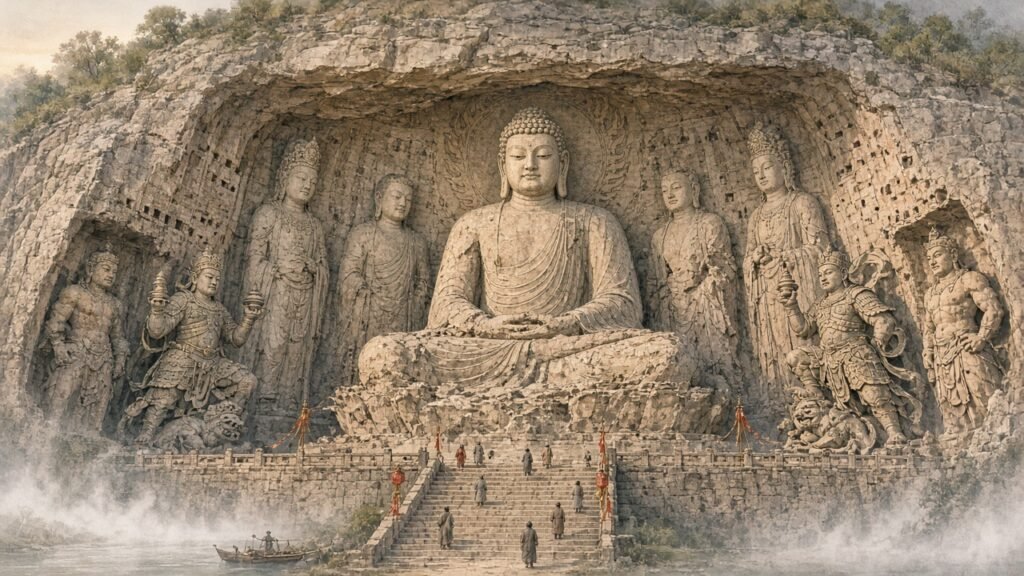
The most lasting monument of those years is at Longmen. In the western cliff, carvers cut a huge open niche, the Fengxian Temple, with a seated Vairocana Buddha about 17 metres high, flanked by disciples, bodhisattvas, heavenly kings and guardians. An inscription added to the base in 722 says the work was made under Gaozong, that the empress gave 20,000 strings of cash from her “cosmetics money” in 672, and that it was finished in 675. Guides often say the Buddha’s calm face is Wu Zetian’s portrait. The inscription says nothing of the kind and many scholars doubt it, but the story is now part of the site’s lore.
Wu was forced to abdicate in 705 and died in Luoyang that year; the court’s weight then shifted back to Chang’an. The city changed hands several times in the An Lushan rebellion but stayed a place of culture. The poet Bai Juyi spent his last years there and was buried in 846 on Xiangshan, the hill facing the Longmen cliffs across the Yi.
Peonies and Historians
After 907 Luoyang was a capital again under some of the Five Dynasties, notably the Later Tang (923–936), and the Song founder Zhao Kuangyin was born there in 927. But the Song chose Kaifeng, better placed on the canal. Luoyang became the Western Capital, Xijing, a secondary seat of government, and never again ruled all of China.
Song Luoyang became a city of gardens rather than palaces, a retreat for scholars and retired ministers. Li Gefei’s Record of the Famous Gardens of Luoyang, written around the 1090s, describes some nineteen of them. It was also the city of peonies. In 1034 the young Ouyang Xiu, posted there, wrote the Account of the Peonies of Luoyang, describing two dozen varieties and the springtime crowds of every rank who came to see them; it is usually counted the earliest Chinese treatise on a single garden flower. A popular tale says Wu Zetian once ordered every flower to bloom in winter and banished the peony, the only one to refuse, from Chang’an to Luoyang. It is folklore, but told everywhere in the city.
The most important book written in Song Luoyang was a history. Sima Guang, a senior minister opposed to Wang Anshi’s New Policies, the reform world described in our profile of Shen Kuo, withdrew to Luoyang in 1071. In a modest estate he called the Garden of Solitary Delight he and his assistants completed the Zizhi Tongjian, the Comprehensive Mirror to Aid in Government, a year-by-year history of China from 403 BC to AD 959 in 294 chapters, presented to the throne in 1084. He believed history showed rulers how order was kept and lost, an idea that still runs through Chinese political thinking.
The Long Quiet
After the Jurchen Jin conquered the north in 1127, Luoyang became a provincial town, under the Yuan, Ming and Qing the seat of Henan prefecture. Its best-known Ming resident, Zhu Changxun, Prince of Fu, was killed when the rebel Li Zicheng took the city in 1641. After the Japanese attack on Shanghai in January 1932 the Nationalist government made it a temporary capital until December, and in 1944 it fell to Japan in the Ichi-go offensive. According to the historian Ding Yiping, its urban population in 1953 was only about 110,000.
Tractor City
Luoyang’s modern revival came through heavy industry. Under the First Five-Year Plan, six of the 156 Soviet-assisted key projects were placed there: the First Tractor Factory together with bearing, mining-machinery, copper-processing, power and diesel-engine plants.
Where to build was itself a heritage question. Ding Yiping’s study of the planning archives shows that surveyors rejected sites east of the old town, near the White Horse Temple, because of the density of ruins and tombs, and the Ministry of Culture opposed building over the ancient cities. The factories went instead west of the Jian River, about eight kilometres from the old centre, on ground where no capital had stood. The new district of Jianxi grew beside the old city rather than over it, and planners still cite this “Luoyang model”.
Work on the tractor plant began on 1 October 1955. On 20 July 1958 it produced its first machine, the Dongfanghong-54 crawler tractor, based on a Soviet design; dongfanghong, “the East is red”, was also the title of the era’s best-known revolutionary song. The plant was inaugurated on 1 November 1959. The company says that by the 1970s its tractors did more than 60 per cent of China’s mechanised ploughing. The firm survives as YTO Group, still making tractors in Luoyang.
Heritage Today
Luoyang today has around seven million people, and its past is a major industry. The Longmen Grottoes were inscribed on UNESCO’s World Heritage List in 2000. UNESCO counts more than 2,300 caves and niches along about a kilometre of cliff on both banks of the Yi, holding almost 110,000 Buddhist statues, more than 60 stupas and 2,800 inscriptions. In 2014 two more listings took in the city. The Silk Roads: Routes Network of the Chang’an–Tianshan Corridor, a joint nomination by China, Kazakhstan and Kyrgyzstan, includes the Han-to-Northern Wei city site, the Dingding Gate of the Sui–Tang city, the Han’gu Pass and a section of the ancient road west. The Grand Canal listing includes the Hanjia and Huiluo granaries.
In the Sui–Tang heritage park, over the excavated foundations of the Mingtang and Tiantang stand modern halls inspired by them, opened in 2014 and 2015: a Mingtang about 33 metres high under a gilded finial, and a Tiantang of about 88 metres. Inside, visitors look down on the real remains, including the Mingtang’s central pillar pit. The Yingtian Gate, the palace city’s main south gate, reopened in 2019 as a site museum, its reconstructed towers and linking galleries raised above the excavated footings. These are informed reconstructions, not replicas; their upper storeys are largely conjecture. Every April the city also holds its Peony Festival, first staged in 1983.
How Many Dynasties?
Luoyang calls itself the “ancient capital of thirteen dynasties”. The usual list is the Xia, Shang, Western Zhou, Eastern Zhou, Eastern Han, Cao Wei, Western Jin, Northern Wei, Sui, Tang (including Wu Zetian’s Zhou), Later Liang, Later Tang and Later Jin. Almost every entry can be questioned. The Xia depends on the Erlitou identification; the Western Zhou’s Luoyi was a secondary capital; under the Sui and Tang, Luoyang was formally the Eastern Capital beside Chang’an, except under Wu Zetian; and some Five Dynasties regimes used it only briefly. Counting Wu’s Zhou separately or adding short-lived regimes, some writers reach fifteen or more, while a strict count of sole main capitals gives fewer. The number is a civic tradition, not a precise claim. The underlying point stands: few cities have been chosen by so many regimes over so long a span.
The Centre That Holds
Luoyang is one of the Four Great Ancient Capitals, with Xi’an, Nanjing and Beijing, and appears on every longer version of the list, which grew through Kaifeng and Hangzhou to eight when the China Ancient Capitals Society added Anyang (1988) and Zhengzhou (2004).
Part of its legacy is in words: zhongguo first described this basin, and Luoyang zhi gui still describes a bestseller. Part is in institutions: the Eastern Han Academy, the stone classics, the first Buddhist translations, the canal hub and the Zizhi Tongjian all came out of this city. And part is in the Silk Road. UNESCO’s 2014 listing treats Chang’an and Luoyang together as the corridor’s eastern end. Silk, the secret that gave the routes their name, flowed west, while monks, merchants and ideas came east. The chain of cave temples that runs through Dunhuang, whose library cave is another huaxia.click story, reaches its imperial climax at Longmen.
The Luoyang Yang Xuanzhi mourned was rebuilt within sixty years, and the Sui–Tang city that replaced it is now being excavated and displayed inside a modern city whose factories were placed to spare it. Li Gefei thought Luoyang’s fortunes measured the state of the realm. On that reckoning, a city that now earns its living by showing visitors the ruins its planners chose to protect has a fairly confident story to tell.
Sources
- UNESCO World Heritage Centre, “Longmen Grottoes” (inscribed 2000), for cave, statue, stupa and inscription counts.
- UNESCO World Heritage Centre, “Silk Roads: the Routes Network of Chang’an–Tianshan Corridor” (2014), and its component map and list (Luoyang city of the Eastern Han to Northern Wei; Dingding Gate; Han’gu Pass; Shihao section of the Xiaohan road).
- UNESCO World Heritage Centre, “The Grand Canal” (2014), and the ICOMOS evaluation describing the Hanjia and Huiluo granary components.
- Yang Xuanzhi, A Record of Buddhist Monasteries in Lo-yang, trans. Yi-t’ung Wang (Princeton University Press, 1984); Internet Archive record. See also W. J. F. Jenner, Memories of Loyang: Yang Hsüan-chih and the Lost Capital (493–534) (Oxford: Clarendon Press, 1981).
- Robert E. Buswell Jr and Donald S. Lopez Jr, The Princeton Dictionary of Buddhism (Princeton University Press, 2014), s.v. “Luoyang qielan ji” (monastery figures 42 / 1,367 / 421); summarised at Encyclopedia of Buddhism.
- Jeffrey Broughton, “Bodhidharma”, in R. E. Buswell, ed., Encyclopedia of Buddhism (Macmillan Reference USA, 2004), pp. 57–58, on the Yongning Temple anecdote.
- Ulrich Theobald, “Luoyang mudan ji 洛陽牡丹記”, ChinaKnowledge.de, on Ouyang Xiu’s peony treatise.
- Ding Yiping 丁一平, “‘一五’计划与洛阳工业基地建设” (The First Five-Year Plan and the building of the Luoyang industrial base), Dangdai Zhongguo shi yanjiu 当代中国史研究, 2017, no. 2: on the six 156-project plants, the Jianxi site selection and the 1953 population.
- China Mechanical Engineering Society Digital Museum, entry on the First Tractor Factory (dates of 1 October 1955, 20 July 1958 and 1 November 1959); and SINOMACH, “‘Oriental Red’ tractors: the first tractors in China” (2019).
- Erlitou Site Museum of the Xia Capital, opened October 2019: see People’s Daily Online report; and Sarah Allan, “Erlitou and the Formation of Chinese Civilization: Toward a New Paradigm”, Journal of Asian Studies 66, no. 2 (2007): 461–496, on the Xia identification debate.
- Li Liu and Xingcan Chen, The Archaeology of China: From the Late Paleolithic to the Early Bronze Age (Cambridge University Press, 2012), on Erlitou and Yanshi.
- Michael Loewe and Edward L. Shaughnessy, eds., The Cambridge History of Ancient China (Cambridge University Press, 1999), on Chengzhou, the He zun and the Eastern Zhou.
- Denis Twitchett and Michael Loewe, eds., The Cambridge History of China, vol. 1, The Ch’in and Han Empires (Cambridge University Press, 1986), on Eastern Han Luoyang, the Taixue and the Xiping Stone Classics.
- Erik Zürcher, The Buddhist Conquest of China (Brill, 1959; 3rd edn 2007), on the White Horse legend, An Shigao and early translation at Luoyang.
- Albert E. Dien and Keith N. Knapp, eds., The Cambridge History of China, vol. 2, The Six Dynasties, 220–589 (Cambridge University Press, 2019), on the Western Jin, the Yongjia disaster and Northern Wei Luoyang.
- Amy McNair, Donors of Longmen: Faith, Politics, and Patronage in Medieval Chinese Buddhist Sculpture (University of Hawai‘i Press, 2007), on the Guyang, Binyang and Fengxian caves and the 722 Fengxian inscription.
- Antonino Forte, Mingtang and Buddhist Utopias in the History of the Astronomical Clock (Rome: IsMEO / Paris: EFEO, 1988), on Wu Zetian’s Mingtang, Tiantang and Axis of Heaven.
- Denis Twitchett, ed., The Cambridge History of China, vol. 3, Sui and T’ang China, 589–906, Part 1 (Cambridge University Press, 1979), on Emperor Yang’s eastern capital, the canals and Wu Zetian’s reign.
- Xiong Victor Cunrui, Emperor Yang of the Sui Dynasty: His Life, Times, and Legacy (SUNY Press, 2006), on the building of Sui Luoyang.
- Chinanews (中国新闻网), “武则天皇宫正殿明堂重建开放” (11 April 2015), on the reconstructed Mingtang and Tiantang; and Luoyang Municipal Government, old-city cultural tourism profile (2024), on the Yingtian Gate site museum, Mingtang and Tiantang heights.
- Library of Congress, Zi zhi tong jian 資治通鑑 catalogue record; and Xiao-bin Ji, Politics and Conservatism in Northern Song China: The Career and Thought of Sima Guang (A.D. 1019–1086) (Chinese University Press, 2005), on Sima Guang’s Luoyang years.