On Wednesday 2 July 1986, 20th Century Fox opened a strange and expensive film in 1,053 American cinemas and watched it sink. Big Trouble in Little China, John Carpenter’s kung fu ghost story set in and beneath San Francisco’s Chinatown, took about $2.7 million over its first weekend and finished its North American run on roughly $11.1 million, against a budget reported at anywhere between $18 million and $25 million. Sixteen days later Aliens arrived and took the rest of the summer. Forty years on, the flop has become one of the most fondly loved cult films of the decade, a kung fu fantasy with a sidekick who thinks he is the hero. It has spawned comics and board games and given a video-game thunder god his hat.
It is also, unavoidably, a time capsule of how America imagined China in the mid-1980s, and a measure of how much that view has changed. It is worth revisiting twice over, as genre film-making and as a record that now sits between two Chinas: the half-imagined country of 1986 and the very present one of 2026.
A trucker, a sorcerer and a pair of green eyes
Kurt Russell plays Jack Burton, a loud, cheerful trucker who drives a rig called the Pork Chop Express and dispenses philosophy over his CB radio. Delivering a load of pigs to San Francisco, he spends the night gambling in Chinatown and wins big from his friend Wang Chi, a restaurant owner played by Dennis Dun. To make sure he gets paid, Jack drives Wang to the airport to meet his fiancée, Miao Yin (Suzee Pai), who is newly arrived in America. She has green eyes, which turns out to be the most dangerous thing a woman can have in this film. A street gang called the Lords of Death snatches her, and the two men follow the trail back into Chinatown.
There they blunder into a funeral procession that becomes a pitched battle between two ancient warrior societies, the Chang Sing and the Wing Kong. Then three figures drop out of the sky: the Three Storms. Thunder (Carter Wong) can swell his body like a bellows, Rain (Peter Kwong) is a deadly swordsman, and Lightning (James Pax) throws bolts from his hands. Behind them stands David Lo Pan, played by James Hong, an ancient sorcerer whom Jack seems to run over with his truck, only to find him standing there unhurt, with light pouring from his mouth.
The plot that follows is gloriously overstuffed. Lo Pan, it emerges, was cursed centuries ago by China’s First Emperor, Qin Shi Huang, to exist without flesh. To become whole he must marry a green-eyed woman and then sacrifice her, and when he notices that the lawyer Gracie Law (Kim Cattrall) has green eyes too, he decides to take both women. Jack, Wang, Gracie and their friends fight their way through a brothel, flooded tunnels and a subterranean wedding chapel. Their guide is Egg Shen, played by Victor Wong, a sorcerer who drives a Chinatown tour bus by day and carries a “six-demon bag” whose contents he sums up as “Wind, fire, all that kind of thing!”
The cast was unusual for a mainstream studio film of the time, and those making it knew it. Kate Burton later recalled that she, Russell and Cattrall were virtually the only non-Asian actors in the film: “I was aware at the time that it was pretty extraordinary.” Hong had more than three decades of film and television behind him and had co-founded East West Players, the first Asian American theatre company. Victor Wong had been a television reporter and photojournalist before he acted, and Carter Wong had starred in Golden Harvest kung fu films in the 1970s. Cattrall, born in Liverpool and raised in Canada, brought screwball timing to a role that Carpenter defended against studio pressure to cast a rock star.
The sidekick who thinks he is the hero
The film’s central joke is what made it strange in 1986 and what makes it fun now. Jack has the swagger, the vest, the poster pose and the John Wayne drawl of an action hero, but he is not the hero. Wang is. Wang can fight, has the personal stake and gets the girl. Jack mostly gets in the way. At the start of the final battle he fires a machine gun into the ceiling in triumph and knocks himself out with the falling rubble. When he finally kills Lo Pan, it is with a knife the sorcerer has just thrown back at him.
This was deliberate. “Jack Burton is a guy who is a sidekick but doesn’t know it,” Carpenter told Entertainment Weekly for its 2016 oral history of the film. “He’s an idiot-blowhard. He’s an American fool in a world that he doesn’t understand.” He was blunter about the fights: “Rather than try to make it look like our American Caucasian lead knew what he was doing with martial arts, we just went ahead and made him an idiot.” Russell, who had no martial arts training, leaned into it. “I couldn’t do the chop-sockey,” he said. “I had to come up with ways to not be involved.” The self-inflicted knockout was his idea.
The screenwriter W. D. Richter, who had turned the original draft’s straightforward cowboy into “kind of a lovable loudmouth”, built the comedy on the gap between Jack’s opinion of himself and the facts. Jack’s boasts are bluster (“it’s all in the reflexes”), and when he asks Lo Pan to explain what is going on, the sorcerer snaps: “Shut up, Mr. Burton! You were not brought upon this world to ‘get it’!”
Not everyone at Fox was comfortable. According to Carpenter’s DVD commentary, as summarised in the American Film Institute’s catalogue, Fox chairman Barry Diller felt Jack was not “heroic enough”. The opening scene, in which Egg Shen assures a sceptical lawyer that Jack Burton is a man of courage, was shot after filming had wrapped. It is a studio note in disguise, and rather proves the film’s point.
From a Western called Lotus to the Fox lot
The story began as a Western. Gary Goldman and David Z. Weinstein, two first-time screenwriters, wrote a script called Lotus set in nineteenth-century San Francisco, in which a cowboy and a Chinese railway worker took on the sorcerer Lo Pan. Fox became involved and hired Richter to rewrite it as a contemporary comedy. After Writers Guild arbitration in 1986, Goldman and Weinstein received the “written by” credit and Richter one for “adaptation”. Carpenter, offered the project in 1985, told Starlog magazine that he had found the original draft “too huge and bizarre”, but he liked Richter’s version.
It was also a race. Paramount had The Golden Child in production, an Eddie Murphy comedy about a Los Angeles social worker caught up in Asian mysticism, and Fox wanted to get there first. Filming began on 7 October 1985 for a July release. Carpenter told Starlog that “Golden Child is basically the same movie as Big Trouble”. Released that December, it took nearly $80 million in North America.
Apart from establishing shots in the real Chinatown, the film was shot on sets built on the Fox lot in Los Angeles by the production designer John J. Lloyd, with Dean Cundey as cinematographer. The fights were planned with the martial artist James Lew, who also appears as a Chang Sing warrior and who died in August 2026, aged 73. “I worked with my martial arts choreographer, James Lew, who literally planned out every move in advance,” Carpenter said in 1986. “I used every cheap gag—trampolines, wires, reverse movements and upside down sets. It was much like photographing a dance.”
Boss Film Studios handled the effects on a budget of just under $2 million, including Lo Pan’s ancient make-up and a floating mass of eyeballs worked by dozens of cables. Hong said that the duel of hand-magic between Lo Pan and Egg Shen came from the actors, who had both grown up on old Chinese films in which rival masters fired energy from their fingers. “So, Victor decided to throw balls at me of fire, and I invented that I would cross my little fingers and little rays would come out. And Carpenter put that in the film.”
Zu Warriors, Shaw Brothers and a six-demon bag
Carpenter made no secret of where his enthusiasm came from. “I saw my first kung fu movie in 1973,” he told Entertainment Weekly. “It was — what the hell was the name of that thing? — Five Fingers of Death! It was truly an astonishing film. There was an innocence to these movies and a joyousness that I loved.” That film, King Boxer in Hong Kong, was a 1972 Shaw Brothers production. Released in America by Warner Bros in 1973, it helped start the North American kung fu craze, which led in time to the Hong Kong stars Western audiences now know, from Bruce Lee to Jackie Chan, who turned stunts into stardom.
His real model, though, was newer and wilder. In 1986 he told Starlog that he was “not that impressed by Bruce Lee’s movies” and preferred “the more adventurous pictures” dealing with “kung fu knights and evil sorcerers”. One in particular “really knocked me out. It’s basically the Chinese Star Wars. It’s nuts—I’ve never seen anything like it.” He meant Tsui Hark’s Zu: Warriors from the Magic Mountain (1983), a Golden Harvest fantasy of flying swordsmen and demons based on a 1930s xianxia novel. Carpenter later called it the film’s biggest inspiration, singling out its airborne sword fights. Big Trouble borrowed its grammar of wirework and energy bolts wholesale.
There were other borrowings. Carpenter said the Storms’ huge straw hats were modelled on those in Shogun Assassin, the American cut of the Japanese Lone Wolf and Cub films. Richter researched Chinese mythology, while admitting that he invented or altered some of the lore. Even so, the film keeps brushing against real Chinese folk religion, which has its own weather gods: Leigong, the Lord of Thunder; his wife Dianmu, the Mother of Lightning; and Yu Shi, the Rain Master, who brings downpours by dipping his sword into a pot. The villain’s name carries a joke the film never makes, too. “Lo Pan” is the Cantonese form of Lu Ban, the ancient craftsman revered as the patron of builders and carpenters.
The curse goes back to Qin Shi Huang, the ruler who unified China in 221 BC (the subject of our piece on the First Emperor of clay and steel). It is the one piece of recognisable Chinese history at the film’s mythological core.
Synthesisers in the alley
Carpenter scored the film himself, as he scored most of his work, with his regular collaborator Alan Howarth. He knew what he wanted to avoid. “The other scores for American movies about Chinese characters are basically rinky tink, chop suey music,” he told Starlog. “I didn’t want that for Big Trouble. I wanted a synthesizer score with some rock & roll.” The result is a pulsing synthesiser-and-rock score with a light mystical Chinese colouring. The trucking theme, “Pork Chop Express”, owes something to ZZ Top, whose “Just Got Paid” was in the temp track. The music was nominated for a Saturn Award, and the end-credits song was performed by the Coupe De Villes, Carpenter’s band with his old university friends Nick Castle and Tommy Lee Wallace.
How a summer flop became a cult
The reviews were mixed rather than hostile. In the New York Times Walter Goodman admitted that viewers might lose track of the plot, but concluded: “What matters is the stunts and the spirit, and this latest set of exotic exploits of an indomitable hero (Kurt Russell) and a spunky heroine (Kim Cattrall) gives good value.” Roger Ebert gave it two stars out of four. He found the first half-hour “visually spectacular” before the film began to repeat itself, and complained that “the characters often seem to exist only to fill up the foregrounds.” In the Los Angeles Times, Michael Wilmington praised the sets, the fights, Cundey’s photography, the score and the performances of Wong and Hong, then dismissed the lot as “excellence in the service of balderdash.”
The audience never really came. Russell blamed a campaign built entirely around a hero nobody had heard of: it was all about getting audiences interested in “Who is this guy?”, he told Entertainment Weekly. Carpenter, stung, turned away from big studio projects for smaller films such as Prince of Darkness (1987) and They Live (1988).
Then came the second life. “Fortunately for us, tapes and DVDs were just beginning to come out,” Russell said, “and Big Trouble in Little China found its life anyway.” Video rental, late-night television and a 2001 special-edition DVD with a commentary by Carpenter and Russell built the following. In 2012 a “Gangnam Style” parody, “Lo Pan Style”, featuring a cameo by James Hong, went viral, and Empire placed the film at number 430 in its list of the 500 greatest films. “When something is a cult classic,” Russell said, “it’s a cult classic for a reason.”
China and Chinese Americans as audiences saw them in 1986
To understand the film’s reception, it helps to remember how little most Western viewers knew about China. For three decades the People’s Republic had been largely closed to them. Deng Xiaoping’s programme of reform and opening was launched in December 1978, and the United States and China established full diplomatic relations on 1 January 1979. Ronald Reagan visited China in 1984, the year Britain and China signed their joint declaration on Hong Kong. In April 1985 Wham! became the first Western pop act to visit the country. In October 1986, three months after Big Trouble opened, the Queen became the first reigning British monarch to visit China, nearly two centuries after the Qianlong Emperor turned away Lord Macartney. The special economic zones that would remake the south coast, described in our piece on how Shenzhen was built from border villages, were only six years old.
This was news, and mostly good news. But for the average cinema-goer in Ohio or Oldham, China remained exotic, distant and little known. Relatively few Westerners had been there, and there was no internet to fill the gap. Older imagery did that instead. For the best part of a century, Western ideas of China had been coloured by the Yellow Peril, a cluster of fears about Chinese numbers, cunning and contagion whose roots we have traced in why the Yellow Peril took hold. Its most famous product was Sax Rohmer’s Dr Fu Manchu, introduced shortly before the First World War, a brand-name Chinese mastermind who taught Westerners to fear China and was still being played on screen by Christopher Lee in the 1960s.
The counterweight was Charlie Chan, Earl Derr Biggers’s courteous Honolulu detective. He was conceived as an alternative to the Yellow Peril villain, but on screen he was usually played by white actors in make-up. The films that made him popular were produced by Fox, which became 20th Century Fox in a 1935 merger, and James Hong had himself played Chan’s “Number One Son” in a 1950s television series. These were the reference points Ebert reached for: Big Trouble, he wrote, was “straight out of the era of Charlie Chan and Fu Manchu, with no apologies and all of the usual stereotypes.” He added that it was perhaps “kind of fun once in a while to pretend”.
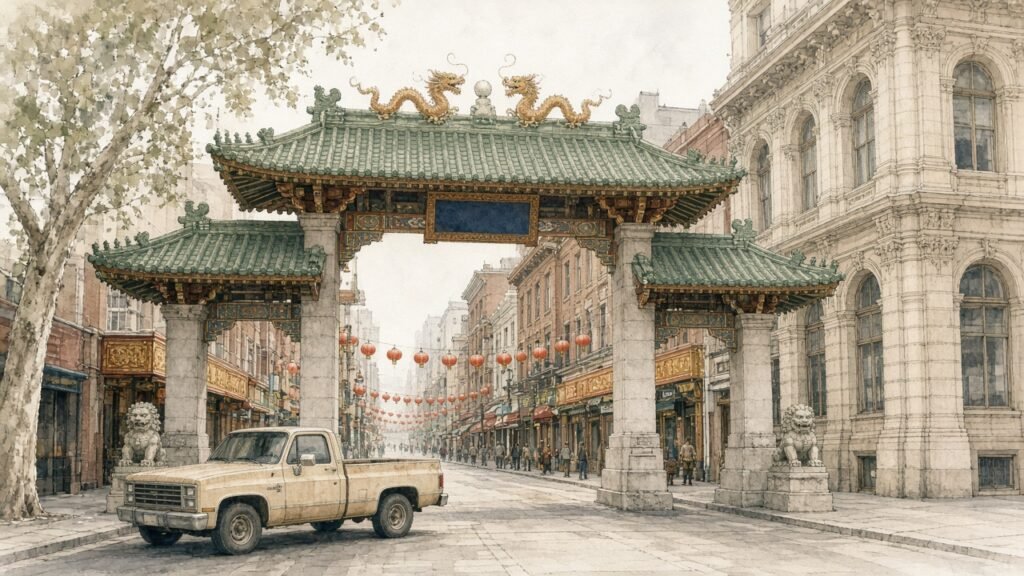
For most Americans “China” meant Chinatown, and San Francisco’s, the oldest in North America, is partly a performance. After the 1906 earthquake destroyed the district, Chinese merchants hired American architects to rebuild in an “Oriental” style to draw tourists, producing the pagoda-topped Sing Chong and Sing Fat buildings on Grant Avenue. The Dragon Gate at Grant and Bush followed in 1970. The film’s conceit, that the visible Chinatown of restaurants and souvenir shops is the lid on a hidden world of temples and dungeons, belongs to that tradition. So do its tongs and gang wars, which drew on the real Tong Wars of the nineteenth century and on a reputation revived by Chinatown gang violence in the 1970s.
There was one living Chinese cinema a Western fan could find. Hong Kong was in its boom years, with the third-largest film industry in the world, and the kung fu craze of the 1970s had left a loyal following. But its films reached the West mostly through Chinatown cinemas and video shops, where cultists prized their exotic excesses. Carpenter was one of those fans.
The immediate background was Michael Cimino’s Year of the Dragon (1985), a New York police thriller whose portrayal of Chinatown as a nest of triads, and whose racial slurs, provoked protests from Chinese American groups and led to a disclaimer being added to its credits. Asian American activism had been energised by the 1982 killing of Vincent Chin in Detroit, and the same coalitions turned their attention to Fox. On 12 November 1985, the Pacific Citizen reported, about 25 protesters chanting “No more racist movies” gathered at Ross Alley, where the crew had been due to film. Leaflets described the film as being about “a macho, smart-aleck white truck driver and his Chinese ‘yes’ man.”
When the film opened, the Los Angeles Times found Asian American opinion divided. Henry Der of Chinese for Affirmative Action called it “a white script written for a white audience . . . the movie is still a white man’s product.” Pat Li of the Association of Asian/Pacific American Artists said the script “had every old Chinese stereotype that you could drudge up—hatchetmen, tong wars, prostitutes, a madam, dragons, incense, hidden alley ways and dungeons.” Peter Kwong, who played Rain, countered that “the movie can’t be taken seriously—it’s tongue and cheek.” Janet Mitsui of East West Players did not find it offensive, and said her company’s support was for “the Asian actors working”, not the film. Fox’s marketing coordinator, Daniel Kwan, called Wang “a potential Asian-American hero”.
The film both used these images and played with them. It is full of the old furniture: sorcerers, gangs, brothels, a wise old magician and a captive bride. But it hands that furniture to a largely Asian American cast and makes the white outsider the butt of the joke. Its Chinatown is a fantasy kingdom, but it is also a community of restaurants, tour buses and second-generation Americans. Dun, whose wife disliked the script, has said he was drawn by Wang’s ordinariness as a second-generation American. “John Carpenter had that kind of vision because he understood that we were Americans,” he said. Carpenter, for his part, told Starlog in 1986: “Big Trouble is definitely a Chinese movie. That rather amazes me, coming from old white boy here.”
Second thoughts from Asian American viewers
Later verdicts have been warmer, though rarely uncritical. In 2010 a contributor to the Asian American blog 8Asians confessed to being “a bad Asian” because he loved the film. He acknowledged its stereotypes but pointed out that its apparent white saviour is an “arrogant bumbler who needs his competent Asian sidekick”, and that “the ‘great white father’ character doesn’t get the Asian girl. The Asian guy gets the Asian girl.” Writing for Women Write About Comics in 2016, Jo Fu read Egg Shen’s tour bus as a joke at the viewer’s expense (“we, the audience, are the real tourists”) and summed up the film’s message as “white people can visit otherness, but maybe they shouldn’t stay.”
The actors’ memories are mixed in a more personal way. Dun recalled that activists were writing to Carpenter about the script before shooting began. “I knew I had a responsibility, being an Asian-American actor,” he said, adding that “on that set you felt like you were part of the team.” The breakthrough he hoped for did not follow. “I thought it was my big chance,” he said, hoping for “more interesting roles that are beyond the stereotypes of Asians. But it didn’t happen.” He went on to appear in The Last Emperor alongside Victor Wong.
Comics, Lo Pan Style and Raiden’s hat
The film’s afterlife has been busier than its release. BOOM! Studios launched a comic series in 2014, co-written by Carpenter and Eric Powell, followed by a crossover with Escape from New York in which Jack meets Snake Plissken. Taika Waititi has cited the film as an influence on Thor: Ragnarok.
Its most surprising descendant is in video games. Designing Mortal Kombat (1992), John Tobias based his thunder god Raiden on the Japanese deity Raijin, then remembered the Storms. “I thought about Lightning from Big Trouble in Little China,” he later wrote. “I doodled a triangular hat on Raiden’s head in homage to BTLIC but also to help give him a distinctive silhouette compared to the other characters.” He has also said the sorcerer archetype behind Lo Pan had a “superficial influence” on Shang Tsung, and the Strong National Museum of Play lists the film among the influences on the game’s blend of martial arts and the supernatural.
Then there is the remake that never quite happens. In 2015 Dwayne Johnson was reported to be developing one, starring as Jack; by 2018 it had become a sequel. In 2021 Johnson’s producing partner Hiram Garcia told Collider that “our goal was never to remake Big Trouble but simply continue it,” while conceding “there are complications that come with a legacy property like that.” No film has yet gone before the cameras.
How China looks from 2026
The China Western audiences see now bears little resemblance to the one they imagined in 1986. It is the world’s second-largest economy and a technological power, leading in fields from electric-vehicle batteries to high-speed rail. In 2020 it overtook the United States as the world’s largest cinema market. For a decade Hollywood courted it intensively, through co-productions such as Zhang Yimou’s The Great Wall (2016) and through changes made with Chinese censors in mind. A 2020 PEN America report, Made in Hollywood, Censored by Beijing, cited the whitewashing of a Tibetan character in Doctor Strange and the disappearance of a Taiwanese flag from Tom Cruise’s jacket in a Top Gun: Maverick trailer. “Our biggest concern is that Hollywood is increasingly normalising pre-emptive self-censorship,” said its author, James Tager.
The courtship has since cooled from both sides. Foreign films reach Chinese cinemas only through state distributors, either as one of 34 revenue-sharing titles a year or for a flat fee. CNBC reported in 2025 that nine Hollywood films earned more than $100 million in China in 2019, but only eight managed it in the following five years. In April 2025, amid a tariff war, the China Film Administration said it would “moderately reduce the number of American films imported.” Chinese audiences increasingly prefer their own spectacles. Ne Zha 2, drawn from the Ming novel Investiture of the Gods and released at Chinese New Year 2025, became the highest-grossing animated film ever, with about $2.2 billion worldwide, a story told in how Ne Zha remade Chinese animation. Patriotic action has its own franchise in the Wolf Warrior films.
Familiarity has grown as fast as power. In 2019 Chinese travellers made about 155 million outbound trips, including to Hong Kong and Macau, according to the China Tourism Academy. Chinese students at American universities peaked at 372,532 in 2019/20 and still numbered 265,919 in 2024/25, according to the Institute of International Education. Martial arts cinema has its own modern canon, from Jet Li’s wushu to Donnie Yen as Ip Man, whose younger self was played by Dennis To. None of this abolishes stereotype, but Chinatown is a far less convincing stand-in for China than it was.
The neatest counterpoint is Marvel’s Shang-Chi and the Legend of the Ten Rings (2021). Its hero, played by Simu Liu, lives under an assumed name in San Francisco, and its signature set piece is a fight on a city bus. In the comics Shang-Chi was the son of Fu Manchu. The film replaced him with an original father, Xu Wenwu, played by Tony Leung. It grossed more than $432 million worldwide but never received a theatrical release in China, where trade reporting linked its fate to old interview remarks by Liu about the country. A year later James Hong played the grandfather in Everything Everywhere All at Once, which won the Oscar for Best Picture, while Ke Huy Quan, Short Round in Indiana Jones and the Temple of Doom (1984), won Best Supporting Actor.
Watching it again at forty
Seen today, Big Trouble in Little China looks less like a lost blockbuster than a genuinely odd hybrid: a Hong Kong fantasy made with Hollywood money, a screwball comedy in an action film’s clothes, and an American movie that knows its American hero is a fool. Its exoticism is real, and so is its self-awareness. Many viewers who once saw a film about Chinatown made for outsiders now see a film about how outsiders see Chinatown.
Carpenter half-predicted his fate. “If I’m lucky,” he told Starlog in the summer of 1986, “Big Trouble may even be the kung fu film for people who don’t like kung fu films.” He was right. The film introduced a generation of Western viewers to the grammar of Hong Kong fantasy cinema, gave a remarkable Asian American cast some of the best material many of them would ever get, and smuggled a good joke about American confidence into a summer movie. In 2026 China is no longer a mystery to be imagined behind a Chinatown façade. The film survives anyway, not as a guide to China but as a portrait of an America just beginning to look.
Sources
- Big Trouble in Little China, Grokipedia
- Big Trouble in Little China, Box Office Mojo
- Big Trouble in Little China, AFI Catalog of Feature Films
- Steve Swires, “John Carpenter: Kung Fu, Hollywood Style”, Starlog no. 109, August 1986 (Internet Archive)
- Clark Collis, “Big Trouble in Little China oral history”, Entertainment Weekly, 16 July 2016
- Walter Goodman, “The Screen: ‘Big Trouble,’ Wild Stunts”, The New York Times, 2 July 1986
- Roger Ebert, review of Big Trouble in Little China, Chicago Sun-Times, 2 July 1986
- Michael Wilmington, “‘Big Trouble in Little China’ Is Big Trouble Indeed”, Los Angeles Times, 2 July 1986
- Sharon Ching, “Asians Divided Over ‘Big Trouble'”, Los Angeles Times, 11 July 1986
- Pacific Citizen, 29 November 1985 (report of the Ross Alley protest)
- “AA actors credit then-panned ’80s cult film with opening Hollywood doors”, Character Media (on the Uproxx oral history)
- “How To Be a Bad Asian: I Love Big Trouble in Little China”, 8Asians, 30 December 2010
- Jo Fu, “Orientalism in Big Trouble in Little China”, Women Write About Comics, 28 April 2016
- “Immortal Mystique: Mortal Kombat’s John Tobias on the Creation and Evolution of a Franchise”, Game Developer
- “How Mortal Kombat’s Raiden Was Inspired By Big Trouble In Little China”, Screen Rant
- Mortal Kombat, The Strong National Museum of Play
- Hiram Garcia interview, Collider, 6 August 2021
- “James Lew Dead: Stuntman, ‘Hot Shots! Part Deux’ Actor Was 73”, The Hollywood Reporter, August 2026
- Zu: Warriors from the Magic Mountain, Grokipedia
- King Boxer (Five Fingers of Death), Grokipedia
- Cinema of Hong Kong, Grokipedia
- Leigong, Grokipedia
- Lu Ban, Grokipedia
- Year of the Dragon (1985 film), Grokipedia
- Charlie Chan, Grokipedia
- Fu Manchu, Grokipedia
- Chinatown, San Francisco, Grokipedia
- Dragon Gate (San Francisco), Grokipedia
- China–United States relations, Grokipedia
- Royal Visit to China, 1986, Royal Collection Trust
- Wham! in China: Foreign Skies, Grokipedia
- James Hong, Grokipedia
- “Hollywood censors films to appease China, report suggests”, BBC News, August 2020
- “China to ‘Moderately Reduce’ U.S. Film Imports After Trump Tariffs”, Variety, April 2025
- “Hollywood Chinese box office was in decline even before Trump tariffs”, CNBC, 11 April 2025
- Cinema of China, Grokipedia
- Ne Zha 2, Grokipedia
- Shang-Chi and the Legend of the Ten Rings, Grokipedia
- Open Doors 2025 country fact sheet: China, Institute of International Education
- China Outbound Tourism Development Report 2020, China Tourism Academy (in Chinese)