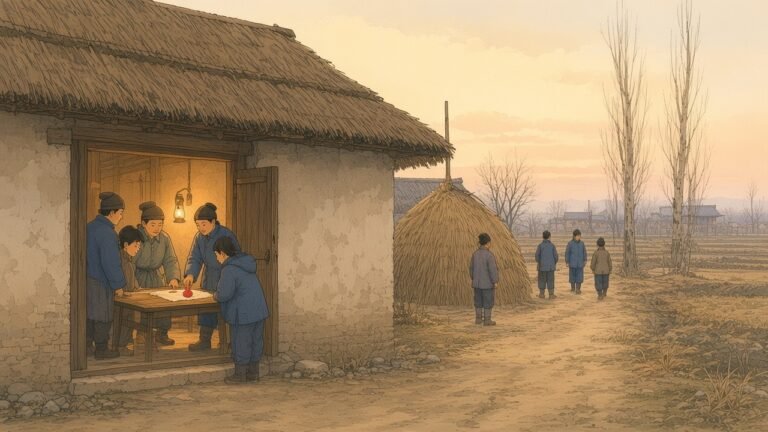
On 20 February 1974, in a rented shed in Tucheng, a rough suburb of Taipei whose name means earth city and which American reporters later translated as Dirt City, a twenty-three-year-old shipping clerk started a plastics firm. His name was Terry Gou, Guo Tai-ming. The money was about NT$100,000, roughly US$7,500, from his mother, Chu Yung-chen. The company was called Hon Hai Plastics. It had a handful of workers, often remembered as about ten, and a couple of moulding machines. The product was the small plastic knob that changed the channel on a black-and-white television. There was no brand called Foxconn, no campus, and no telephone the world wanted. There was a shaft, a cap of plastic that had to fit it, and a young man who had decided that the object on the bill of lading was a better living than the bill of lading itself.
Half a century on, the same legal person is Hon Hai Precision Industry Co., Ltd., ticker 2317 in Taipei, and the name painted on the factories is Foxconn. It became the largest electronics contract manufacturer in the world, the firm that assembled other companies’ computers and, later, the iPhone. The later geography of that business, the split with the chip foundry next door in the Taiwanese story, and the thin margin under the enormous revenue, are the subject of another dispatch, Foxconn and TSMC. This one stops at the advent. It asks how a knob shop in Tucheng became a walled town in Shenzhen, and why the company that did it kept someone else’s name on the box.
The clerk and the docks
Gou was born in 1950 in Banqiao, in what is now New Taipei City. His parents had come to Taiwan with the Nationalist retreat in 1949, and his father served as a policeman. Gou was the eldest son. He had a vocational education at a maritime college, did his military service, and by about 1971 was a clerk in a shipping company.
The job was a good school and a poor prospect. Taiwan’s export boom was already the island’s answer to having few resources and a contested state. The Kaohsiung Export Processing Zone had opened in 1966, a fenced patch of coast where imported materials came in, Taiwanese hands worked them, and finished goods went out under someone else’s brand. A clerk who handled the paper saw the pattern every day. The profit sat with the foreign buyer, and a slice sat with whoever could make the thing to the buyer’s drawing, on time, at a price the drawing had already assumed. The island that produced people of that cast of mind is a longer story, told in Taiwan and the people it produced. Gou was one clerk among many. The difference was that he took a sum from his mother and rented a shed.
The sum is one of the few figures the sources almost agree on. English profiles, including the long Businessweek portrait of 2010, say about US$7,500 from his mother. Chinese-language reporting is more precise about the path of the money: it came from what Chu Yung-chen had raised in a rotating credit club, a biaohui, the neighbourhood instrument by which people who could not easily get a bank loan financed one another. NT$100,000 was enough for a small machine or two, a lease, and a payroll measured in a single row of people. It was not enough to survive a bad year.
The partners leave
He did not start entirely alone. The Chinese retellings speak of friends in the first partnership, and of a firm that hit the wall almost at once. Within about a year, those accounts say, the partners withdrew and left him with the machines. A Nikkei profile remembers the same pinch from the kitchen: his wife could barely put rice on the table, and her parents lent the money to go on. Chinese business profiles name a loan of about NT$700,000 from his father-in-law. Family money, not a bank and not a state programme, kept the firm alive.
What he did with the rescue is the first real decision in the advent. He did not go back to a general plastics shop. He looked at what was actually selling. Black-and-white television sets were spreading through Taiwan and, more to the point, through the export orders the island lived on. A set needed knobs. He renamed the firm Hon Hai Industrial and pointed the machines at that one part. The profiles that follow the company from the inside say it turned its first profit in 1977. The customers, as a Bloomberg biographical note later listed them, were the names on the sets: Admiral, the Chicago maker, as an early one, then RCA, Zenith and Philips. A reader should hold those names lightly. They come from the founder’s biographical tradition, not from a public contract archive. What they establish is the shape of the trade. Hon Hai was not selling a Gou television. It was selling a part into televisions that already had brands, most of them foreign.
The mould and the knob
A channel knob is a good object to think with, because there is nowhere in it to hide. On a set of that decade the tuner was a rotary shaft. Over the shaft sat a moulded cap, often with a skirt of ridges so that a thumb could turn it. The cap had to fit, the plastic had to survive the warmth of a set that ran hot, the colour had to match the cabinet, and the seam left by the mould could not sit where the finger would find it and judge the whole television by a scratch. The customer decided every one of those things. The maker’s freedom was the tool, the seconds of the cycle, and the price.
Gou’s useful obsession was the tool. Taiwanese moulding of that period was still in large part a craft held by a master who kept the trick of a difficult tool in his head. The handbook accounts of Hon Hai say that Gou wanted the mould shop inside the firm, and wanted it run as a procedure. By the late 1970s he had his own tooling. If the mould is yours, a new shape is a matter of weeks rather than a negotiation with a rival. If the mould is yours, the small profit on the tool stays in the same accounts as the profit on the part. If the mould is yours, a customer who wants to take the drawing down the road has to teach someone else your last ten years of mistakes. Every later boast about vertical integration is this decision, repeated on a larger part.
The Chinese name already had the boast in it. Hon Hai, 鴻海, he later glossed with an old metaphor: a great swan that flies a thousand miles, a sea that takes in a hundred rivers. It was an absurd name for a shed that made knobs. He was not a modest namer. He was a modest manufacturer, and the gap between the two is the career.
A cable for Atari
The turn out of television parts came around 1980, and it came, like the knob, as someone else’s product. Atari ordered a connector, the join between a games console and its joystick. A joystick is yanked by a child, dropped, and twisted. The cable that survives is a small assembly: a moulded plug, a set of pins, a clamp, a length of wire, and a test to prove the joint is honest. Hon Hai could mould the housing. It now had to learn the metal and the cable as well.
In 1981 the firm had a connector aimed at personal computers, which multiplied the joins inside a single machine: power, serial ports, the ribbon between a drive and a board. In 1982 the company took the name it still carries in law, Hon Hai Precision Industry Co., Ltd., 鴻海精密工業股份有限公司. Plastics had described the material. Precision described the promise, which was that a drawing from an American or Japanese engineer would come back as a part that fitted. A connector is an ungrateful trade. The specification is the customer’s, the volume is high, and the price falls as soon as a second source appears. The winner is the firm that can tool a new housing quickly and ship it without a speech. Hon Hai was offering to be the part of the computer that the brand did not want to staff or to explain. That offer is the whole of electronics manufacturing services, years before the phrase became a line in an analyst’s note.
Eleven months in America
Customers of that kind did not come to Tucheng. Gou went to them. In the early 1980s he spent a long stretch in the United States, an eleven-month selling trip in the magazine reporting, calling on companies that had not asked to see him. The portraits describe a man arriving without an appointment, sometimes persistent enough that security was called, and sometimes leaving with a drawing. The anecdote the Bloomberg note preserves, because it is particular, is Raleigh, North Carolina. He took a motel room near an IBM plant, waited about three days, got a meeting, and left with an order for connectors.
The engineers who chose a connector sat in the United States. A Taiwanese mould shop stayed invisible until a purchasing office agreed to try a sample. Gou came home with a few American relationships, including work that fed, through a supplier, into Intel’s world, and with a clock running. Taiwanese wages were rising. A connector that won on price in 1982 would not win on the same wage in 1992.
Other Taiwanese manufacturers read the clock and looked south, to Thailand, Malaysia, the Philippines and later Vietnam. The model was familiar. It was Kaohsiung, moved. Gou looked the other way, across the strait. He was not the first Taiwanese investor to try the mainland, and this advent should not be told as if he were. Direct investment was still politically awkward in Taipei, and a great deal of early Taiwanese manufacturing on the mainland went through Hong Kong paperwork and processing contracts. What is true, and more important, is that when his peers scanned Southeast Asia, he decided the workforce and the political bet he wanted were in Guangdong.
The tenth year of reform
Nineteen eighty-eight was the tenth year of reform and opening. Shenzhen had been a special economic zone since 1980, cut out of a county of villages on the Hong Kong border. How that zone was built is the subject of how Shenzhen was built from border villages. Hon Hai did not build the zone. It arrived when the zone had a decade of practice and was still, at its edges, a building site.
He needed a processing-trade regime, machines and materials in, finished parts out, and people who would travel for a wage that was low by Taipei standards and high beside a village income. Shenzhen’s cadres were competing with other coastal towns to land Taiwanese manufacturers. A firm that promised a payroll was a prize. That fact is the silent partner in every later story about the scale.
The first door was not the famous one. Longhua, the walled city of the 2000s, was not yet a Hon Hai site. The 1988 plant sat in Xixiang, in Bao’an. In the company’s memory the sign read Shenzhen Ocean Precision Computer Connector Factory, 深圳海洋精密電腦接插件廠. Ocean picked up the second character of Hon Hai. Connector said what the shop still was. Gou has described the start plainly, in remarks the Shenzhen press carried around the thirtieth anniversary. The factory was rented. The equipment, the materials and the methods came from Taiwan. The mainland operation processed those materials.
A rented shop in Xixiang
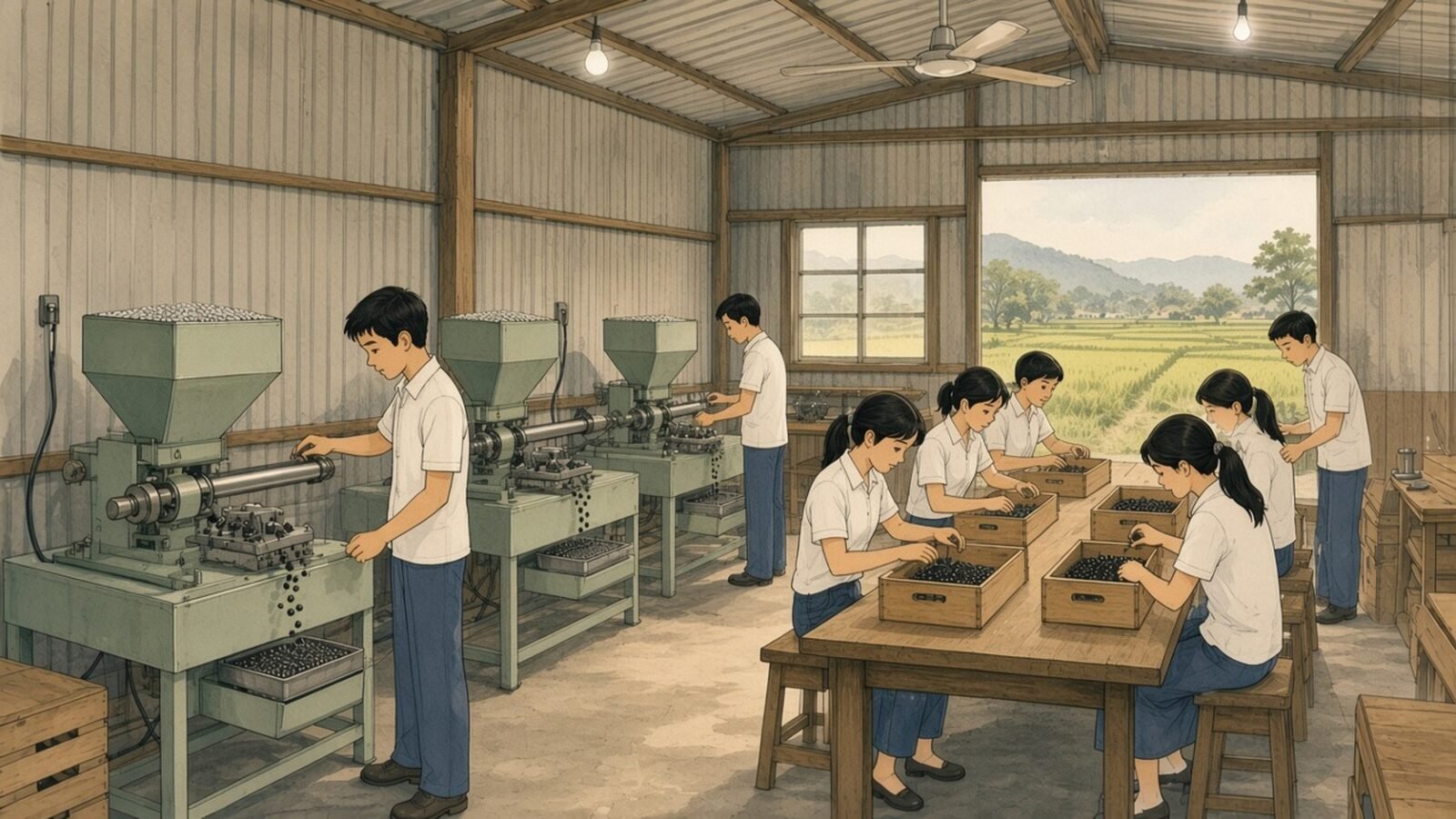
The headcount was about 150. Later profiles of that first intake, and the reminiscences of people who were in it, put most of them as young women recruited out of Guangdong towns. The arrangement the giant campuses would keep was there from the start: the job and the bed sold together. A dormitory was how you hired a person who had come from somewhere else. The early wage is remembered in one biographical note as about US$30 a month, plus housing and a breakfast, and, because an egg was still a treat, an egg. Hold the dollar figure as a profile’s memory, not as a wage sheet. The structure lasted. Pay, a bunk, a meal, a gate.
The day-to-day was less like a brochure. Chinese profiles of the first cohort describe shared bunks, power cuts, and rice that sometimes cooked up red from the water. People left. The ones who stayed learned a connector properly. Among them was a twenty-one-year-old from Chenghai, in Shantou, called Wang Laichun, born in 1967, on the line in 1988 assembling connectors. She did not stay forever. In 2004 she and her brother, Wang Laisheng, founded Luxshare Precision. A generation later Luxshare took a serious share of the Apple assembly Hon Hai had taught the industry how to do. The advent contains, almost from its first month on the mainland, the person who would build a rival out of the same lesson. That is how a shop floor works when the skill walks out of the gate in the evening.
Towns such as Dongguan were filling, in the same years, with plants of the same kind. How Dongguan became a manufacturing city is the wider map. Hon Hai’s own bet was to refuse to stay a specialist: a connector firm that owned its moulds could add a cable, then a metal piece, and offer one address instead of a lane of them.
The hill at Longhua
Later profiles put Gou, in 1993, on a rise in Longhua, then a town of ponds and villages north of the city, telling the people with him that he wanted the land in front of him. The sentence is remembered as a claim on everything he could see. In 1996 the company bought a tract from the Shenzhen government, and the Longhua industrial park went up. He has described the building of it as work the firm did itself, down to the gravel, the bricks, the pipes and the drain covers. Deng Xiaoping’s southern tour of 1992 sits in the political weather behind that purchase. After 1992 the zone model was no longer an experiment that a change of mood in Beijing might close. A manufacturer who had been early could become large.
Longhua is where the shed became a settlement. The mature campus held factories, dormitories, canteens, clinics, shops, a fire crew, and at one point its own television channel, inside a wall. Published headcounts disagree because they were taken in different years and seasons. Figures of 230,000, 300,000 and 450,000 have all been attached to Longhua, on a site of roughly one to one and a half square miles. The group-wide China workforce was later described near, and sometimes above, a million at the seasonal peak. None of these is a census. All of them mark a change in kind. A factory that needs its own fire brigade is a town whose product happens to be someone else’s.
People came to the gate in crowds, and buses went out to villages and came back with workers. A recruit could sleep inside the wall, eat inside the wall, and send money home. Profiles record roll calls and a culture that treated obedience as a slogan. For a decade, while the wall kept the customers’ names off the building, that bargain held in silence. The silence was part of what he was selling.
A ticker, a chassis, an airport road
In 1991 Hon Hai listed in Taipei as 2317, to fund the mainland build. Connectors had made a profitable firm. They were not going to make a giant one. The step that changed the size of the order came when Hon Hai took on metal chassis for personal computers. The Businessweek reporting puts the Compaq desktop chassis at 1996. A chassis is a knob the size of a machine: folded metal, holes that have to match a board, a finish the brand will judge in a second when the side panel comes off. Win that, and the conversation moves. The firm that makes the box can be asked to put something in the box.
Within a few years Hon Hai was shipping barebones computers, the machine short of the brand’s last choices, to Compaq, HP, IBM, and into Apple’s supply chain. Dell’s first chassis order is placed by the same Businessweek account in 1998, with a condition that says how the buyers still thought: Dell wanted the work done in the United States, close to the market. There is a second Dell story, in a Forbes account, set a little earlier, in which Gou collected a young Michael Dell on the road to an airport and took him to the Shenzhen floor. The detour is a story the company likes. The chassis orders are the part that shows in the business. He was no longer selling a part. He was selling the time between a drawing and a truck.
By the end of the 1990s the offer had a plain shape, whatever the industry called it. The brand kept the name on the outside. The contractor took the mould, the metal, the cable, the test, the dormitory and the truck.
A product with someone else’s name
Apple is the customer that made Foxconn a household word, and the customer the factories were built not to discuss. A Nikkei account has put an early Apple job in the middle of the 1990s and associated the firm with casings. The translucent iMac the public queued for was a machine of 1998, so a tidy claim about iMac shells in 1994 is more than the record can hold. The sequence is solid without it. By the late 1990s Hon Hai was inside the enclosure business of the personal-computer brands, Apple among them. Through the early 2000s it was deep in the iPod, a product whose volume rewarded a contractor with its own tools, its own test lines and its own beds. In January 2007 Apple announced the iPhone. It went on sale that June. For a large share of the units, the last human hands on the object belonged to a Hon Hai payroll in China.
The brand and the software sat in California. The most valuable silicon was likely fabricated by TSMC. The board, the screws and the final test sat, very often, on a Hon Hai line. Chip War, as read on this site, is about the chokepoints further up that chain. Analysts have guessed that Apple grew toward something like two fifths of Hon Hai’s revenue. The company does not publish a clean figure. The concentration was real enough that a launch date in California became a hiring season in Henan.
The inland road
Coastal wages rose, as Taiwan’s had. Workers who had learned a line had more places to take the lesson. Local governments away from the Pearl River wanted the payroll Shenzhen had used to justify itself. Hon Hai moved toward the cheaper bed and the keener cadre, and the first great move did not leave China to do it. A plant at Kunshan, on the Yangtze delta, was in production by the middle of the 1990s. Through the 2000s the inland announcements gathered: Shanxi, Sichuan, Chongqing, and then Henan. Zhengzhou is the campus reporters took to calling iPhone City. From about 2010, with the province and the city as partners, the public side of the bargain ran, on the New York Times’s later itemising, past a billion dollars in factory and housing support, plus roads and the airport. The daily phone counts and the seasonal headcounts move from profile to profile. The authorship does not. Chinese local government recruited, housed, and cleared customs, and it had its own reasons for wanting the calendar met.
The first relocation was from Shenzhen toward the interior, with the Taiwanese managers kept and the customer’s name still off the gate. Later lines in India and Vietnam were a variant of the same 1988 method. Why China did not stay at the thin end tells what those rooms accumulated: process knowledge in the same building where the brand’s margin did not stay.
The year the campus was seen
In 2010 the silence broke. A run of deaths at Longhua, most of them reported as suicides, became a worldwide story. The counts published at the time sit in the low teens for the deaths, with a larger number of attempts, and later summaries still do not settle on a single integer. Gou came to Shenzhen, apologised, and promised changes. Wages rose. Nets went up. Counselling was announced. Apple became a public party to conditions in a factory it did not own, and over the next few years spread assembly toward other contractors, Pegatron among them.
Researchers led by scholars such as Jenny Chan documented long overtime, dormitory rules and a military flavour in the routine. The company and Apple pointed to audits and higher pay. Launch calendars put real pressure on young people far from home, and paid wages those people had crossed provinces to earn. The price and the date the public enjoyed had a dormitory attached, and in 2010 that dormitory acquired a window the wall could not cover.
What the shed had turned into
The numbers at the far end are a warning against confusing revenue with power. For 2024 Hon Hai reported sales of NT$6.86 trillion, on the order of US$200 billion, enough to place the group high on the Fortune Global 500 and to make it Taiwan’s largest company by revenue, ahead of TSMC on the top line. The net margin on that mountain has stayed around two per cent, and the gross margin near six, in the results discussed in our essay on the two firms. Those are the economics of a firm that takes the volume and leaves the rent. The advent succeeded at the thin end, because the thin end was the end a knob maker could occupy without permission from the owner of the name.
Gou remained chairman until 2019, then stepped down. Liu Yang-wei, known in English as Young Liu, succeeded him. The registered office and the legal name stayed in Tucheng. Hon Hai is a Taiwanese firm that learned to run the largest private payroll in China. Without Taipei there is no mould shop and no decision to cross in 1988. Without Guangdong, and then Henan, that mould shop remains a connector company the world has little reason to learn by name.
A different giant from Samsung
Samsung, which began as a trading house in Daegu, climbed into a family group with its own name on the glass. Hon Hai climbed by leaving the name to the customer. There is no Foxconn telephone that matters the way a Galaxy matters. The mainland brands told in how China built its own brands are a third path: take the process those shops had concentrated on the coast and put a Chinese name on the finished good. Wang Laichun’s Luxshare is that path from inside the Xixiang gate. The Wisconsin project of the late 2010s, announced as if a campus could be unpacked wherever a subsidy was offered, never became a second Longhua, because the campus was a workforce, a local state and a tool shop already trained on the last product, all at once.
The sea and the fox
In 1985, before the mainland plant existed, Gou gave the export side a name an American buyer could remember. Foxconn joined fox and connector. The fox, he said, was speed. Connector was the honest half, the thing the company sold. A later couplet bent the same sound toward recruitment: gather able people and the company is strong. On the mainland the trademark became 富士康, chosen for the sound and for auspicious characters rather than as a translation. Three names, one payroll. The legal person remained Hon Hai Precision Industry. The sea in the Chinese name was the founder’s boast. The fox was a salesman’s animal, picked so that a purchasing manager would not file the card under a name he could not pronounce.
Stand again in the yard at Tucheng in February 1974. The shed is rented. Two machines turn out a cap of plastic that a thumb will use to change the channel. A basket of knobs sits by the door. The young man who has just spent his mother’s loan knows that a customer will not care about his ambitions if the seam of the mould can be felt by a finger. Everything the world later meant by Foxconn is that seam on a larger part. A connector carries a signal. A chassis has to close around a machine. A phone is what the public mistakes for a brand, because the brand is what the public is shown and the contractor was paid to stay unseen. The headquarters is still in Tucheng. The legal name is still Hon Hai. The shed’s victory was to meet other people’s orders at a scale no shed could hold, and to remain, in the profit, a shed.
References
- Key Milestones, Hon Hai Technology Group: the 1974 founding as Hon Hai Plastics and the 1982 renaming. The founding date of 20 February 1974 is from Hon Hai’s 2022 bond prospectus; the mother’s NT$100,000 and the rotating credit club from the Central News Agency, 26 October 2016; the 2024 revenue from Foxconn, Grokipedia.
- Terry Gou, Grokipedia: the shed, the early workforce, the mother’s loan and the 1988 move into mainland China. The Atari order, the American trip and the 1996 Compaq chassis are in the Businessweek article below.
- “The man who makes your iPhone”, Bloomberg Businessweek, as carried by NBC News, September 2010: Tucheng, the mother’s loan, the 1991 listing, and the 1998 Dell chassis order.
- Bloomberg’s archived billionaire profile of Terry Gou: Admiral, RCA, Zenith and Philips, the Raleigh motel, the Foxconn name in 1985, and the early Shenzhen wage and breakfast.
- “The real face of Terry Gou”, Nikkei Asia: the family background and the early crisis.
- Shenzhen Special Zone Daily, reported by GDToday around the thirtieth anniversary of the investment: Gou’s account of the rented 1988 factory and the 1996 Longhua purchase.
- Longhua Science and Technology Park, Grokipedia: the campus and the range of reported headcounts.
- Chinese business profiles of Wang Laichun: the 1988 Xixiang intake and the 2004 founding of Luxshare Precision with her brother.