Mawangdui is a site in the eastern part of the city of Changsha, the capital of Hunan province in central China, where three tombs of the early Western Han dynasty were excavated between 1972 and 1974. The tombs belonged to a noble family of the second century BCE: Li Cang, chancellor of the kingdom of Changsha and first Marquis of Dai, his wife, and a man believed to be their son. The excavations produced one of the richest bodies of evidence ever recovered for the material culture, beliefs and learning of early imperial China. They included the remarkably preserved body of the marquis’s wife, a painted silk banner of great complexity, large quantities of lacquerware, textiles and food, and a library of texts written on silk and bamboo, among them the earliest known manuscripts of the Daodejing and many works on medicine, astronomy and philosophy that had been lost for two thousand years. This article describes the history of the family and the kingdom they served, the discovery and structure of the tombs, the principal finds and their significance for the study of the Han period. The general history of the dynasty is outlined in The Han People and Their History, and the unification that preceded it in The First Emperor and the Terracotta Army.
The Kingdom of Changsha
When Liu Bang founded the Han dynasty in 202 BCE, he did not rule the whole of his territory directly. Following the collapse of the short-lived Qin empire, he rewarded some of his allies and relatives with kingdoms in the east and south, while the western part of the empire was governed through commanderies administered by officials appointed from the capital at Chang’an. One of these kingdoms was Changsha, in the region of the middle Yangtze that had formerly belonged to the state of Chu. Its first king was Wu Rui, a commander who had supported Liu Bang in the wars that brought him to power, and his descendants ruled the kingdom for several generations. Unlike most of the other kingdoms ruled by non-imperial families, which were abolished in the early decades of the dynasty, Changsha survived until the middle of the second century BCE, partly because it lay on the southern frontier, facing the independent kingdom of Nanyue in what is now Guangdong.
The kingdom’s officials included a chancellor appointed by the imperial court, who served as a link between the central government and the local ruler. The region retained many features of the culture of Chu, which had been one of the great powers of the Warring States period, with its own traditions of art, religion and literature. The material from Mawangdui reflects this mixture of Han imperial institutions and older southern culture. Background on the earlier state is given in the Grokipedia article on Chu, and on the dynasty in the article on the Han dynasty.
The Marquis of Dai and His Family
Li Cang served as chancellor of Changsha in the reign of Emperor Hui. In 193 BCE he was made Marquis of Dai, a title that carried the right to the revenues of several hundred households, and he died in 186 BCE. The marquisate passed to his descendants for several generations. His wife, whose personal name is recorded on a seal in her tomb as Xin Zhui, outlived him by many years and died at around the age of fifty, probably some time after 168 BCE. The occupant of the third tomb was a man in his thirties at death, who is generally believed to have been a son of Li Cang and Xin Zhui, though his precise identity has been debated. A wooden tablet found in this tomb records a date corresponding to 168 BCE, which is taken as the year of burial.
The family thus belonged to the upper ranks of the Han nobility, but they were not members of the imperial family or royal rulers. Their tombs therefore illustrate the burial practices and possessions of a wealthy aristocratic household of the early Han, rather than of the emperors whose tombs remain largely unexcavated.
The Discovery
The name Mawangdui means the mound of King Ma, and local tradition associated the two large earthen mounds on the site with Ma Yin, a ruler of the region in the tenth century, or with other figures of the past. In the late 1960s and early 1970s, during construction work at a military hospital on the site, workers digging air-raid shelters encountered signs of an ancient tomb, including the escape of gas from the ground. Archaeologists from the Hunan Provincial Museum examined the site and began a full excavation of the eastern mound in January 1972. This tomb, later designated tomb 1, proved to be that of Xin Zhui.
The excavation of tomb 1 lasted several months and attracted national attention, as its extraordinary state of preservation became apparent. Tombs 2 and 3, under the western mound and immediately south of tomb 1 respectively, were excavated between late 1973 and early 1974. Tomb 2, the tomb of Li Cang, had been robbed in antiquity and was poorly preserved, but it contained three seals that identified the occupant: one with his personal name, one with his title as Marquis of Dai, and one with the title of chancellor of Changsha. Tomb 3 was well preserved and contained the largest group of manuscripts. The general history of the site is set out in the Grokipedia article on Mawangdui.
The Construction of the Tombs
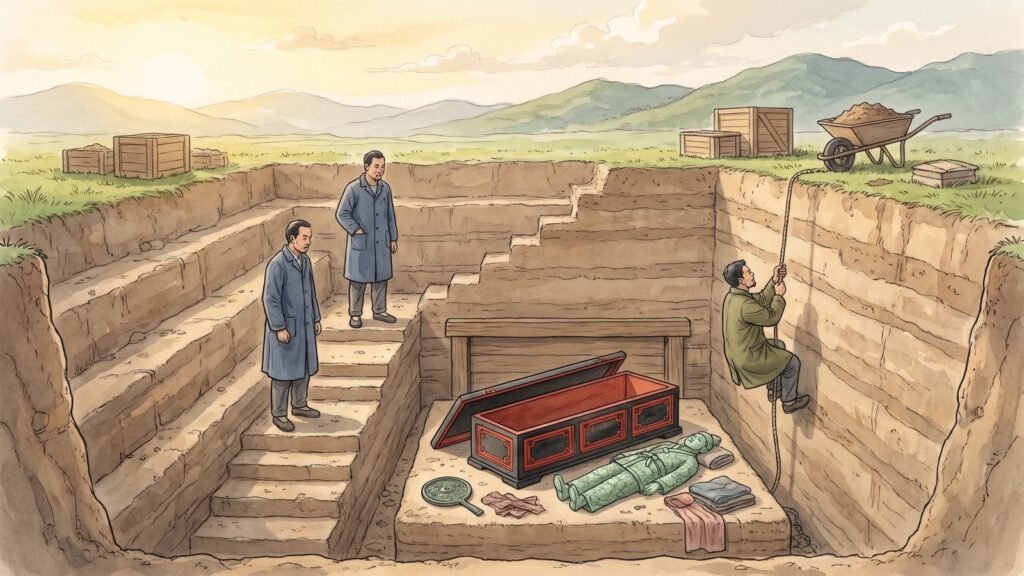
The Mawangdui tombs were vertical pit tombs of a type common in the region of Chu. A deep rectangular shaft was dug into the ground, with stepped sides narrowing toward the bottom, and at the base a large wooden chamber was constructed. In tomb 1 the chamber was built of massive planks of wood and divided into a central compartment holding the coffins and four surrounding compartments that served as storerooms for the objects buried with the deceased. The coffins were nested one inside another, four in number in the case of tomb 1, each richly decorated.
The chamber was surrounded by a thick layer of charcoal, amounting to several tonnes, and this was in turn enclosed by a layer of dense white clay. The pit was then filled with pounded earth and covered by a mound. The charcoal absorbed moisture, and the clay sealed the chamber against air and water, creating a stable, airless and constant environment. These conditions, together with the depth of the tomb and the treatment of the body, account for the exceptional preservation of organic materials in tomb 1, including wood, silk, lacquer, food and the human remains. Similar construction techniques have been found in other tombs of the region, but few have been as well sealed as tomb 1 at Mawangdui.
The Body of Xin Zhui
The most famous discovery at Mawangdui was the body of Xin Zhui. When the innermost coffin was opened, the body was found immersed in a liquid, wrapped in many layers of silk and other textiles, and in a state of preservation that astonished the excavators. The skin was soft and retained some elasticity, the joints of the limbs could still be flexed, and the internal organs were intact. The body has been described as one of the best-preserved human remains of comparable antiquity found anywhere in the world, and it differs from Egyptian mummies in that it was not dried, but preserved in a moist condition.
A detailed medical examination was carried out after the excavation. It showed that Xin Zhui had suffered from a number of ailments, including hardening of the arteries, gallstones and lower back problems, and it concluded that she had probably died suddenly, perhaps of a heart attack. Melon seeds were found in her stomach and intestines, indicating that she had eaten melon shortly before her death, which suggests that she died in the summer. Her blood type was identified, and parasites were found in her body. These findings have made Xin Zhui an important subject for the study of health and disease in ancient China. Her life and remains are described in the Grokipedia article on Xin Zhui.
The precise reasons for the preservation of her body remain the subject of research. The sealing of the tomb, the low temperature at depth, the absence of oxygen and the possible effects of the liquid in the coffin have all been considered, along with the rapid burial of the body after death. There is no evidence that the Han used a deliberate process of embalming comparable to that of Egypt, and the preservation appears to have resulted from a combination of careful burial practices and favourable natural conditions.
The Coffins
The four nested coffins of Xin Zhui are themselves important works of art. The outermost coffin was coated in plain black lacquer. The second was painted with a black ground covered by swirling cloud patterns among which appear a variety of strange creatures and spirits, some of them animal-like, some human in form, engaged in hunting, playing music and other activities. The third coffin had a red ground decorated with dragons, tigers, deer and other auspicious creatures, together with a mountain that many scholars have identified as Kunlun, the sacred mountain of the west associated in Chinese mythology with immortality and the dwelling place of divine beings. The innermost coffin, which held the body, was decorated with feathers and embroidered silk.
The sequence of decoration from the outer to the inner coffins has been interpreted as reflecting ideas about the passage from the world of the living to the realm of the spirits, and about protection of the deceased against harmful forces. The cloud patterns and creatures belong to a decorative tradition that had developed in the lacquer art of Chu, and they show how this tradition continued under the Han. Together with the banner, the coffins form a programme of images that surrounded the body and expressed beliefs about its fate.
The Silk Banner
Draped over the innermost coffin of Xin Zhui was a painted silk banner, about two metres long, in the shape of the letter T. A similar banner was found in tomb 3. The banner from tomb 1 is one of the most important surviving works of early Chinese painting and has been the subject of extensive study. It is painted in mineral pigments on silk with fine outlines, and its composition is divided into several zones arranged vertically.
The upper, horizontal part of the banner represents the heavens. On the right is a red sun containing a black bird, and on the left a crescent moon with a toad and a hare, symbols found in later Chinese mythology. Between them is a figure with a human head and a serpent’s body, whose identity has been variously interpreted, and the heavens are populated by dragons, birds and other creatures. Below this, at the junction of the upper and lower parts, are a pair of gateways guarded by figures, often interpreted as the gate of heaven.
The central part of the vertical section shows an elderly woman leaning on a staff, accompanied by attendants, with kneeling figures before her. This figure is generally interpreted as Xin Zhui herself. Below her is a scene of ritual offerings or a funeral feast, with vessels and figures arranged beneath a canopy. The lowest part depicts an underworld, with a figure standing on a pair of large fish, supporting the platform above, and surrounded by serpents and other creatures.
The function and meaning of the banner have been debated. Some scholars have seen it as a depiction of the journey of the soul of the deceased to the heavens, while others have emphasised its role in the funeral ritual, perhaps as a banner carried in procession and then placed in the tomb. Inventories found in the tomb refer to objects that may correspond to the banner, but the terms used are open to interpretation. Whatever its exact purpose, the banner offers a unique visual record of beliefs about death, the cosmos and the afterlife in early Han China.
Textiles and Clothing
The textiles found in tomb 1 are among the most important collections of early Chinese silk. They include garments, lengths of fabric, shoes, gloves and other items, in a variety of weaves and decorative techniques, including plain weave, gauze, damask, brocade and embroidery. Many were painted or printed with designs. The most celebrated is a plain gauze robe of very fine silk, with long sleeves, weighing only about forty-nine grams, an extraordinary demonstration of the skill of Han silk weavers.
These textiles provide direct evidence of the techniques of sericulture and weaving that had made silk one of the most valuable products of China. They show that by the early Han the Chinese had mastered complex methods of patterned weaving and that a household of the nobility could possess a large wardrobe of luxurious garments. The history of the silk trade and the efforts of the Chinese state to protect its techniques are described in Silk Smuggling Was a Capital Crime, and the routes along which silk travelled westward in the Grokipedia article on the Silk Road.
Lacquerware, Figurines and Food
The tombs contained large numbers of lacquered objects, including cups, dishes, boxes, tables, screens and toilet cases, many decorated with elaborate designs in red and black. Some carried inscriptions identifying them as the property of the household of the Marquis of Dai, and some bore marks indicating where they were made. Lacquer was a costly material, requiring the repeated application of layers of the sap of the lacquer tree, and these objects reflect the wealth of the family and the skill of the craftsmen who served them.
Wooden figurines representing servants, musicians and dancers were placed in the tomb to attend the deceased in the afterlife. Musical instruments, including a zither and a set of pipes, were also found. The storerooms of tomb 1 held quantities of food in bamboo cases and pottery vessels, including grains, fruits, meats and prepared dishes, along with herbs and medicines. A set of bamboo slips listed the objects placed in the tomb, providing a written inventory that could be compared with the actual finds and that preserved the names used for foods and objects in the Han period.
This material offers a detailed picture of the daily life of an aristocratic household of the time. It shows the foods they ate, the vessels they used, the clothes they wore and the entertainment they enjoyed. It also shows that the deceased were expected to need these things after death, and that the tomb was conceived as a dwelling furnished for the continued existence of its occupant.
Beliefs About Death
The arrangement of the Mawangdui tombs reflects the beliefs about death that were current in early Han China. It was widely held that a human being possessed two kinds of soul, often referred to as the hun and the po. The hun was associated with the spirit and the heavens and was thought to depart from the body at death, while the po was associated with the body and remained with it in the tomb. Funeral rites sought to call back the departing spirit, to provide for the needs of the soul that remained, and to ensure that the dead would not become restless or harmful to the living.
The tomb was furnished as a dwelling, with food, clothing, servants, music and books, so that the deceased could continue an existence similar to that of life. Documents found in some Han tombs, including one at Mawangdui, were addressed to officials of the underworld, informing them of the arrival of the deceased and listing the possessions accompanying them, in a form modelled on the administrative documents of the living state. This suggests that the afterlife was imagined in part as a bureaucracy similar to that of the Han government. At the same time, the images of the heavens on the banner and the coffins show an interest in the ascent of the spirit and in immortality. Historians have debated how these different ideas related to one another, and the Mawangdui material has been central to this discussion.
The desire to preserve the body, evident in the elaborate sealing of tomb 1, was also connected with these beliefs. Later in the Han, members of the imperial family were sometimes buried in suits made of small plaques of jade sewn together with wire, in the belief that jade would protect the body from decay. Although no such suit was found at Mawangdui, the care taken to protect the body of Xin Zhui reflects the same concern.
Tomb 3 and Its Occupant
The occupant of tomb 3 was a man aged about thirty at death. His remains were not preserved in the same way as those of Xin Zhui, but the objects buried with him reveal much about his interests and position. Besides the manuscripts, the tomb contained weapons and the military maps already described, suggesting that he held a military role, possibly connected with the defence of the southern border of the kingdom. The presence of the large library of texts indicates that he was a man of learning with wide interests, from philosophy and history to medicine, astronomy and divination.
The identity of this man has been debated since the excavation. The early reports on the excavation described him as a son of Li Cang and Xin Zhui. In 1983 the archaeologist Fu Juyou published an article in the journal Kaogu proposing that the occupant was Li Xi, who succeeded Li Cang as the second Marquis of Dai. The difficulty with this view is that the Shiji and the History of the Former Han record Li Xi’s death in 165 BCE, three years after the date of burial given by the tablet in tomb 3. Many scholars have therefore preferred to see the occupant as another son of the couple, perhaps one who held a military post in the kingdom, while others have accepted the identification with Li Xi and questioned the transmitted dates. Donald Harper, in his edition of the medical manuscripts, presents the question as unresolved, and later discussion has not produced a consensus. This article therefore refers to the occupant simply as a son of Li Cang and Xin Zhui.
The Manuscripts of Tomb 3
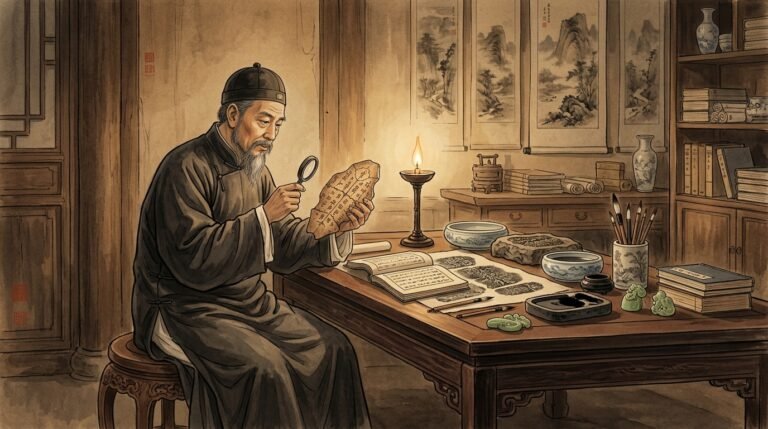
The greatest scholarly importance of Mawangdui lies in the manuscripts found in tomb 3. In a lacquered box in the eastern storage compartment the excavators found a collection of texts written on silk, along with bamboo and wooden slips. The silk manuscripts had been folded or rolled, and many had become fragmented, so that their reconstruction required years of careful work. Donald Harper counts some thirty manuscripts containing about forty-five distinct texts, with maps, diagrams and illustrations included in the count, and estimates that about 125,000 characters survive. They cover philosophy, history, divination, astronomy, medicine and other subjects, and they represent the library of a member of the Han elite at a date that can be fixed with unusual precision. An overview is given in the Grokipedia article on the Mawangdui Silk Texts.
The manuscripts were written in ink in a script that shows the transition from the seal script of the Qin to the clerical script of the Han. Some were written with care, while others are more hurried. Some texts include diagrams or illustrations. Their dates of copying can be estimated in part from the treatment of the personal names of emperors, which were taboo and were avoided by substitution in texts copied during or after the reign of the emperor concerned.
The Laozi Manuscripts
Among the most important texts were two copies of the Laozi, the work also known as the Daodejing and traditionally attributed to the philosopher Laozi. These were, at the time of their discovery, the oldest known manuscripts of the work, and they remained so until the discovery of bamboo-slip versions at Guodian in Hubei in 1993. The two copies, known as Laozi A and Laozi B, differ in script and date. Laozi A does not avoid the personal name of Liu Bang, the founder of the dynasty, and is therefore thought to have been copied before or early in his reign, while Laozi B avoids it and was copied later.
Both manuscripts differ in several ways from the received text of the Daodejing. Most notably, they place the section on virtue, de, before the section on the way, dao, reversing the order of the standard version. They also contain many variations in wording, some of which clarify passages that are obscure in the received text, and they have been of great importance for the study of the textual history of the work. The general history of the text is described in the Grokipedia article on the Tao Te Ching.
The Yellow Emperor Texts and Other Philosophy
Preceding the Laozi B manuscript on the same piece of silk were four texts that many scholars have identified with the Four Classics of the Yellow Emperor, a work listed in the bibliographical treatise of the History of the Former Han but long since lost. These texts present a political philosophy that combines Daoist ideas about the way of nature with principles of law and government, and they are associated with the Huang-Lao school that was influential at the Han court in the early decades of the dynasty. Their discovery transformed the understanding of this school, which had previously been known largely from brief references in other sources. The legendary ruler to whom these texts were attributed is described in the Grokipedia article on the Yellow Emperor.
The tomb also contained a manuscript of the Book of Changes, the Zhouyi, with commentaries, some of which correspond to parts of the received commentaries and others of which were previously unknown. The order of the hexagrams differs from the received text. Other texts included a work on the five forms of virtuous conduct associated with the Confucian tradition, collections of persuasions and stratagems attributed to the political advisers of the Warring States period, some of which correspond to passages in the Intrigues of the Warring States and others of which are new, and historical anecdotes related to the Spring and Autumn period.
Medical Texts
A large group of manuscripts dealt with medicine and the cultivation of health. They include texts on the channels of the body, which are among the earliest known descriptions of the system of vessels or meridians that later became central to Chinese medicine, and texts on moxibustion. A work known as Recipes for Fifty-Two Ailments contains prescriptions for a wide range of conditions, combining drugs, physical treatments and ritual and magical procedures. Other texts deal with diet, breathing, sexual practices and other methods for preserving health and prolonging life.
One of the most remarkable items is a painted silk chart showing figures performing physical exercises, known as the Daoyin Tu. It depicts dozens of men and women in various postures, some accompanied by labels indicating the name of the exercise or the ailment it was intended to treat. It is the earliest known illustration of such exercises in China, and it shows that systematic techniques of physical cultivation, which later contributed to the traditions of qigong and related practices, were already established in the early Han.
The Mawangdui medical texts predate the classical medical canon, the Inner Classic of the Yellow Emperor, in its received form, and they have provided valuable evidence for the early development of Chinese medicine. The later history of Chinese pharmacology is described in Li Shizhen and the Materia Medica.
Astronomy and Divination
Several manuscripts deal with astronomy and astrology. A text on the five planets records observations of the positions of Jupiter, Saturn and Venus over a period of about seventy years, and gives values for their periods that are close to modern figures. A silk chart of astronomical and meteorological omens includes drawings of comets, showing different forms of the head and tail, each with a label and an interpretation. It is among the earliest known illustrations of comets in the world. Other texts concern divination by various methods, the calendar and the correlation of the cosmos with human affairs according to the theory of yin and yang and the five phases.
Maps
Tomb 3 also contained maps drawn on silk, which are among the oldest surviving maps from China. One is a topographic map of the southern part of the kingdom of Changsha and the border region with Nanyue, showing mountains, rivers and settlements. A second is a military map showing the positions of garrisons and other features in the same region, with different colours used to distinguish different kinds of information. A third has been interpreted as a plan of a town. The maps show that the Han had developed sophisticated methods of cartography for administrative and military purposes, and their orientation, with south at the top, differs from the convention of later Chinese maps. The military map may reflect the tensions with Nanyue that existed in the early second century BCE, and it suggests that the occupant of tomb 3 had military responsibilities.
The Hunan Museum
The finds from Mawangdui are held by the Hunan Museum in Changsha, which was rebuilt and reopened in 2017 with new galleries devoted to the tombs. The body of Xin Zhui is preserved in a specially controlled environment and is displayed to the public, along with the coffins, the banner, the textiles, the lacquerware and other objects. The manuscripts have been published in successive scholarly editions, culminating in a comprehensive edition of all the Mawangdui texts in seven volumes. The edition was prepared by the Research Centre for Chinese Excavated Classics at Fudan University, under the palaeographer Qiu Xigui, together with the Hunan Museum, and it was published in 2014. It incorporated new photographs, corrected earlier transcriptions and placed many fragments in their original positions for the first time.
The publication of the complete edition has made it possible to study the manuscripts as a library rather than as separate texts. Scholars have examined the physical features of the silk sheets, the hands of the different copyists, the layout of text and illustration, and the ways in which several texts were copied onto a single sheet. Such studies have shown that the manuscripts were produced at different times and by different scribes, and that some were working copies rather than formal presentation copies. They have also raised questions about why such texts were placed in a tomb, whether as the personal library of the deceased, as objects for his use in the afterlife, or as a statement of his learning and status.
Significance
The Mawangdui tombs have had a profound influence on the study of early China. They have provided an unparalleled body of evidence for the material culture of the early Han, including textiles, lacquerware, food and medicine. The banner has given a rare insight into the religious beliefs of the period and the visual arts of the region of Chu. The body of Xin Zhui has offered unique evidence for the health and diet of the Han aristocracy.
Above all, the manuscripts have transformed the understanding of the intellectual history of the period. They show that the texts available to a member of the elite in the early second century BCE were far more diverse than the received tradition would suggest, and that many works had been lost in the course of transmission. They have revealed the importance of schools of thought, such as the Huang-Lao tradition, that were later overshadowed by the establishment of Confucianism as the orthodoxy of the Han state, a development reflected in debates such as the Salt and Iron Debate of 81 BCE. They have also shown the close connection between philosophy, medicine, astronomy and divination in early Chinese thought.
Together with other discoveries of manuscripts in Chinese tombs, such as the bamboo slips from Shuihudi, Guodian and Zhangjiashan, the Mawangdui finds have given rise to a new field of study of excavated texts, which has changed the understanding of the early history of Chinese thought and institutions. Later manuscript discoveries from a very different context are described in The Library in the Sand at Dunhuang.
Conclusion
The three tombs at Mawangdui preserved the possessions, the body and the books of a noble family of the kingdom of Changsha in the early Western Han. Their careful construction, with layers of charcoal and clay sealing the burial chambers, allowed the survival of materials that rarely last, and their excavation in the 1970s revealed a world of luxury, belief and learning that had been hidden for more than two thousand years. The banner, the robes, the lacquer and the food show how the family lived and how they imagined the life after death, while the manuscripts show what they read and how they understood the cosmos, the body and the state. The site remains one of the most important archaeological discoveries in China and a central source for the history of the Han period.
Sources and Further Reading
- Grokipedia, Mawangdui
- Grokipedia, Xin Zhui
- Grokipedia, Mawangdui Silk Texts
- Grokipedia, Changsha
- Michael Loewe, Ways to Paradise. The Chinese Quest for Immortality, Allen and Unwin, 1979
- Donald Harper, Early Chinese Medical Literature. The Mawangdui Medical Manuscripts, Kegan Paul International, 1998
- Robert G. Henricks, Lao-tzu Te-tao Ching. A New Translation Based on the Recently Discovered Ma-wang-tui Texts, Ballantine, 1989
- Hunan Museum and Fudan University Research Centre for Chinese Excavated Classics (eds.), Changsha Mawangdui Han mu jianbo jicheng, seven volumes, Zhonghua Book Company, 2014
- Fu Juyou, article on the occupant of Mawangdui tomb 3, Kaogu, 1983